
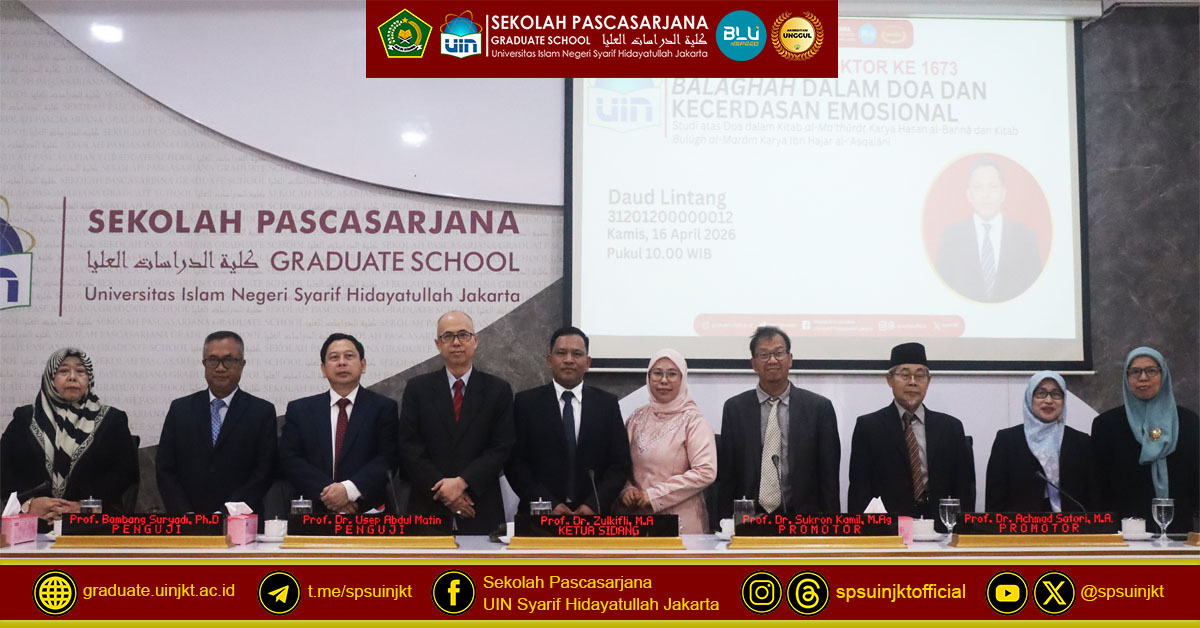
David Lintang's Doctoral Promotion Exam, Balāghah in Prayer and Emotional Intelligence
Auditorium of Prof. Dr. Suwito, MA SPs UIN Jakarta, SP NEWS – The Graduate School (SPs) of UIN Syarif Hidayatullah Jakarta held the 1673rd Doctoral Promotion Exam in the Auditorium Room of Prof. Dr. Suwito, MA on Thursday, April 16, 2026 with promovendus Daud Lintang.
Daud is a student of the Doctoral program in Islamic Studies with a Concentration in Arabic Language and Literature. His dissertation was entitled "Balāghah in Prayer and Emotional Intelligence (Study of Prayer in the Book of al-Ma'thūrāt by Ḥasan al-Bannā and the Book of Bulūgh al-Marām by Ibn Ḥajar al-'Asqalānī)". This research attracts attention because it marries the discipline of classical Arabic linguistics with the concept of modern psychology.
Specifically, this study aims to analyze the asālīb al-balāghah or rhetorical language style contained in the selected prayers of the two monumental books. David dissected the text of prayer using the three main pillars of balaghah science, namely al-bayān (figurative semantics), al-ma'ānī (contextual semantics), and al-badī' (language aesthetics).
The main focus of this research does not only stop at textual beauty, but also seeks to answer how uslūb al-du'ā (the style of prayer language) can affect a person's emotional intelligence. In addition, David conducted a comparative study to uncover the reason why al-Ma'thūrāt was considered to have a higher weight of balāghī compared to Bulūgh al-Marām.
The methodology used in this research is descriptive-qualitative with a balāghiyyah stylistic approach and transformative generative. To dissect the psychological impact, David integrated the theory of emotional intelligence to see the link between prayer diction and the mental state of the reader.
To strengthen the empirical evidence, David did not rely solely on the text. He conducted in-depth interviews with 25 respondents representing various levels of society, ranging from lecturers, researchers, ustaz, students, students, to the women of the taklim council. This is done to see how the structure of prayer language is felt directly by the practitioner.
Although it involves field studies, this research is still based on the character of library research. David searched through a variety of literature, from books, articles, to scientific journals to build a solid theoretical foundation on language and psychological styles.
The main primary sources in this study are, of course, the book al-Ma'thūrāt by Hasan al-Banna and Bulūgh al-Marām by Ibn Hajar al-'Asqalani. Meanwhile, secondary sources include various references relevant to the theme of uslūb al-balāghah and emotional intelligence that are analyzed using content and comparative analysis methods.
The results of the study revealed that the prayers in the two books were arranged in a very beautiful and rhetorical Arabic style. This beauty emanates from the element of al-bayān which uses deep metaphors and similes, so that it is able to arouse the deepest inner feelings for anyone who permeates it.
On the element of al-ma'ānī, this research shows that the choice of words and the order of sentences in these prayers are very much in harmony with the condition of the human soul. Meanwhile, the element of al-badī' is present through the play of sounds and aesthetics of language style that adds emotional appeal and provides calmness when recited.
The combination of these three elements of balaghah creates a harmony of language that touches the heart. This proves that prayer is not just a series of words to ask, but a spiritual instrument that strengthens the relationship between creatures and their God through the beauty of literacy.
Furthermore, David proved that balaghah devices such as al-tashbīh, al-isti'ārah, al-kināyah, and al-saja' play an active role in building emotional intelligence. This aesthetic style of language is proven to instill the values of self-awareness, self-control, motivation, empathy, and social skills in a person.
The field studies in this dissertation provide empirical evidence that asālīb al-balāghah in prayer has a strong influence on affective psychology. These findings confirm that the power of language in ma'tsur prayers has a real impact in shaping the character and emotional stability of Muslims who practice it consistently.
Daud Lintang successfully defended his dissertation under the guidance of Prof. Dr. Sukron Kamil, M.Ag, Prof. Dr. Achmad Satori Ismail, MA, and Dr. Siti Amsariah, M.Ag, and was tested in front of a board of examiners consisting of Prof. Dr. Zulkifli, MA, Prof. Dr. Sukron Kamil, M.Ag, Prof. Dr. Achmad Satori Ismail, MA, Dr. Siti Amsariah, M.Ag, Prof. Usep Abdul Matin, S.Ag, MA, MA, Ph.D, Prof. Bambang Suryadi, Ph.D, Prof. Dr. R. Yani'ah Wardani, M.Ag.
After paying attention to the writing of the dissertation, the comments of the examiner team and the answers of the promovendus, the examiner team determined that Daud Lintang graduated with the title of Very Satisfactory. Daud Lintang is the 1673rd Doctor in the field of Islamic Studies, the doctoral program of the Graduate School of UIN Syarif Hidayatullah Jakarta. (JA)