
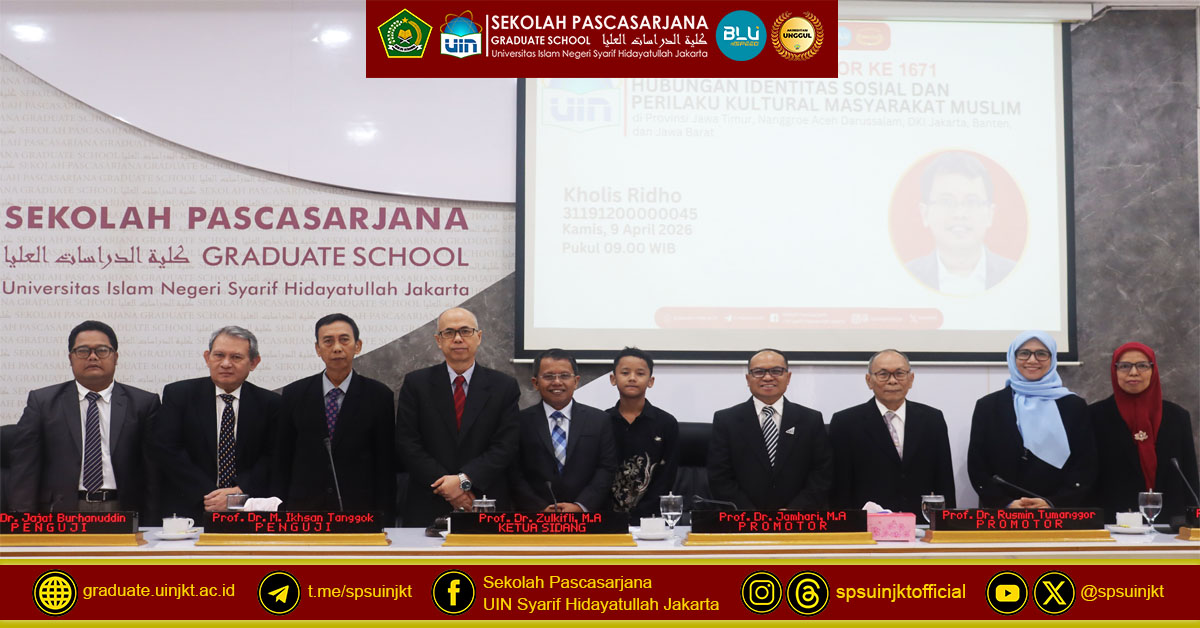
Kholis Ridho Doctoral Promotion Exam, Social Identity Relations and Cultural Behavior of Muslim Communities
Auditorium of Prof. Dr. Suwito, MA SPs UIN Jakarta, SPs NEWS – The Graduate School (SPs) of UIN Syarif Hidayatullah Jakarta held the 1671st Doctoral Promotion Exam in the Auditorium Room of Prof. Dr. Suwito, MA on Thursday, April 9, 2026 with promovendus Kholis Ridho.
Kholis is a student of the Doctoral program in Islamic Studies with a concentration in Anthropology and Sociology of Religion. His dissertation is entitled "The Relationship between Social Identity and Cultural Behavior of Muslim Communities in East Java Province, Nanggroe Aceh Darussalam, DKI Jakarta, Banten, and West Java".
This research departs from intellectual anxiety towards the polarization of identity theory. On the one hand, identity is considered a static historical legacy, but on the other hand it is seen as the result of highly flexible negotiations. Kholis is present in the midst of this academic gap to offer a new argument: that the social identity of contemporary Muslim society, especially in the era of digital transformation, has much more complex characteristics than just the black-and-white between "fluid" or "inherited".
Using the paradigm of post-positivism with sociological and anthropological approaches, Kholis designed an ambitious research. Through the mix-methods method, he combined the strength of quantitative data from 323 respondents with the depth of qualitative data through participatory observation. The selected research area is also very representative, covering areas with mono-cultural to multicultural characteristics spread across five major provinces in Indonesia.
One of the attractions of this research is the use of Pierre Bourdieu's framework such as the concepts of habitus, capital, and realm which are then expanded with the perspective of in-group and out-group identity. Kholis not only sees religion as a dogma, but tests it as a cultural practice that interacts with social, economic, and virtual capital that now dominates people's lives through the internet.
Interesting findings were revealed when the data was processed by multiple regression analysis. It is evident that the orientation of regional pluralism, be it a homogeneous or heterogeneous environment, has a significant influence on a person's cultural behavior. Simultaneously, variables such as categorical identity, age, and the "digital realm" were able to explain changes in people's cultural behavior to reach 82.6 percent.
Kholis introduced the concept of "Multiple Identity" as a new synthesis. According to him, the identity of a Muslim can be fixed in terms of theological doctrine but becomes very fluid when in contact with social interaction. He distinguishes between vertical "transcendental piety" and "cultural piety" which is the result of a process of habituation and social accommodation.
Furthermore, this research proposes that the process of identifying Muslims is not only seen from the perspective of sociogenesis, but also through the concept of ethnoheterogenesis. This is because the transfer of beliefs or orientations in Islam is often an ontological critique of a value, rather than simply following the social current. This view gives a new breath in looking at the dynamics of the movement of madzhab and beliefs in Indonesia.
In the era of technology, Kholis also highlighted the role of "virtual capital". He argues that the expansion of the digital realm has given birth to a performative "virtual piety" on social media. This is different from traditional capital (cultural and symbolic) which is more widely used to express piety in offline reality. These findings are particularly relevant to understanding why religious behavior on mobile screens can be different from in real life.
Mental health and spirituality have also emerged as new capital in the concept of piety. Kholis emphasized that the observance of compulsory worship should be viewed through a theological-emancipatory perspective. This means that religion must be understood as a force that frees humans from psychosocial shackles, not as a source of anxiety or limitations in interacting with the multicultural world.
With data validated by the Central Statistics Agency (BPS), this research provides a roadmap for policymakers and academics in understanding how Indonesian Muslim identity continues to move dynamically in the midst of the rapid flow of globalization and digital transformation.
Kholis Ridho successfully defended his dissertation under the guidance of Prof. Dr. Jamhari, MA, Prof. Dr. Rusmin Tumanggor, MA and Prof. Dr. Dzuriyatun Toyibah, M.Si, MA, and was tested in front of a board of examiners consisting of Prof. Dr. Zulkifli, MA, Prof. Dr. Jamhari, MA, Prof. Dr. Rusmin Tumanggor, MA, Prof. Dr. Dzuriyatun Toyibah, M.Si, MA, Prof. Dr. Jajat Burhanudin, MA, Prof. Dr. Media Zainul Bahri, MA and Prof. Dr. M. Ikhsan Tanggok, M.Si.
After paying attention to the writing of the dissertation, the comments of the examiner team and the answers of the promovendus, the examiner team determined that Kholis Ridho graduated with the title of Very Satisfactory. Kholis Ridho is the 1671st Doctor in the field of Islamic Studies, doctoral program of the Graduate School of UIN Syarif Hidayatullah Jakarta. (JA)