
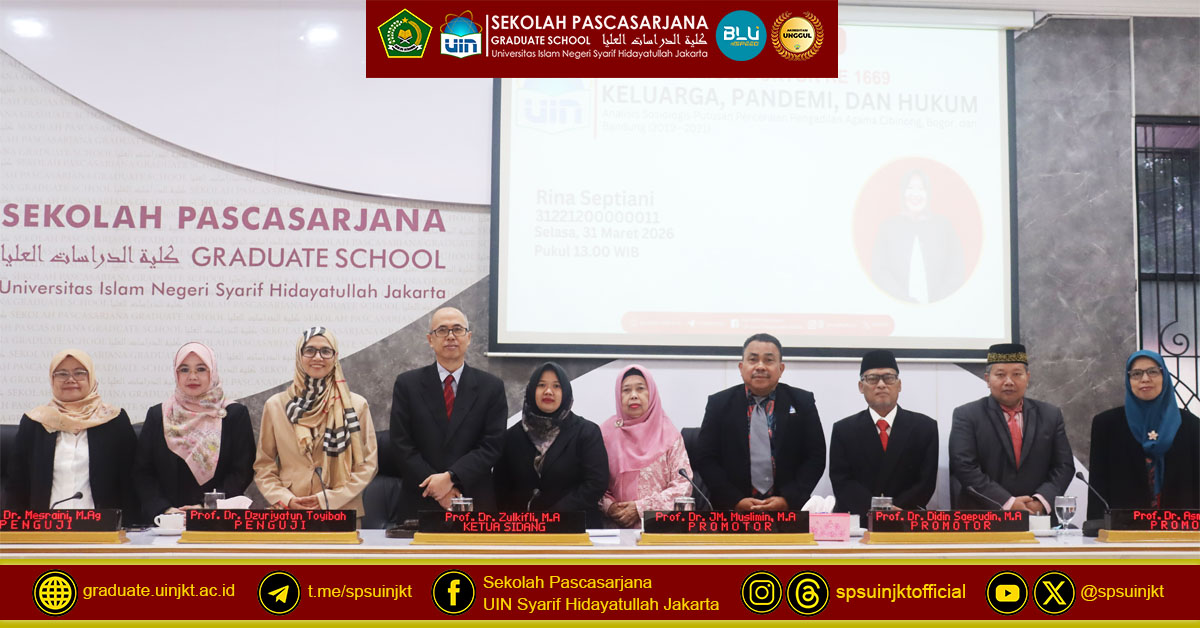
Rina Septiani's Doctoral Promotion Exam, Family, Pandemic, and Law: A Sociological Analysis of Divorce Decisions
Auditorium of Prof. Dr. Suwito, MA SPs UIN Jakarta, SPs NEWS – The Graduate School (SPs) of UIN Syarif Hidayatullah Jakarta held the 1669th Doctoral Promotion Exam in the Auditorium Room of Prof. Dr. Suwito, MA on Tuesday, March 31, 2026 with promovenda Rina Septiani.
Rina is a student of the Doctoral program in Islamic Studies with a Concentration in Sharia. His dissertation is entitled "Family, Pandemic, and Law: A Sociological Analysis of Divorce Decisions of the Cibinong, Bogor, and Bandung Religious Courts (2019-2021)".
This study highlights how the global shock of COVID-19 has a direct impact on the most private space of humans, namely family institutions.
This research departs from academic anxiety about the surge in divorce rates in West Java during the pandemic. Rina specifically dissected the characteristics and dynamics of cases in the three strategic areas of Cibinong, Bogor, and Bandung, to see the extent to which the law responds to changes in people's behavior when under intense pressure.
Rina successfully integrates the perspective of legal sociology with formal juridical analysis of religious court decisions, creating a bridge between textual norms and social realities in the field.
Through Rina's lens, the law is no longer seen as a rigid and isolated set of articles. Instead, he positions the law as a living and dynamic social action, which honestly reflects the shifting behaviors and values in society in the face of a national crisis.
Using a descriptive-analytical method, Rina conducted an "in-depth dissection" of the pile of case decisions from 2019 to 2021. The data was analyzed qualitatively to find the hidden patterns behind the reasons for divorce that often appear uniform on the surface of court documents.
One interesting finding revealed by Rina is the position of the COVID-19 pandemic which is not the sole cause of divorce. Instead of being the main reason, the pandemic actually functions as a "social catalyst" that accelerates the activation of latent conflicts that have actually been embedded for a long time in the domestic sphere.
To explain this phenomenon, Rina formulated an original concept that she called the 4K Model. This model maps the four main dimensions of conflict that trigger the breakdown of marriages: economic conflicts, power relations conflicts, cultural and social-moral conflicts, and conflicts regarding the continuation of life after divorce.
Rina's findings also strengthen the theory put forward by Meder (2024). Both agreed that structural pressures, both economic and social during the pandemic, were factors that exacerbated domestic friction, which ultimately influenced divorce trends in both the short and long term.
This dissertation makes a major contribution to the development of contemporary Islamic family law studies. Rina succeeds in placing divorce not just as a private affair, but as a social-institutional phenomenon that is influenced by structural pressures and the dynamics of gender power relations that continue to change.
Not only stopping at theory, Rina also offers concrete policy recommendations. He encouraged the strengthening of mediation based on family resilience and the preparation of special guidelines for judges in handling divorce cases in crisis situations so that the protection of vulnerable parties is maintained.
As a preventive measure in the future, this study emphasizes the importance of integrating economic policies with family resilience. Strengthening premarital education and community-based counseling services is considered to be the main key to making Indonesian families more resilient to the storm of crises that may return. (JA)