
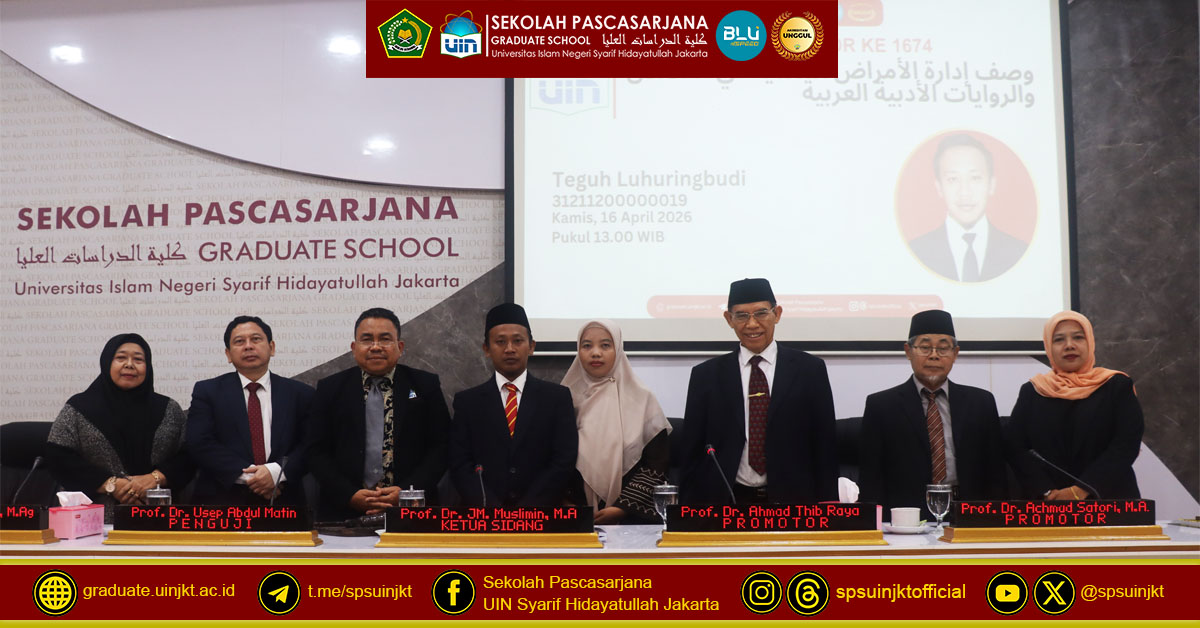
Teguh Luhuringbudi's Doctoral Promotion Exam, Management of Infectious Diseases in Arabic Literary Stories and Novels
Auditorium of Prof. Dr. Suwito, MA SPs UIN Jakarta, SPs NEWS – The Graduate School (SPs) of UIN Syarif Hidayatullah Jakarta held the 1674th Doctoral Promotion Exam in the Auditorium Room of Prof. Dr. Suwito, MA on Thursday, April 16, 2026 with promovendus Teguh Luhuringbudi.
Teguh is a student of the Doctoral program in Islamic Studies with a Concentration in Arabic Language and Literature. His dissertation is titled "وصف إدارة الأمراض المعدية في القصص والروايات الأدبية العربية" (Depiction of Infectious Disease Management in Arabic Literary Stories and Novels).
Teguh succeeded in dissecting how contemporary Arabic literature no longer sees health crises as mere clinical medical events. For him, plague is a profound social, historical, and ethical phenomenon.
Teguh explained that this shift in meaning is firmly rooted in the collective memory of Islamic history. Starting from the events of Tha'un 'Amwās during the time of Caliph 'Umar ibn al-Khaṭṭāb to the fall of the Umayyad Dynasty which was colored by the pandemic, Arabic literature revived the "bitter nostalgia" for the collapse of the political and social order due to the plague.
This study explores in depth the representation of infectious disease management in 20th and 21st century Arabic literature. The focus of the study is directed at how the experience of pain, treatment patterns, and the tug of war between fear and hope are manifested through captivating novelistic narratives.
Interestingly, Teguh highlighted how literary texts interact harmoniously with Islamic treasures. From the Prophet's hadiths about the plague, to the classic medical thought of Ibn Sīnā and al-Rāzī, to religious verses, all of them collaborate to shape the reader's ethical awareness in dealing with epidemics.
Six main novels are the subject of study in this study, including al-Maṣābīḥ al-Zurq by Ḥannā Mīnah, al-Wabā' by Hānī al-Rāhib, to contemporary works such as Kūfīd-7 by Sharaf al-Dīn al-'Abābanah and Ḥurriyyah fī Zamān al-Kūrūnā by Sundus al-Shāwī.
Methodologically, this research combines a literary sociology approach with a sharp narrative analysis. Uniquely, Teguh applies the modern crisis management concept of Planning, Organizing, Actuating, Controlling (POAC) to dissect the disease management mechanism implied in the literary discourse.
The findings show that the Arabic novels carry a strong message about the importance of collaboration and social solidarity. Literature emphasizes that the main bulwark against the plague is not just authoritarian policies, but the ethical strength and togetherness of the people at the grassroots.
Furthermore, the literary narrative studied revealed the imbalance of professional and gender responsibilities in health emergency situations. Arabic literature reconstructs disease management as a social practice in which inner peace as taught in the Islamic perspective becomes an integral part of the healing process.
Teguh concluded that the experiences of suffering depicted in Arabic novels have a significant influence on the moral formation of readers. The narrative is not just a recording of pain, but a bridge that connects religious teachings, historical memory, and the demands of modern life comprehensively.
This research also strengthens the arguments of figures such as Ibn Ḥajar al-'Asqalānī and Michael W. Dols that literature and plague grow from the same social womb. On the other hand, Teguh firmly rejects the narrow view that considers the plague only as an inhibitor of civilization with no reflective value.
Although he made a very significant contribution, Teguh acknowledged that there were limitations related to the breadth of the corpus of texts studied. Therefore, he recommends the existence of an advanced comparative study between Arabic literature and other world literature in a global context to enrich the perspective of literary sociology.
In the future, the integration of social psychology and analysis of language styles in the poems of scholars is expected to become a new space for future researchers. With the completion of this exam, Teguh Luhuringbudi not only brought home his doctorate, but also offered a new perspective in looking at the outbreak through a clearer humanitarian lens.
Teguh successfully defended his dissertation under the guidance of Prof. Dr. Ahmad Thib Raya, MA, Prof. Dr. Achmad Satori Ismail, MA, and Dr. Tb. Ade Asnawi, MA, and was tested in front of a board of examiners consisting of Prof. Dr. JM. Muslimin, MA, Prof. Dr. Ahmad Thib Raya, MA, Prof. Dr. Achmad Satori Ismail, MA, Dr. Tb. Ade Asnawi, MA, Prof. Dr. Sukron Kamil, M.Ag, Prof. Usep Abdul Matin, S.Ag, MA, MA, Ph.D, Prof. Dr. R. Yani'ah Wardani, M.Ag.
After paying attention to the writing of the dissertation, the comments of the examiner team and the answers of the examiner, the examiner team determined that Teguh graduated with the title of Very Satisfactory. Teguh Luhuringbudi is the 1674th Doctor in the field of Islamic Studies, the doctoral program of the Graduate School of UIN Syarif Hidayatullah Jakarta. (JA)