
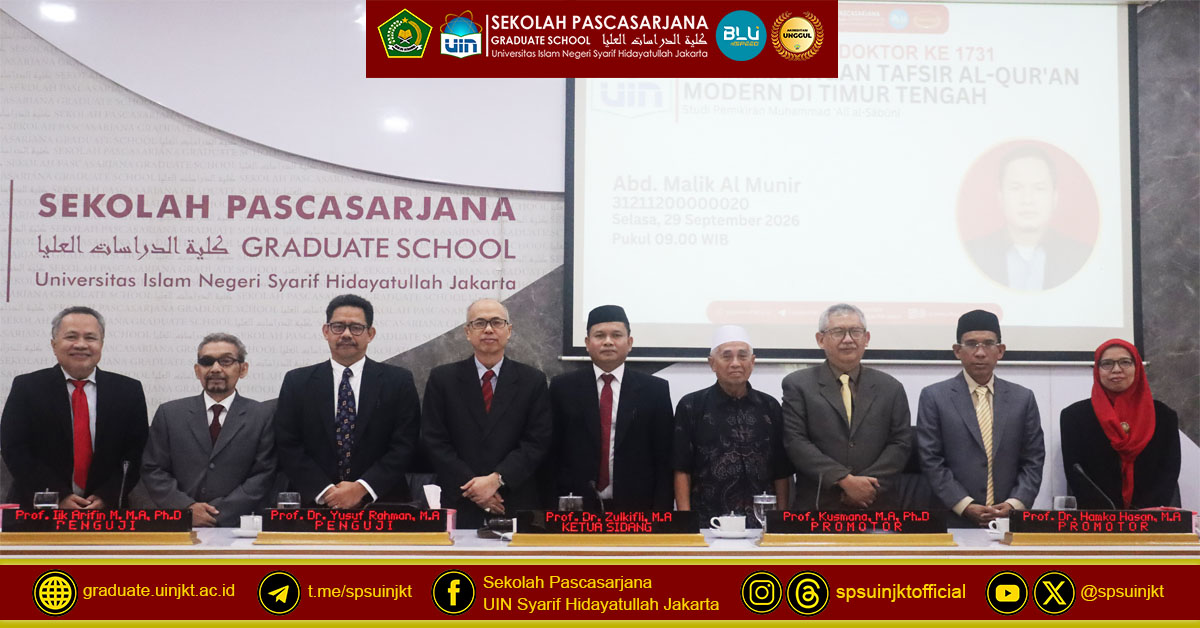
Abd. Malik Al Munir Doctoral Promotion Exam, The Development of Modern Qur'an Interpretation in the Middle East
Auditorium of Prof. Dr. Suwito, MA SPs UIN Jakarta, SPs NEWS – The Graduate School (SPs) of UIN Syarif Hidayatullah Jakarta held the 1731st Doctoral Promotion Exam in the Auditorium Room of Prof. Dr. Suwito, MA Graduate School on Tuesday, September 29, 2026 with promovendus Abd. Malik Al Munir.
Malik is a student of the Doctoral program in Islamic Studies with a concentration in Interdisciplinary Interpretation. His dissertation is entitled "The Development of Modern Qur'an Interpretation in the Middle East: A Study of Muḥammad 'Alī alī al-Ṣābūnī Thought".
Malik successfully defended his dissertation which highlighted the dynamics of the development of modern Qur'an interpretation in the Middle East through the thought of a well-known scholar, Shaykh Muḥammad 'Alī al-Ṣābūnī. Malik dismantled how a great figure processed and transmitted the treasures of classical Islam to remain relevant and easily digestible by modern Muslim society.
This literature-based research dissects three monumental works of al-Ṣābūnī as primary sources, namely Ṣafwah al-Tafāsīr, Rawā'i' al-Bayān fī Tafsīr Āyāt al-Aḥkām, and al-Tibyān fī 'Ulūm al-Qur'ān. With a qualitative, historical, intellectual, and epistemological approach, Malik traces the roots of thought, argumentation patterns, and the response of the mufasir to contemporary issues.
The results of the study show that al-Ṣābūnī's expertise in concocting tafsir was not born out of nowhere, but was the result of a process of consolidation, selection, synthesis, and simplification of the presentation (pedagogization) of the classical heritage. The character of his interpretation was formed by a strong Sunni educational background, mastery of the Arabic language, jurisprudence, and moral encouragement to preach through the world of education.
al-Ṣābūnī's intellectual journey was also influenced by the rich external environment. Starting from the scientific tradition in his homeland of Aleppo, the academic cluster at Al-Azhar University in Egypt, to the teaching experience in Saudi Arabia. The rapid development of the printing industry and the modernization of Islamic education at that time also encouraged al-Ṣābūnī to produce a work of tafsir that was concise, practical, but still trustworthy.
When examining al-Ṣābūnī's thinking on various contemporary issues such as tolerance, gender, ecology, mutasyabihat verses, law, and science, Malik found a limited normative-contextual response pattern. This means that although al-Ṣābūnī is open to responding to the problems of the times, all his views are still firmly anchored in the authority of the Arabic language, sahih history, fiqh doctrine, and Sunni faith.
The findings in this dissertation provide a new, more complete picture than previous studies, such as the works of 'Isam Ahmad 'Irsan Shahadah, Ziauddin Bahar, or Muḥammad Yusuf, which tend to focus on a single book or methodological aspect partially. Malik succeeds in knitting the intellectual genealogy, epistemology, and social response of al-Ṣābūnī into a complete web of analysis.
Theoretically, this research strengthens the views of world interpreters such as Rotraud Wielandt, Johanna Pink, and Walid A. Saleh. Brand concludes that modernity in Islamic interpretation does not always mean a disconnection with the past, but rather the sustainability of traditions that are repackaged according to the needs of the times.
On that basis, Malik placed al-Ṣābūnī as a figure of neo-traditional Sunni mufasir who was synthetic and pedagogical. He is considered to have succeeded in presenting the face of modernity of interpretation not through radical overhaul, but through a systematic reorganization and delivery of classical heritage to modern readers.
The novelty of this research confirms that classical Islamic science has high durability and elasticity. In the midst of the rapid flow of change in the Middle East, al-Ṣābūnī proves that maintaining the continuity of tradition can be done elegantly without losing the foothold of the original Islamic scientific authority.
Amrin successfully defended his dissertation under the guidance of Prof. Kusmana, MA, Ph.D and Prof. Dr. Hamka Hasan, MA, and was tested in front of a board of examiners consisting of Prof. Dr. Zulkifli, MA, Prof. Kusmana, MA, Ph.D, Prof. Dr. Hamka Hasan, MA, Prof. Dr. Yusuf Rahman, MA, Prof. Jajang Jahroni, MA, Ph.D, Prof. Dr. Iik Arifin Mansurnoor, MA.
After paying attention to the writing of the dissertation, the comments of the examiner team and the answers of the promovendus, the examiner team determined that Malik graduated with the title of Very Satisfactory. Abd. Malik Al Munir is the 1731st Doctor in the field of Islamic Studies, the doctoral program of the Graduate School of UIN Syarif Hidayatullah Jakarta. (Jay A)