
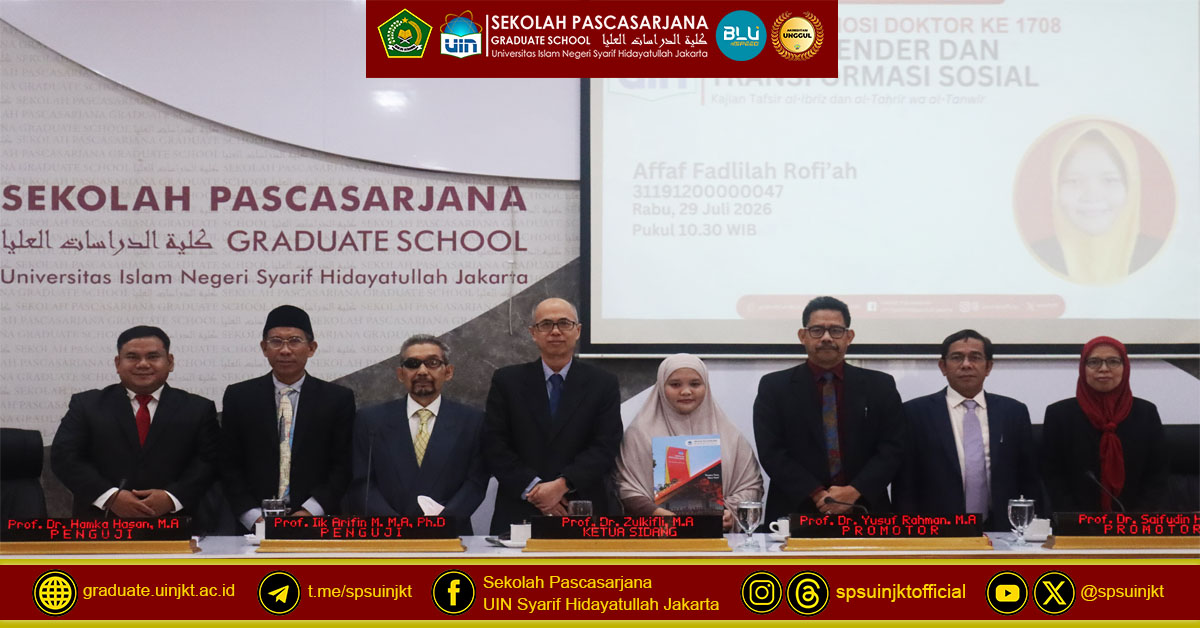
Affaf Fadlilah Rofi'ah Doctoral Promotion Exam, Gender Relations and Social Transformation (Study of Tafsir al-Ibrīz and al-Taḥrīr wa al-Tanwīr)
Auditorium of Prof. Dr. Suwito, MA SPs UIN Jakarta, SP NEWS – The Graduate School (SPs) of UIN Syarif Hidayatullah Jakarta held the 1708th Doctoral Promotion Exam in the Auditorium Room of Prof. Dr. Suwito, MA on Wednesday, July 29, 2026 with promovendus Affaf Fadlilah Rofi'ah.
Affaf is a student of the Doctoral program in Islamic Studies with a concentration in Tafsir. Her dissertation was entitled "Gender Relations and Social Transformation (A Study of Tafsir al-Ibrīz and al-Taḥrīr wa al-Tanwīr)".
Through her research, Affaf establishes three main interrelated focuses: to analyze comparatively Bishri Muṣṭ afāand Ibn 'Āshūr's interpretation of gender verses, to unravel the construction of gender relations and their constituent factors, and to evaluate the extent to which these constructions of thought have an impact on the social transformation of the reader's community. This issue is considered very crucial in the midst of the strengthening dynamics of women's rights discourse and modern Islamic thought.
Methodologically, this literature-based qualitative research presents a rich analytical knife. Affaf marries the method of comparative interpretation (muqāran) with the social hermeneutic theories of Hans-Georg Gadamer (fusion horizon, Wirkungsgeschichte) and Paul Ricoeur (distance, appropriation). The hermeneutic approach is then neatly integrated with Karl Mannheim's gender analysis and sociological theories of knowledge to dissect the primary texts of Tafsīr al-Ibrīz and al-Taḥrīr wa al-Tanwīr.
The results of Affaf's findings show the uniqueness of the pattern of each mufassir. Bishri Muṣṭafā, a scholar from the archipelago, is proven to build a soft patriarchy construction in Tafsīr al-Ibrīz. When translating the word qawwāmūn to "powered", he inserted a typical Javanese warning "but ojo very" on the order to beat his wife. These findings reflect the contradictory acculturation of Javanese culture: maintaining hierarchical values but resolutely rejecting acts of violence.
On the other hand, Ibn 'Āshūr through his famous work al-Taḥrīr wa al-Tanwīr took the path based on maqāṣid al-sharī'ah. This Tunisian mufassir interprets qiwāmah as a functional responsibility in the household, rejects the narrative of the creation of women from Adam's ribs, and makes room for contextual female leadership.
Affaf argues that the contrast between Tafsīr al-Ibrīz and al-Taḥrīr wa al-Tanwīr is not a coincidence. The difference in gender construction between the two is the result of a very selective fusion of horizons, a dynamic meeting point between sacred texts, accepted scientific traditions, and the socio-cultural context that surrounds each figure in his time.
Furthermore, the theoretical contribution of this research succeeded in correcting and revising the views of several previous researchers. Affaf's research position criticizes the tendency of Rosalina and the Mujahidin to homogeneously label Tafsīr al-Ibrīz as a patriarchal interpretation without looking at its moderate side. At the same time, this finding refutes the claim of Ibrahim and Asfar who portrayed al-Taḥrīr wa al-Tanwīr as purely a reformist interpretation, without considering its conservative elements as mentioned by Herlambang.
As a conclusion to his dissertation, Affaf offers a more nuanced and objective perspective by emphasizing the ambivalent nature of the two books of commentary. Both Tafsīr al-Ibrīz and al-Taḥrīr wa al-Tanwīr have a dual potential: they can be agents of change that drive social transformation towards gender justice, or conversely, they can be instruments of the preservation of the status quo all depend largely on how the community of readers appropriates the texts.
Affaf successfully defended his dissertation under the guidance of Prof. Dr. Yusuf Rahman, MA, Prof. Dr. Saifuddin Herlambang, MA, and was tested in front of a board of examiners consisting of Prof. Dr. Zulkifli, MA, Prof. Dr. Yusuf Rahman, MA, Prof. Dr. Saifuddin Herlambang, MA, Prof. Dr. Hamka Hasan, MA, Prof. Dr. Iik Arifin Mansurnoor, MA, Prof. Dr. Hasani, MA.
After paying attention to the writing of the dissertation, the comments of the examiner team and the promovenda's answers, the examiner team determined that Affaf Fadlilah Rofi'ah graduated with the predicate of Very Satisfactory. Affaf Fadlilah Rofi'ah is the 1708th Doctor in the field of Islamic Studies, doctoral program of the Graduate School of UIN Syarif Hidayatullah Jakarta. (Jay A)