
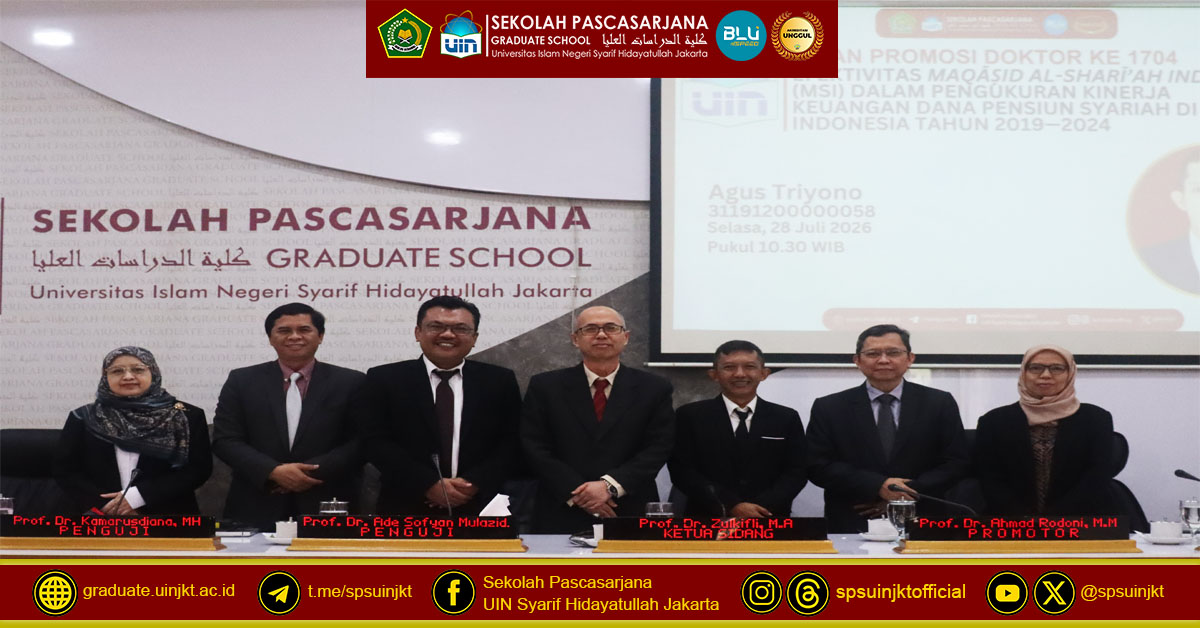
Agus Triyono's Doctoral Promotion Exam, the Ideal Model for Measuring the Financial Performance of Sharia Pension Funds
Auditorium of Prof. Dr. Suwito, MA SPs UIN Jakarta, SPs NEWS – The Graduate School (SPs) of UIN Syarif Hidayatullah Jakarta held the 1704th Doctoral Promotion Exam in the Auditorium Room of Prof. Dr. Suwito, MA on Tuesday, July 28, 2026 with promovendus Agus Triyono.
Agus is a student of the Doctoral program in Islamic Studies with a concentration in Islamic Economics. His dissertation is entitled "The Effectiveness of the MAqashid Shariah Index (MSI) in Measuring Sharia Financial Performance and Pensions in Indonesia in 2019-2014".
This dissertation was born out of concern over the evaluation of the Sharia Pension Fund which has been considered less comprehensive. The measurement of the performance of the long-term fund management institution is considered to still depend entirely on conventional financial indicators. In fact, instruments that are purely financial ratios have not been able to capture the substantive dimension and true sharia values.
This condition emphasizes the existence of an academic gap that is quite crucial. The characteristics of Sharia Pension Funds are very unique because they manage long-term actuarial obligations and bring an inter-generational dimension of responsibility. However, the literature of the Maqāṣid Shariah Index (MSI) has never been applied specifically to the Sharia Pension Fund sector in Indonesia.
Through his research, Agus Triyono aims to analyze the influence of various dimensions of the MSI model ranging from the Abu Zahrah, A.M. Najjar, to Hudaefi-Noorden's Integrated Maqāṣid Shariah Performance Measurement (IMSPM) on the financial performance of the Sharia Pension Fund. This study seeks to determine which model is the most effective as well as explore the extent of the management practitioner's understanding of the sharia-based instrument.
This study applies a mixed methods approach with a parallel convergent design during the period 2019–2024. Three institutional objects are the focus of the main study, namely DPLK Syariah Muamalat, DapenMU, and Dapensya UMS. To dissect quantitative and qualitative data in depth, this research combines Structural Equation Modeling-Partial Least Squares (SEM-PLS), Simple Additive Weighting–Multiple Attribute Decision Making (SAW-MADM), and Braun-Clarke's six-stage thematic analysis.
The results of the SEM-PLS test prove that partially or simultaneously, the dimensions of the MSI model of Abu Zahrah, A.M. Najjar, and IMSPM Hudaefi-Noordin have a positive and significant effect on the financial performance of the Sharia Pension Fund. Maqashid-based measurement has proven to be not only an ethical complement, but also has a real correlation to strengthening the financial performance of institutions.
Interestingly, the analysis of the SAW-MADM calculation named the IMSPM model as the instrument with the highest effectiveness value, which reached a score of 0.839. The main advantage of IMSPM lies in its scope which is able to fully accommodate the maqāṣid al-khamsah, including the dimension of ḥifẓ al-nasl (safeguarding heredity/sustainability) which is essential to the character of the inter-generational fund management institution.
On the qualitative side, the thematic analysis revealed that the conceptual acceptance rate of Sharia Pension Fund managers towards MSI was actually very high. Nevertheless, its implementation in the field still faces a barrage of challenges, such as limited human resources (HR), complexity of data processing, and the absence of standard regulatory standards. In addition, if previous research in the Islamic banking sector placed ROA and profitability as the dominant determinants, Agus's research actually proves that the dimensions of ḥifẓ al-māl (safeguarding property) and ḥifẓ al-nafs (safeguarding one's soul) are much more decisive in the Sharia Pension Fund.
As a concrete step, the 1704th doctoral research of SPs UIN Jakarta recommends that managers of Sharia Pension Funds immediately integrate MSI into the internal reporting system as an added value and competitive advantage. Institutionally, the results of this research also urge the Financial Services Authority (OJK) together with the National Sharia Council-Indonesian Ulema Council (DSN-MUI) to issue IMSPM-based evaluation regulations with a clustering system according to the type of institution in order to ensure the fairness of performance assessments.
Agus successfully defended his dissertation under the guidance of Prof. Dr. Ahmad Rodoni, MM, Prof. Nur Hidayah, S.Ag, SE, MA, MA, Ph.D, and was tested in front of a board of examiners consisting of Prof. Dr. Zulkifli, MA, Prof. Dr. Ahmad Rodoni, MM, Prof. Nur Hidayah, S.Ag, SE, MA, MA, Ph.D, Prof. Dr. Euis Amalia, M.Ag, Prof. Dr. Kamarusdiana, MH, Prof. Dr. Ade Sofyan Mulazid, S.Ag, MH.
After paying attention to the dissertation writing, the comments of the examiner team and the promovenda answers, the examiner team determined that Agus Triyono graduated with the title of Very Satisfactory. Agus Triyono is the 1704th Doctor in the field of Islamic Studies, the doctoral program of the Graduate School of UIN Syarif Hidayatullah Jakarta. (Jay A)