
Ahmad Afrizal Qosim's Thesis Exam: Tobacco Hajj Authority (Case Study of Rural Muslim Middle Class in Temanggung)
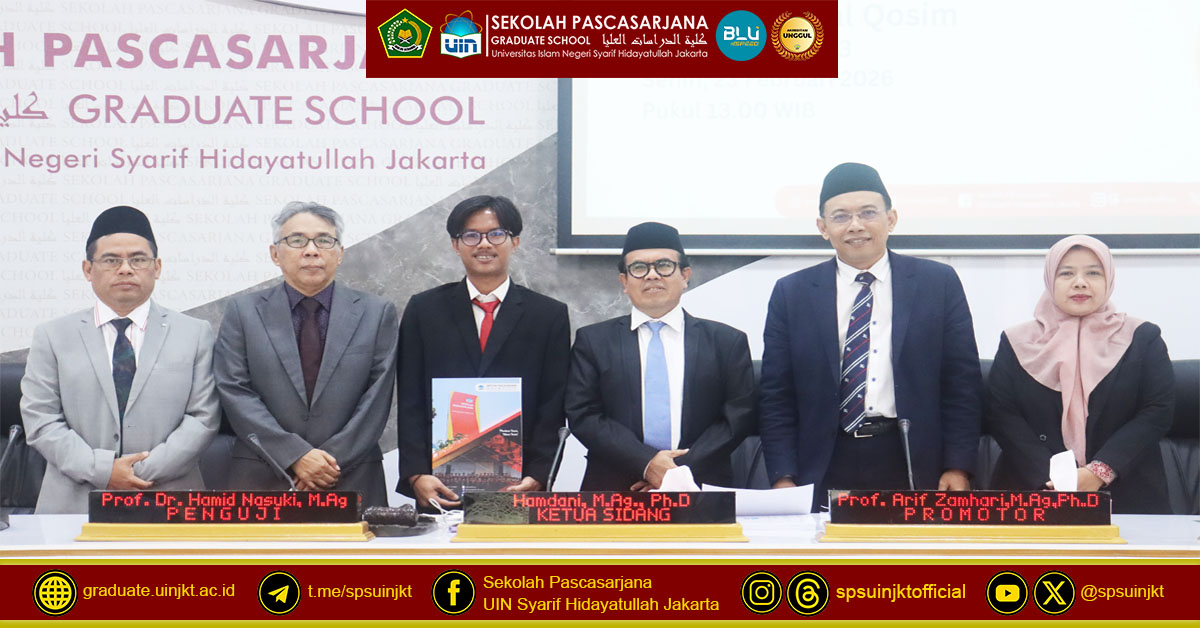
Auditorium of Prof. Dr. Suwito, MA SPs UIN Jakarta, SPs NEWS - The Graduate School (SPs) of UIN Syarif Hidayatullah Jakarta held the 2805th Thesis Exam at the Auditorium Room of Prof. Dr. Suwito, MA SPs UIN Jakarta on Monday, February 23, 2026 with candidate Ahmad Afrizal Qosim.
Afrizal is a student of the Master of Islamic Studies program with a concentration in Anthropology and Sociology of Religion. His thesis is entitled "Tobacco Hajj Authority (Case Study of Rural Muslim Middle Class in Temanggung)".
This study dissects the sociological phenomenon in Temanggung, Central Java, where the title of Hajj is not just a spiritual achievement, but a symbol of agrarian economic success. The main focus of this research is the figure of the "Tobacco Hajj", which is farmers who have succeeded in setting foot in the holy land through the results of sweat processing the "green gold" commodity. For the people of Temanggung, going on Hajj is the peak of the economic cycle and blessings of the earth.
Using a thick ethnographic approach, Afrizal went directly into the field to dig up data from 10 key informants. Through in-depth interviews and observations, he found that the meaning of Hajj in the countryside has been recycled multidimensionally. This worship is a complex meeting point between sincere theological intentions, aspirations to raise social status, and an established agrarian economic logic.
In his analysis, Afrizal used a scalpel of the concept of habitus and class to show how Hajj became a medium of capital conversion. The wealth from the tobacco harvest (economic capital) is not allowed to settle just like that, but is converted into religious symbolic capital through the Hajj title. This transformation then gave birth to a very strong local authority in the community.
These findings make a fresh contribution by filling in the gaps in the study of hajj that has been too dominated by urban perspectives or just formal theological narratives. Afrizal criticized the views of previous researchers who were considered less sharp in seeing the relationship between sacred rituals and agrarian capital. He argues that religiosity at the local level has an articulation that is highly dependent on the economic status of the region.
Furthermore, this thesis reveals that the authority of a "Tobacco Hajj" is relational and contextual. Their influence in society did not fall from the sky, but rather was cultivated through a network of markets and strong local traditions. They are not only leaders in prayer, but also key actors who determine the direction of negotiations between Islamic ethics, market dynamics, and solidarity among farmers.
One of the most interesting points is the role of these pilgrims as "cultural brokers" or localizers. They are able to bridge the universal Islamic tradition with specific local agrarian practices. On the one hand they practice the sharia, on the other hand they are economic drivers who understand the intricacies of the soil and weather.
It does not stop there, the figure of the Tobacco Hajj is also an important mediator in the chain of industrial capitalism. They stand in the middle, connecting smallholder farmers with a vast network of tobacco markets down to the level of giant industries. The Hajj degree gives them extra confidence (trust) that is very valuable in the risky world of tobacco business.
Sociologically, Afrizal concluded that this phenomenon represents the birth of a new middle class formation in the countryside. This group has a distinctive identity: their authority rests on the ability to revive Islamic values as a social ethic as well as economic ethics in everyday life. They proved that religion and the market can go hand in hand in agrarian harmony.
This thesis exam is not only an academic proof for Afrizal, but also an eye-opener about how dynamic the face of Islam is in rural Indonesia. "Tobacco Hajj" is a real portrait of how religious symbols are managed, converted, and practiced as a leadership instrument that is firmly rooted in local wisdom and economic independence.
Afrizal successfully defended his thesis under the guidance of Prof. Arif Zamhari, M.Ag, Ph.D, and was tested in front of a board of examiners consisting of Hamdani, M.Ag, Ph.D, Prof. Arif Zamhari, M.Ag, Ph.D, Prof. Dr. Hamid Nasuki, M.Ag, Ahmad Abrori, M.Si, Ph.D.
After paying attention to the thesis writing, the comments of the examiner team and the candidate's answers, the examiner team determined that Ahmad Afrizal Qosim graduated with the title of Very Satisfactory. Ahmad Afrizal Qosim is the 2805th Master in the field of Islamic Studies, in the Master's program of the Graduate School of UIN Syarif Hidayatullah Jakarta. (JA)