
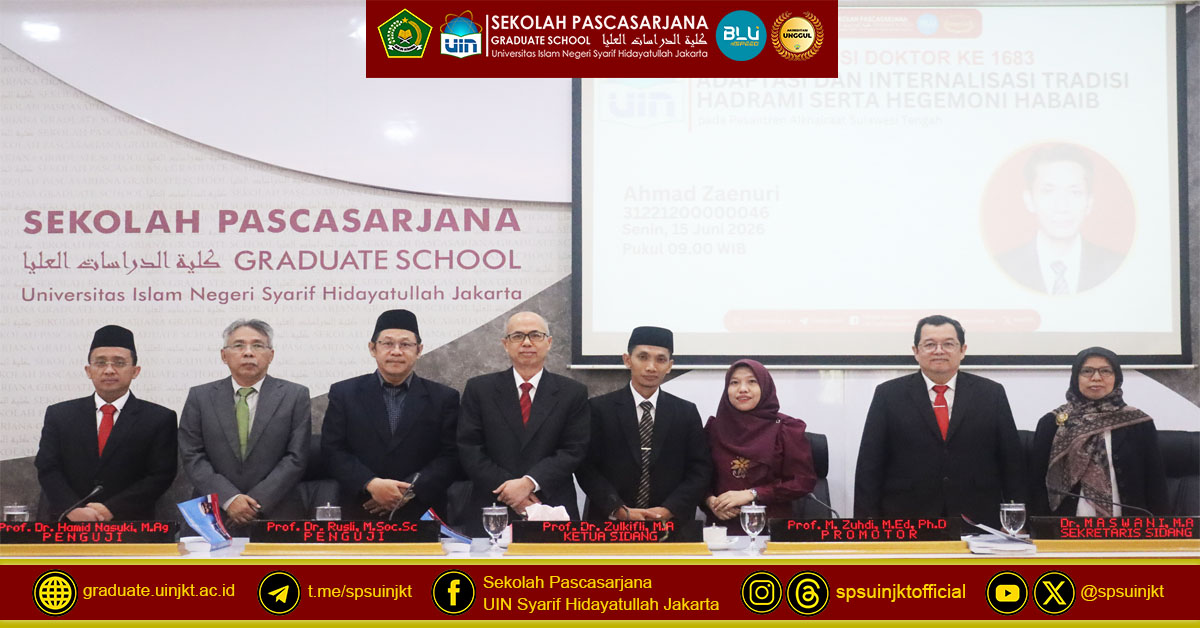
Ahmad Zaenuri's Doctoral Promotion Exam, Adaptation and Internalization of the Hadrami Tradition and Habaib Hegemony
Auditorium of Prof. Dr. Suwito, MA SPs UIN Jakarta, SPs NEWS – The Graduate School (SPs) of UIN Syarif Hidayatullah Jakarta held the 1683rd Doctoral Promotion Exam in the Auditorium Room of Prof. Dr. Suwito, MA on Monday, June 15, 2026 with promovendus Ahmad Zaenuri.
Zaenuri is a student of the Doctoral program in Islamic Studies with a concentration in Islamic Religious Education. His dissertation is entitled "Adaptation and Internalization of the Hadrami Tradition and Habaib Hegemony at the Alkhairaat Islamic Boarding School in Central Sulawesi".
This research was born out of an academic anxiety to re-examine the sociological stigma that has been attached to the Hadrami Arab community in the archipelago, which is often seen as an exclusive, elitist, and prone to shut themselves off from assimilation of local culture.
Through comprehensive scientific exploration, Zaenuri empirically proves that the reality on the ground points in the opposite direction. Using qualitative research methods with an ethnographic approach, the researcher is not just a remote observer, but involves himself directly in cultural activities in the field to capture the pulse of life, the deepest meaning, and social interaction of a day in the Alkhairaat Islamic Boarding School, Central Sulawesi.
The results of this field research succeeded in identifying that the process of adaptation of the ḥaḍramī tradition in the institution of Alkhairaat was not rigid, but manifested into three main patterns. The first pattern is substantive adaptation, which is characterized by the complete adoption of the classical works of scholars ḥaḍramī, but at the practical level its implementation still undergoes contextualization and elastic adjustment to the rhythm of the life of local students.
The second pattern found by the researchers is contextual adaptation, a cultural flexibility in which common religious practices in the ḥaḍramī tradition are drawn into the public sphere by aligning the sociological culture of the Central Sulawesi locality. While the third pattern is a pattern of socio-religious legitimacy, a structure that provides cultural recognition of the position of the sayyids (descendants of the Prophet) as the highest social strata in the hierarchy of the community.
The flexibility of this tradition in turn seeps strongly into the institutional blueprint, in which the educational system and curriculum of Alkhairaat reflect a highly dynamic process of adaptation and synthesis. This institution expertly combines various educational models, ranging from the traditional ribaṭ Hadhramaut system, secular public schools, typical Javanese pesantren to contemporary integration between general science and religious science.
Despite having extraordinary curriculum adaptability, this research provides a critical note that the pattern of traditionalism in Alkhairaat is still very strong. As a result, in several sociological aspects, this institution is considered not fully able to spread its wings flexibly in order to reach, embrace, and attract the urban Muslim middle class widely and massively.
On the other hand, the portrait of the hegemony ḥabāib that occurred in the body of Alkhairaat was rigidly mapped by Zaenuri through the mastery of the three pillars of strategic resources. The first pillar is the mastery of the educational path and the transformation of Islamic values, which is proven quantitatively through the leadership of the ḥabāib in various branches of Alkhairaat, including controlling about 36.4% of the total number of all Islamic boarding schools spread across the Palu City area.
The second pillar moves in the spiritual realm, where the ḥabāib breed holds strong leadership control over various strategic socio-religious institutions at the regional level, one of which is the Indonesian Ulema Council (MUI). Meanwhile, the third pillar includes mastery in the social and political fields, which is marked by the real work of several elites and the representation of Alkhairaat who have successfully penetrated the political stage, both as local and national political figures.
Through the common thread of his analysis, Zaenuri concludes that cultural adaptation, internalization of tradition, and hegemony of ḥabāib do not stand alone, but become three synergistic pillars that support the sustainability and existence of the Alkhairaat Islamic Boarding School until the current modern era. Cultural adaptation and internalization are used as an adjustment strategy so that the values brought are easily accepted by the local community, while the hegemony ḥabāib serves to strengthen the religious legitimacy of the institution.
Theoretically, this ethnographic finding succeeded in strengthening the thesis of Martin Slama (2011) on the translocal dynamics of the ḥaḍramī community, Syamsul Rijal (2022) on the symbolic appeal of sādah, and Kevin W. Fogg (2018) on the formation of ḥabāib charisma. At the same time, this study firmly rejects the thesis of Frode Jacobsen (2007) who voices the myth of Hadrami's exclusivism, and supports the theory of Azyumardi Azra (2003) and Muhammad Zuhdi (2021) regarding the dynamic characteristics of pesantren and the pattern of public-private sector partnerships in the world of education.
Zaenuri successfully defended his dissertation under the guidance of Prof. Dr. Zulkifli, MA and Prof. Muhammad Zuhdi, M.Ed, Ph.D, and was tested in front of a board of examiners consisting of Prof. Dr. Zulkifli, MA, Prof. Muhammad Zuhdi, M.Ed, Ph.D, Prof. Dr. Rusli, S.Ag, M.Soc.Sc, Prof. Dr. Hamid Nasuki, M.Ag, Dr. Suwendi, M.Ag.
After paying attention to the writing of the dissertation, the comments of the examiner team and the answers of the promovendus, the examiner team determined that Ahmad Zaenuri graduated with the title of Very Satisfactory. Ahmad Zaenuri is the 1683rd Doctor in the field of Islamic Studies, a doctoral program at the Graduate School of UIN Syarif Hidayatullah Jakarta. (JA)