
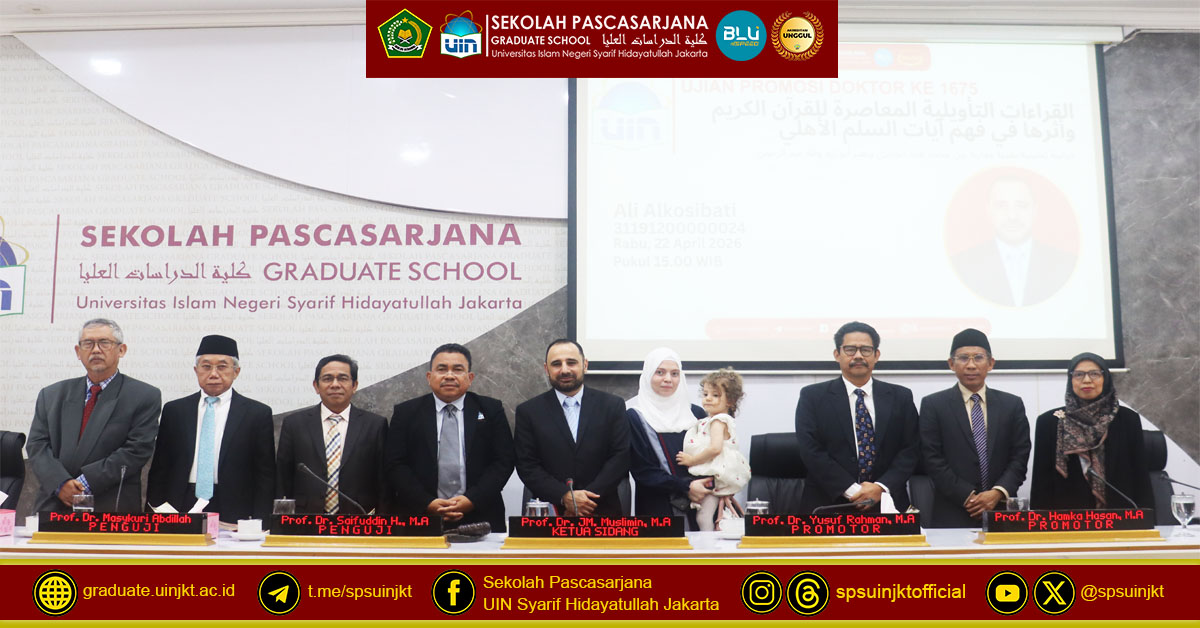
Ali Alkosibati's Doctoral Promotion Exam, Civil Peace Discourse in Modern Interpretation: The Dialectic of Reason and Revelation according to Three Contemporary Thinkers
Auditorium of Prof. Dr. Suwito, MA SPs UIN Jakarta, SPs NEWS – The Graduate School (SPs) of UIN Syarif Hidayatullah Jakarta held the 1675th Doctoral Promotion Exam in the Auditorium Room of Prof. Dr. Suwito, MA on Thursday, April 16, 2026 with promovendus Ali Alkosibati.
Ali merupakan mahasiswa program Doktor Pengkajian Islam dengan Konsentrasi Bahasa dan Sastra Arab. Disertasinya berjudul "Contemporary Hermeneutic Readings of the Noble Qur'an and Their Impact on Understanding the Verses of Civil Peace: A Comparative Analytical and Comparative Study between Muhammad Abed Al-Jabri, Nasr Abu Zeid and Taha Abd Al-Rahman"
Ali's research focuses on the thoughts of three Arab intellectual giants, namely Muhammad Abid al-Jabiri, Nasr Hamid Abu Zayd, and Taha Abdurrahman. The three are known to have a very influential hermeneutic approach, but they also often spark heated discussions and sharp debates on the world academic stage. Ali thoroughly explores how their big ideas have direct implications for the interpretation of the verses of al-silm al-ahli or civil peace in the complex realities of modern life.
One crucial finding that Ali revealed in his study was the existence of a symptom of "disconnection" or al-infisal that infected the methodology of the three figures. Ali critically argues that behind their great contributions, there is a disconnect that hinders a complete understanding of the sacred text. Al-Jabiri is considered to have cut the text from its civilizational roots, Abu Zayd separated the text from the Divine dimension through historicity, while Taha Abdurrahman tended to distance the text from its legal-legislative role in pursuit of ethical idealism.
More deeply, Ali explained that this epistemological gap results in human interaction with the Qur'an becoming fragmented or incomplete. Al-Jabiri is trapped in a rigid "epistemological disconnection" partition, while Abu Zayd overexploits the humanities aspect of the text to obscure its transcendental side. Meanwhile, Taha Abdurrahman's philosophical approach is considered too heavenly, so that the practical function of the Qur'anic law in regulating the social order becomes less real.
As an antithesis as well as a solution to this problem, Ali Alkosibati offers a new methodological construction that he calls the integrative hermeneutics approach. This offer is here to bridge the gap that has been separating text, reason, and sociological reality. Using analytical-critical qualitative methods, he formulated a framework that not only understands the text from a linguistic point of view, but also sits it on a legal, ethical, and practical foundation simultaneously.
Ali's integrative approach stands firmly on four main pillars: bayani as the key to opening linguistic aspects, burhani for the process of rational deduction, akhlaqi (ethical) as a benchmark for moral truth, and amali (practical) as the estuary of action. Through this synthesis, the Qur'an is no longer seen as a mere historical document or ethical theory, but a guideline for life that is able to align knowledge with behavior and discourse with social reality.
In order to prove the effectiveness of his theory, Ali applied this approach to the concept of "Civil Peace" in Islamic society. He examines how the holy scriptures can be transformed into foundations for the rule of law, social justice, equality, and pluralism dialogue. The results are very convincing; An integrative understanding of the sacred text has proven to be a crucial key in building sustainable political and social stability in the current era.
The uniqueness of Ali's study lies in his courage to reveal the "common gap" that exists in these great figures. If much of the previous research focused only on one figure or one theoretical aspect, Ali went further by proposing applicative solutions for the development of society. He emphasized that the centrality of the Qur'an al-Karim must be able to answer the real problems faced by mankind practically and comprehensively.
Ali successfully defended his dissertation under the guidance of Prof. Dr. Yusuf Rahman, MA and Prof. Dr. Hamka Hasan, MA, and was tested in front of a board of examiners consisting of Prof. Dr. JM Muslimin, MA, Prof. Dr. Yusuf Rahman, MA, Prof. Dr. Hamka Hasan, MA, Prof. Dr. Masykuri Abdillah, Prof. Kusmana, MA, Ph.D, Prof. Dr. Saifuddin Herlambang, MA.
After paying attention to the writing of the dissertation, the comments of the examiner team and the answers of the promovendus, the examiner team determined that Ali Alkosibati graduated with the title of Very Satisfactory. Ali Alkosibati is the 1675th Doctor in the field of Islamic Studies, doctoral program of the Graduate School of UIN Syarif Hidayatullah Jakarta. (JA)