
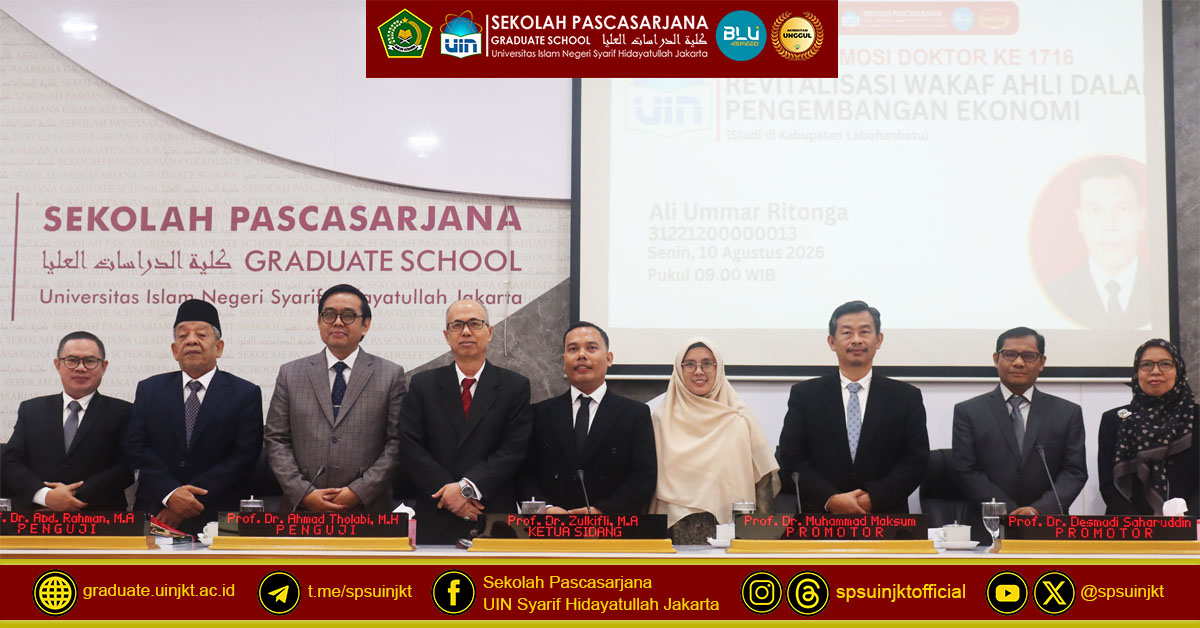
Ali Ummar Ritonga's Doctoral Promotion Exam, Revitalization of Waqf Experts in Economic Development
Auditorium of Prof. Dr. Suwito, MA SPs UIN Jakarta, SPs NEWS – The Graduate School (SPs) of UIN Syarif Hidayatullah Jakarta held the 1716th Doctoral Promotion Exam in the Auditorium Room of Prof. Dr. Suwito, MA Graduate School on Monday, August 10, 2026 with promovendus Ali Ummar Ritonga.
Ali is a student of the Doctoral program in Islamic Studies with a concentration in Sharia Economic Law. His dissertation is entitled "Revitalization of Expert Waqf in Economic Development (Study in Labuhanbatu Regency)".
This research departs from the reality that expert waqf or family waqf actually has enormous economic potential if managed productively. However, in contemporary practice, this instrument often encounters various crucial obstacles, ranging from stagnation of asset utilization, rampant internal family disputes, lack of legal literacy at the community level, to low level of professionalism asmanagers.
To unravel this complexity, this study aims to examine the urgency of revitalizing expert waqf as a solution in improving the economic welfare of the community. The methodology used is an empirical juridical approach, which combines normative analysis of laws and regulations and related literature with empirical data in the field through observation and in-depth interviews with experts and waqf managers.
The results of the study confirm that the transformation of assets into productive waqf is a key step in revitalization. This effort must be supported by strengthening the capacity and professionalism of the nazir, as well as optimizing the role of coaching from the Indonesian Waqf Agency (BWI) so that asset management can run accountably and effectively.
In terms of regulation, an analysis of Article 30 paragraphs (5) and (6) of Government Regulation Number 42 of 2006 reveals the existence of a vacuum and ambiguity of legal parameters. The lack of clear indicators regarding the mechanism for the transition of expert waqf status to waqf khairī (general waqf) triggers legal uncertainty that leads to the potential for prolonged conflicts within the wāqif family.
This legal problem is exacerbated by the agrarian aspect regulated in the Basic Agrarian Law (UUPA) Number 5 of 1960 Article 49. Weak supervision of certification and asset data collection causes many expert waqf lands to not be inventoried in an orderly manner, making them vulnerable to disputes. The technical insynchronization between the UUPA, the Waqf Law, and its derivative regulations is the main juridical obstacle that holds asset productivity hostage.
The novelty of this study lies in its specific mapping of expert waqf practices in Labuhanbatu Regency through a comparative approach. The model offered emphasizes the importance of synergy between adaptive regulations, strong institutional governance, and economic innovation as a new strategy to maintain the economic sustainability of the wāqif family while encouraging the socio-economic development of the people.
The theoretical position of this dissertation complements the findings of previous researchers such as Luthfi (2019), Samsuri (2019), Zulkifli (2021), Ridwan (2023), and Budiman (2024) who both emphasized legal reform and institutional strengthening. On the other hand, this work provides a different color from the studies of Fauziah (2017), Malini, and Usman and Abrahman (2021) which tend to focus only on managerial and behavioral aspects.
Theoretically, this dissertation stands on the footing of Satjipto Rahardjo's Progressive Legal Theory and Maṣlaḥah al-Ghazālī Theory which emphasizes that the rule of law should be oriented towards real benefits to society. This foundation is further strengthened by Loeren's Law in Empowerment Theory, which views law not just as a rigid norm, but as an effective means for social empowerment and economic independence of the people in a sustainable manner.
Ali successfully defended his dissertation under the guidance of Prof. Dr. Muhammad Maksum, MA, Prof. Dr. Desmadi Saharuddin, MA, and was tested in front of a board of examiners consisting of Prof. Dr. Zulkifli, MA, Prof. Dr. Muhammad Maksum, MA, Prof. Dr. Desmadi Saharuddin, MA, Prof. Dr. Ahmad Tholabi Kharlie, S.Ag, SH, MH, MA, Prof. Dr. H. Abd. Rahman, MA, Prof. Dr. Jaenal Aripin, M.Ag.
After paying attention to the writing of the dissertation, the comments of the examiner team and the answers of the promovendus, the examiner team determined that Ali graduated with the title of Very Satisfactory. Ali Ummar Ritonga is the 1716th Doctor in the field of Islamic Studies, doctoral program of the Graduate School of UIN Syarif Hidayatullah Jakarta. (Jay A)