
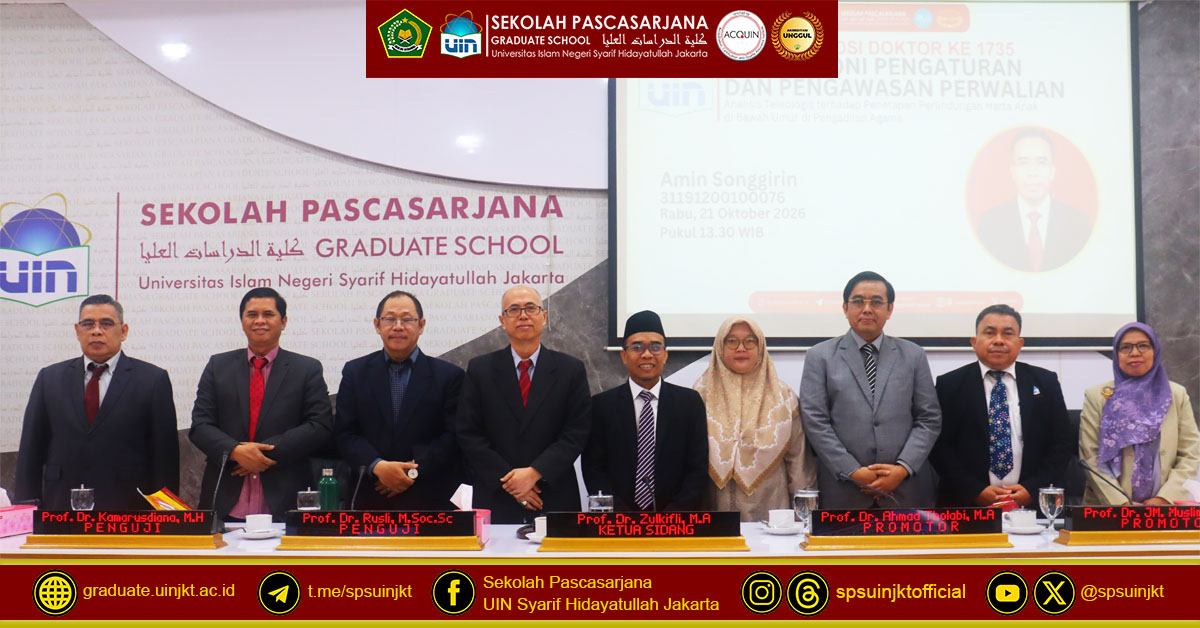
Amin Songgirin’s Doctoral Promotion Examination: The Disharmony of Guardianship Regulation and Supervision
Auditorium Prof. Dr. Suwito, MA, SPs UIN Jakarta, BERITA SPs - The Graduate School (SPs) of UIN Syarif Hidayatullah Jakarta held its 1,735th Doctoral Promotion Examination at the Auditorium Prof. Dr. Suwito, MA on Wednesday, October 21, 2026, featuring Amin Songgirin as the promovendus.
Amin is a student of the Islamic Studies Doctoral Program with a concentration in Sharia. His dissertation is titled "The Disharmony of Guardianship Regulation and Supervision (A Teleological Analysis of Child Property Protection Determinations in Religious Courts)." Amin addressed a crucial issue surrounding legal loopholes in the protection of children's civil rights. This research stems from academic concerns regarding how regulations on the guardianship of minors are scattered across various legal instruments that frequently lack synchronization with one another.
In-depth, this study pursues three ambitious yet grounded primary objectives. First, it analyzes the coherence of guardianship regulations across various legal frameworks, ranging from the Indonesian Civil Code (KUHPerdata), the Marriage Law, the Child Protection Law, the Compilation of Islamic Law (KHI), to Government Regulation Number 29 of 2019. Second, it scrutinizes substantive justice in eleven guardianship determinations issued by Religious Courts using Gustav Radbruch’s legal formula (Radbruch Formel) and maqāṣid al-sharī‘ah (objectives of Islamic law) as analytical lenses. Third, it formulates an ideal guardianship supervision reconstruction model to safeguard the future of children's assets.
To examine these issues, a normative juridical approach was adopted, combining various legal methodologies including statutory, conceptual, case, comparative, Islamic law, and teleological analyses. The analysis focuses on measuring the extent to which the objective of child asset protection is genuinely achieved in both normative provisions and judicial determination practices.
The primary legal materials in this study originate from statutory regulations and eleven guardianship determinations issued by Religious Courts between 2013 and 2024. Meanwhile, secondary materials were enriched through relevant books, journals, and research, and supported by in-depth interviews with judges, legal practitioners, notaries, and guardians to capture realities in the field.
The research findings reveal a compelling fact: teleologically, various guardianship regulations actually share a common ground centered on child protection. However, this shared objective has not been followed by mature normative and institutional coherence. These gaps are clearly evident in discrepancies regarding the child's age limit, the determination of eligible guardians, asset management and accountability rules, as well as weak institutional mechanisms and post-determination supervision.
From the perspective of judicial practice, the eleven analyzed guardianship determinations have indeed succeeded in providing legal certainty and utility for the child's best interests. Nevertheless, substantive justice in asset protection has not been uniformly realized, particularly concerning the limitation of guardian authorities, asset inventory, high-risk legal actions, accountability mechanisms, and post-determination oversight.
As a solution to these issues, the dissertation offers a breakthrough in the form of a risk-based, teleologically-oriented integrative guardianship supervision model. This model combines the values of maqāṣid al-sharī‘ah specifically the preservation of wealth (ḥifẓ al-māl) and the prevention of harm (sadd al-dharā’i‘)—with Lawrence M. Friedman’s legal system theory and Gustav Radbruch’s legal objectives. The model weaves synergy among Religious Court judicial control, transparent asset management by guardians, administrative-preventive supervision, and support from sectoral institutions.
Interestingly, as a de lege ferenda proposal for future legal reform, the study proposes the National Zakat Agency (BAZNAS) as an alternative supervisory guardian for Muslim children. This proposal is advanced through the attribution of firm authority, without necessarily replacing the historical role of the Public Trustee Office (Balai Harta Peninggalan or BHP), to ensure that the assets of orphans or minors are optimally protected from potential misuse.
Amin successfully defended his dissertation under the guidance of Prof. Dr. Ahmad Tholabi Kharlie, S.Ag, SH, MH, MA and Prof. Dr. JM Muslimin, MA, and was examined before a board of examiners consisting of Prof. Dr. Zulkifli, MA, Prof. Dr. Ahmad Tholabi Kharlie, S.Ag, SH, MH, MA, Prof. Dr. JM Muslimin, MA, Prof. Dr. Kamarusdiana, MH, Prof. Dr. Rusli, S.Ag, M.Soc.Sc, and Prof. Dr. Abdul Halim, M.Ag.
After reviewing the dissertation text, the examiners' comments, and the promovendus' responses, the board of examiners determined that Amin Songgirin graduated with the predicate of Very Satisfactory (Sangat Memuaskan). Amin Songgirin is the 1,735th Doctor in Islamic Studies from the Doctoral Program of the Graduate School of UIN Syarif Hidayatullah Jakarta. (Jay A)