
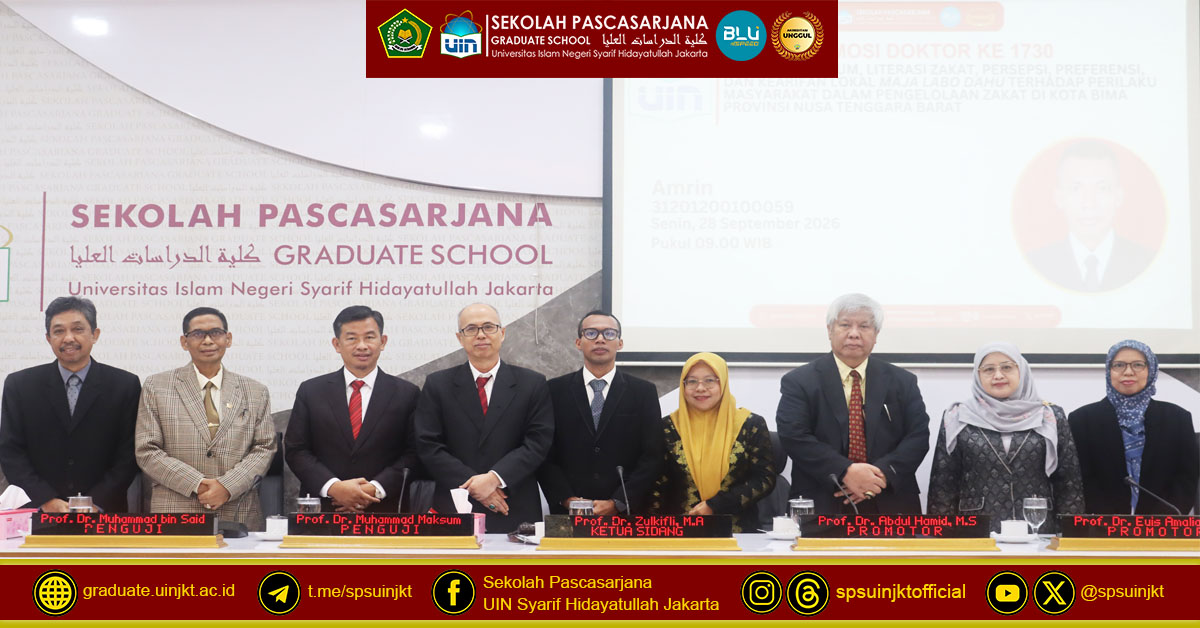
Amrin's Doctoral Promotion Exam, Maja Labo Dahu's Moral Values Become the Transformative Key to Zakat Management in Bima City
Auditorium of Prof. Dr. Suwito, MA SPs UIN Jakarta, SPs NEWS – The Graduate School (SPs) of UIN Syarif Hidayatullah Jakarta held the 1730th Doctoral Promotion Exam in the Auditorium Room of Prof. Dr. Suwito, MA Graduate School on Monday, September 28, 2026 with the promovendus Amrin.
Amrin is a student of the Doctoral program in Islamic Studies with a concentration in Sharia Economic Law. His dissertation is entitled "Legal Policy, Zakat Literacy, Perception, Preferences, and Local Wisdom of Maja Labo Dahu on Community Behavior in Zakat Management in Bima City, West Nusa Tenggara Province". Amrin defended his dissertation which highlighted the strengthening of culture-based zakat governance in West Nusa Tenggara.
This dissertation dissects the extent to which legal policies and local traditions are interlinked. This study aims to evaluate the effectiveness of existing zakat regulations, as well as formulate new strategies that are more adaptive to the social conditions of the local community.
The method used is fairly comprehensive through a mixed approach, combining qualitative and quantitative analysis. Field data collection involves in-depth interviews with 13 key informants and the distribution of questionnaires to 300 respondents of the Muslim community in Bima City. All of the data was then processed using Miles-Huberman model analysis, SWOT mapping, and Partial Least Squares Structural Equation Modeling (PLS-SEM) statistical modeling.
The results of the study reveal the fact that the implementation of the zakat legal policy at the Bima City BAZNAS has actually been guided by Law Number 23 of 2011 and its derivative regulations. However, in practice, the effectiveness of zakat management in the field has not been fully optimal. There are still a number of real challenges, ranging from the limitations of regulations at the regional level to the lack of human resource capacity of amil zakat.
In addition to internal institutional issues, other obstacles highlighted include the limited network of Zakat Collection Units (UPZ), the lack of integration of Muzakki and Mustahiq data, and the slow digitization of services. The implication is that the level of transparency of the institution has not been maximized, which ultimately affects the level of trust and participation of the community in distributing their zakat through official institutions.
Answering this problem, Amrin formulated a breakthrough idea in the form of an Integrative Model for Zakat Reconstruction Based on Maja Labo Dahu (MIRZ-MLD). This model combines legal policies and the principles of Good Zakat Governance with institutional strengthening, public participation, and economic empowerment of zakat recipients. Uniquely, this approach combines control by system with moral control (control by conscience).
The value of Maja Labo Dahu, a philosophy of life of the Bima people that emphasizes shame (maja) to do evil and fear (dahu) of Allah SWT, has proven to be a strong moral fortress. This study confirms that the literacy of zakat, perceptions, preferences, and local wisdom of Maja Labo Dahu has been proven to have a positive and significant influence on people's behavior in managing and distributing zakat.
Theoretically, these findings strengthen the approach of the maqāṣid al-sharī'ah system of Jasser Auda and M. Umer Chapra's thoughts on justice-based human development. This idea is also in line with the views of Yusuf al-Qaradawi and Didin Hafidhuddin who position zakat not just as a ritual worship, but as an important instrument for wealth redistribution, social protection, and poverty alleviation.
This research also refutes the skeptical assumptions of some world economists such as Dambisa Moyo and Angus Deaton who consider social assistance to be at risk of creating dependence. According to Amrin, zakat that is managed professionally, transparently, and oriented towards empowerment is actually able to build the economic independence of mustahiq in a sustainable manner.
The main novelty of this dissertation lies in its success in combining Maja Labo Dahu as a legal culture with the effectiveness of regulations and community behavior into one reconstruction model. The results of this study are expected to be a strategic foothold for local governments and BAZNAS to strengthen local regulations, modernize governance, and maximize the potential of zakat for the welfare of the people.
Amrin successfully defended his dissertation under the guidance of Prof. Dr. Abdul Hamid, MS and Prof. Dr. Euis Amalia, M.Ag, and was tested in front of a board of examiners consisting of Prof. Dr. Zulkifli, MA, Prof. Dr. Abdul Hamid, MS, Prof. Dr. Euis Amalia, M.Ag, Prof. Dr. Muhammad Bin Said, Prof. Dr. Muhammad Maksum, MA, Prof. Dr. Kadir, M.Pd.
After paying attention to the writing of the dissertation, the comments of the examiner team and the answers of the promovendus, the examiner team determined that Amrin graduated with the title of Very Satisfactory. Amrin is the 1730th Doctor in the field of Islamic Studies, a doctoral program at the Graduate School of UIN Syarif Hidayatullah Jakarta. (Jay A)