
Aris Munandar Thesis Exam: Muhammadiyah and NU's Response to Jokowi's Era Democracy
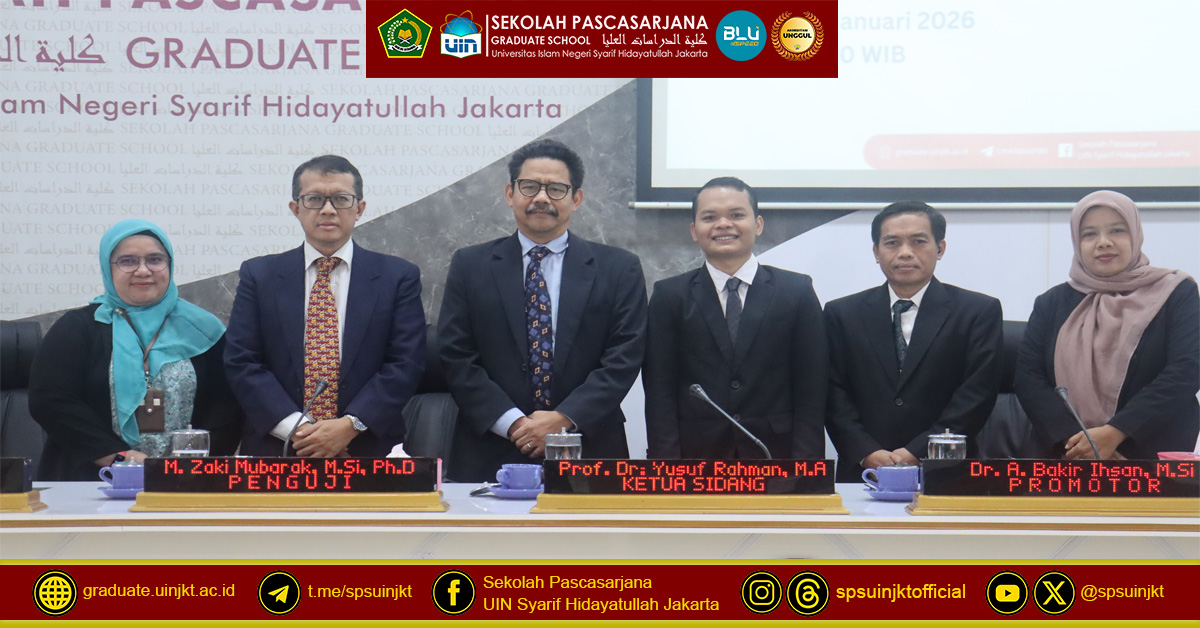
Auditorium of Prof. Dr. Suwito, MA SPs UIN Jakarta, SPs NEWS - The Graduate School (SPs) of UIN Syarif Hidayatullah Jakarta held the 2794th Thesis Exam at the Auditorium Room of Prof. Dr. Suwito, MA on Wednesday, January 14, 2026 with candidate Aris Munandar.
Aris is a student of the Master of Islamic Studies program with a concentration in Islamic Political Thought. His thesis was entitled "The Response of Muhammadiyah and Nahdlatul Ulama to the Quality of Democracy during the Joko Widodo Government".
This study explores how Muhammadiyah and NU position themselves as pillars of civil society in the midst of the debate on the rise and fall of the democracy index in the country.
Using a qualitative method with a phenomenological approach, Aris collected data in depth through interviews, observations, and documentation. He tried to see clearly the involvement of the two organizations in maintaining democratic values during the decade of President Joko Widodo's administration.
The theoretical foundation used in this study refers to Robert W. Hefner's thoughts on the potential of Islamic organizations as a motor for democratization. In addition, Aris uses the Larry Diamond framework to measure the extent to which the ideal functions of civil society are being carried out by both organizations.
The results of the study revealed a striking difference between the two. Muhammadiyah was found to be more prominent as a policy-oriented civil society. This organization tends to be critical, rational, and constitutional through policy advocacy and active oversight of various government political measures.
The role of Muhammadiyah in guarding democracy is strengthened through the work of the Institute of Wisdom and Public Policy (LHKP). This institution is the spearhead in supervising state policies, ensuring that the running of government remains in the corridor of law and social justice.
On the other hand, this study found that Nahdlatul Ulama (NU) shows more cultural-oriented civil society character. NU tends to be accommodating and prioritizes social stability through a strong cultural network and the influence of pesantren at the grassroots.
However, Aris gave a critical note that NU's structural proximity to power in this era had an impact on the limited control function. This makes NU's role in criticizing indications of democratic decline not as strong as Muhammadiyah.
Interestingly, this thesis refutes Samuel P. Huntington's classic thesis which considers Islam difficult to compromise with democracy. On the contrary, Aris's findings actually strengthen Jeremy Menchik's theory about the compatibility of Islam and democracy, where religious organizations are an important instrument in the consolidation of democracy.
Overall, this study confirms that even though they have different orientations, both Muhammadiyah and NU still have a vital role. The stylistic differences between "policy criticism" and "cultural approaches" reflect the richness of civil society strategies in Indonesia in responding to democratic challenges.
This thesis exam ends with the conclusion that strengthening civil society is a dead price for the sustainability of the quality of democracy in the future. Aris hopes that this research can be a reference for policymakers and academics in understanding the relationship between religion and the state in Indonesia.
Aris Munandar successfully defended his thesis under the guidance of Dr. A. Bakir Ihsan, M.Si, and was tested in front of a board of examiners consisting of Prof. Dr. Yusuf Rahman, MA, Dr. A. Bakir Ihsan, M.Si, M. Zaki Mubarak, M.Si, Ph.D and Dr. Suryani, M.Si.
After paying attention to the thesis writing, the comments of the examiner team and the candidate's answers, the examiner team determined that Aris Munandar graduated with the title of Very Satisfactory. Aris Munandar is the 2794th Master in the field of Islamic Studies, in the Master's program of the Graduate School of UIN Syarif Hidayatullah Jakarta. (JA)