
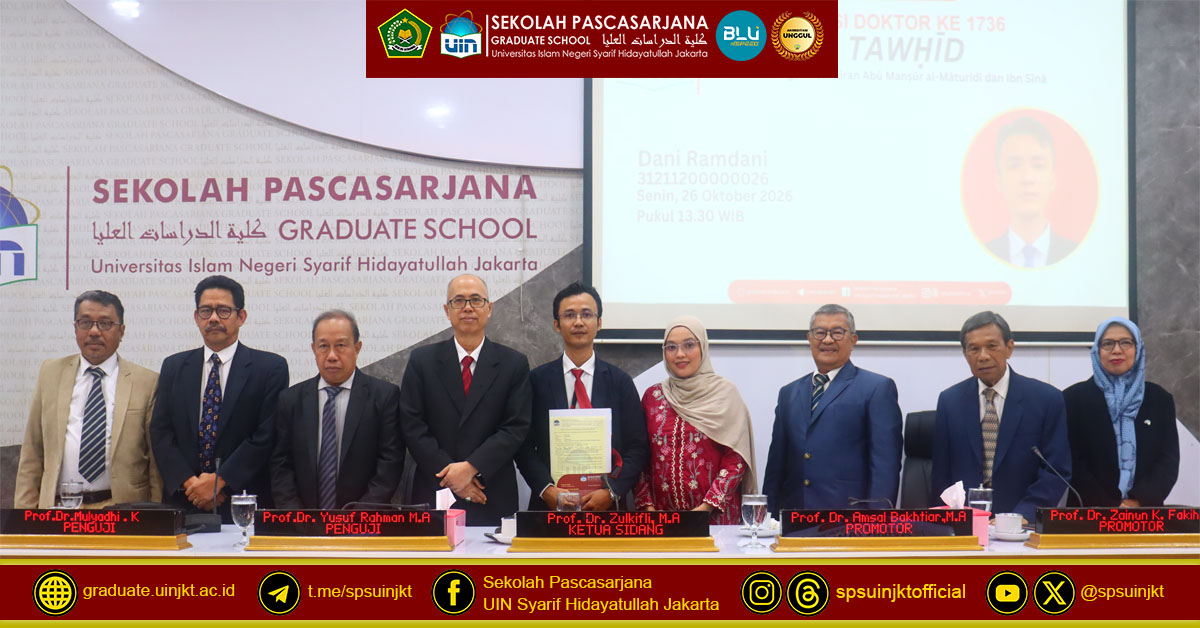
Dani Ramdani's Doctoral Promotion Exam, The Doctrine of Tawḥīd: A Comparative Study of the Thought of Abū Manṣūr al-Māturīdī and Ibn Sīnā
Auditorium of Prof. Dr. Suwito, MA SPs UIN Jakarta, SPs NEWS – The Graduate School (SPs) of UIN Syarif Hidayatullah Jakarta held the 1736th Doctoral Promotion Exam in the Auditorium Room of Prof. Dr. Suwito, MA Graduate School on Monday, October 26, 2026 with promovendus Dani Ramdani.
Dani is a student of the Doctoral program in Islamic Studies with a concentration in Islamic Thought. His dissertation is entitled "The Doctrine of Tawḥīd: A Comparative Study of the Thought of Abū Manṣūr al-Māturīdī and Ibn Sīnā". Dani explores how two great figures of Islamic civilization built the concept of the oneness of God. This topic was chosen because it brings together the tradition of rational kalam theology with illuminating philosophy which is often an important pillar in the intellectual history of Islam.
This research departs from the realization that the study of the oneness of God or monotheism never stops at a purely dogmatic level. More than that, monotheism has a broad epistemological and ontological dimension, which, if carefully explored, is able to provide answers to the anxieties of religious thought in the contemporary era.
In more detail, this research is focused on three main problem formulations. These three formulations include the epistemological structure and position of reason-revelation, the ontological construction of the oneness of God, and the comparative interpretation of both of the Sūrat al-Ikhlāṣ.
In terms of methodology, this research is categorized as an in-depth qualitative literature research. Primary data were collected directly from the monumental works of both figures, such as al-Māturīdī's Kitāb al-Tawḥīd and al-Māturīdī' s Taʾwīlāt Ahl al-Sunnah, as well as al-Shifāʾ, al-Najāt, al-Taʿlīqāt, and Tafsīr Sūrat al-Ikhlāṣ by Ibn Sīnā.
All of these data are processed through the stages of documentation, identification, classification, interpretation, and comparison using a descriptive-analytical analysis knife. The philosophical theology approach was chosen to bridge a healthy dialogue between revelation-based theological arguments and rational and coherent philosophical analysis.
The first findings of this study reveal that epistemologically, both al-Māturīdī and Ibn Sīnā both reject the attitude of taklid and place reason as an important instrument for recognizing God. Nevertheless, both take an operational path that has its own distinctive character.
Al-Māturīdī positions the intellect, senses, and news in a relationship complementary to revelation, where revelation remains the highest normative orientation. In contrast, Ibn Sīnā prioritizes demonstrative demonstrations or burhānī and views revelation as the culmination of human intellectual acceptance.
In the ontological aspect that is the second finding, al-Māturīdī proves the existence of God as al-Wāḥid al-Qahhār through the postulates of natural order (dalīl al-tadbīr) and the argument of absolute independence (dalīl al-tamānuʿ). On the other hand, Ibn Sīnā affirms God as Wājib al-Wujūd who is simple, unorganized, independent of other elements, and the source of all forms through the famous argument of burhān al-ṣiddīqīn.
Meanwhile, in the realm of interpretation of Sūrat al-Ikhlāṣ, al-Māturīdī interprets al-Aḥad and al-Ṣamad as an affirmation of the absolute transcendence of God as well as the dependence of all beings on Him. As for Ibn Sīnā, he translates the letter metaphysically as the necessity of existence, absolute simplicity, and the perfection of divine identity that is free from the barriers of division.
This comparative analysis is also enriched by comparisons with the views of modern scholars. The findings of this study are in line with Mustafa Cerić's (1995) thesis on the synthesis of reason and revelation in al-Māturīdī theology, and strengthen Ramon Harvey's (2021) view of theological rationality based on the order of the universe.
In the context of Ibn Sīnā's thought, this research supports the finding of Damien Janos (2024) that the oneness of God does not just mean numerical calculations, but a manifestation of simplicity, undivision, and self-identity of Wājib al-Wujūd. However, this study provides a distinguishing note from the study of Laura Hassan (2017) which previously emphasized the encounter between the Ash'ariyah tradition and Avicennism through the doctrine of creation in al-Āmidī thought.
The novelty of this dissertation lies in the attempt to make a systematic and thorough direct comparison between al-Māturīdī and Ibn Sīnā, placing the concept of monotheism as the main axis of analysis. The clear integration between the epistemology, ontology, and hermeneutics of Sūrat al-Ikhlāṣ is the main strength of this study.
Through this integration, Dani succeeded in mapping two interesting models of monotheistic rationality, namely theological rationality centered on revelation and philosophical rationality based on metaphysical analysis of existence. This research succeeded in proving that the difference in views between the two is not a form of absolute contradiction between faith and ratio, but a variation of departure points, conceptual devices, and limits of the authority of reason.
Overall, the findings of the Doctoral Promotion Test offer a valuable conceptual foundation for the development of contemporary Islamic theology. The model of thought offered is rational in nature, open to philosophical discourse, but still firmly rooted in the values of revelation.
Dani successfully defended his dissertation under the guidance of Prof. Dr. Amsal Bakhtiar, MA and Prof. Dr. Zainun Kamaluddin Fakih, MA, and was tested in front of a board of examiners consisting of Prof. Dr. Zulkifli, MA, Prof. Dr. Amsal Bakhtiar, MA, Prof. Dr. Zainun Kamaluddin Fakih, MA, Prof. Dr. Rd. Mulyadhi Kartanegara, Prof. Dr. Yusuf Rahman, MA, Prof. Dr. Kholid Al Walid, M.Ag.
After paying attention to the writing of the dissertation, the comments of the examiner team and the answers of the examiners, the examiner team determined that Dani Ramdani graduated with the title of Very Satisfactory. Dani Ramdani is the 1736th Doctor in the field of Islamic Studies, the doctoral program of the Graduate School of UIN Syarif Hidayatullah Jakarta. (Jay A)