
Daniel Barkah's Thesis Exam: The Dynamics of the Hisbah Council PERSIS in the Formulation of Fatwa
Auditorium Prof. Dr. Suwito, MA SPs UIN Jakarta, SPs NEWS - The Graduate School (SPs) of UIN Syarif Hidayatullah Jakarta held the 2808th Thesis Exam at the Auditorium Room of Prof. Dr. Suwito, MA SPs UIN Jakarta on Wednesday, February 25, 2026 with candidate Daniel Barkah.
Daniel is a student of the Master of Islamic Studies program with a concentration in Islamic Thought. His thesis is entitled "The Dynamics of the Thinking of the PERSIS Hisbah Council in the Formulation of Fatwa (Fatwa Product Analysis for the 1996-2018 Period)".
This research was born out of Daniel's interest in dissecting how the Hisbah Council of Islamic Unity (PERSIS) responds to the wave of contemporary issues through religious fatwas. During the period from 1996 to 2018, Daniel tracked the thought of PERSIS scholars to identify crucial factors that influenced the change and consistency of the organization's religious attitudes.
In the process, Daniel uses a qualitative method with a very comprehensive descriptive-analytical approach. He not only relied on the study of fatwa documents and court minutes, but also conducted in-depth interviews to understand the legal istinbat process. This was done to see how collective practices in the purification of teachings interact with the dynamics of social change.
The analytical knife used in this study is the epistemological theory of Islamic thought by Muhammad Abid al-Jabiri, which divides Islamic reason into three frameworks: bayani, burhani, and irfani. Daniel found that the PERSIS Hisbah Council predominantly operates within the framework of bayani epistemology, where the Qur'an and Hadith are placed as the primary source of absolute legitimacy.
Interestingly, the use of rational reasoning or burhani was found to be very limited and instrumental, that is, it was only used to strengthen existing normative arguments. Meanwhile, the intuitive-spiritual approach or irfani has almost no place in the fatwa decision-making process. This pattern reinforces the image of PERSIS as a movement that is faithful to the line of purification of Islamic teachings.
This methodological consistency, according to Daniel, serves as an internal mechanism that keeps the organization's orientation from being swayed by the currents of modernity. In the midst of massive social changes, the Hisbah Council managed to maintain strict institutional discipline, so that the resulting legal products remained in harmony with the organization's struggle from the beginning.
The findings of this research provide an antithesis to the views of a well-known Islamic law scholar, Wael B. Hallaq (2009). If Hallaq considers that modern Islamic legal authorities tend to experience fragmentation and loss of normative power due to the dominance of the nation-state, Daniel proves otherwise. The PERSIS Hisbah Council shows that internal religious authority can still be strong through methodological discipline.
On the other hand, this research strengthens the thesis of the late Azyumardi Azra (1999) regarding the vital role of non-state religious institutions. PERSIS is seen as a concrete example of how scholars are able to maintain the continuity of Islamic traditions while responding to social changes in a measurable manner, without having to lose their original identity as a conservative-textual reform movement.
Daniel argues that the label "conservative" or "moderate" on a fatwa is actually a logical consequence of the choice of methodology. A community that adheres to textual methodologies with strict normative boundaries will automatically result in a very cautious fatwa. This makes it difficult for them to shift towards substantive moderation that is too flexible.
On the contrary, Daniel explained that the space for moderation will only be wide open if an institution adopts a more adaptive and contextual methodology. Thus, the orientation of a fatwa is not just a choice of ideological attitudes that appear suddenly, but the end result of the thinking machine or epistemology used by its scholars. Daniel managed to photograph how a large Islamic organization was able to maintain its independence of thought in the midst of the increasingly complex pull of the times.
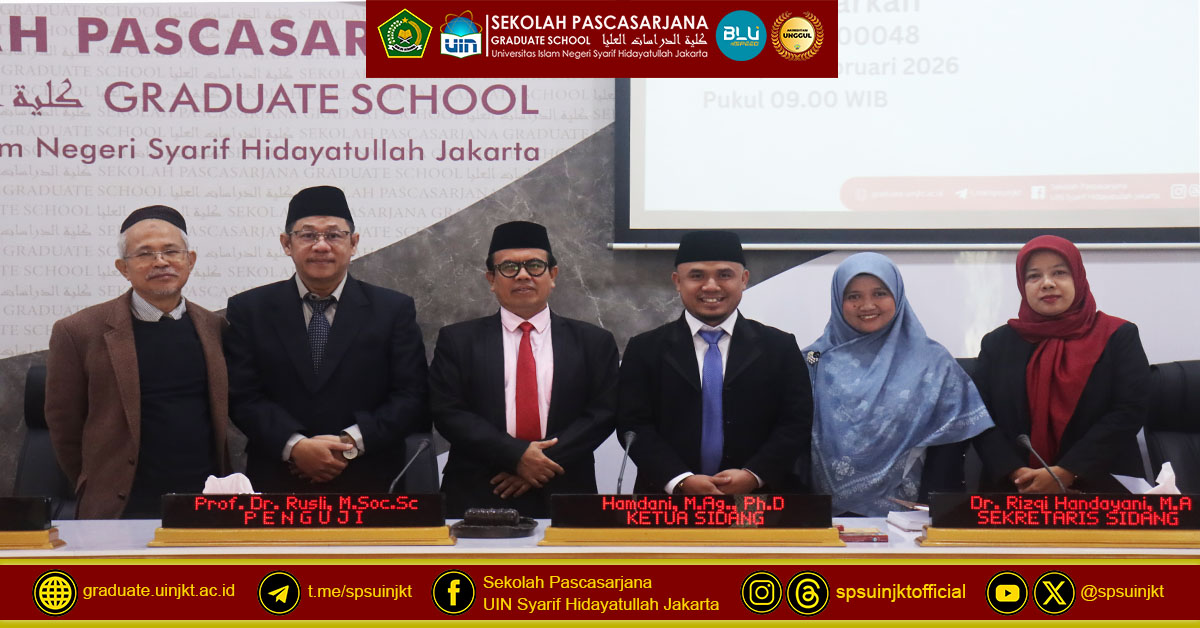
Daniel successfully defended his thesis under the guidance of Prof. Dr. Yusuf Rahman, MA, and was tested in front of a board of examiners consisting of Hamdani, M.Ag, Ph.D, Prof. Dr. Rusli, S.Ag, M.Soc.Sc and Dr. Fuad Jabali, MA.
After paying attention to the thesis writing, the comments of the examiner team and the candidate's answers, the examiner team determined that Daniel graduated with the predicate of Very Satisfactory. Daniel Barkah is the 2808th Master in the field of Islamic Studies, in the Master's program of the Graduate School of UIN Syarif Hidayatullah Jakarta. (JA)