
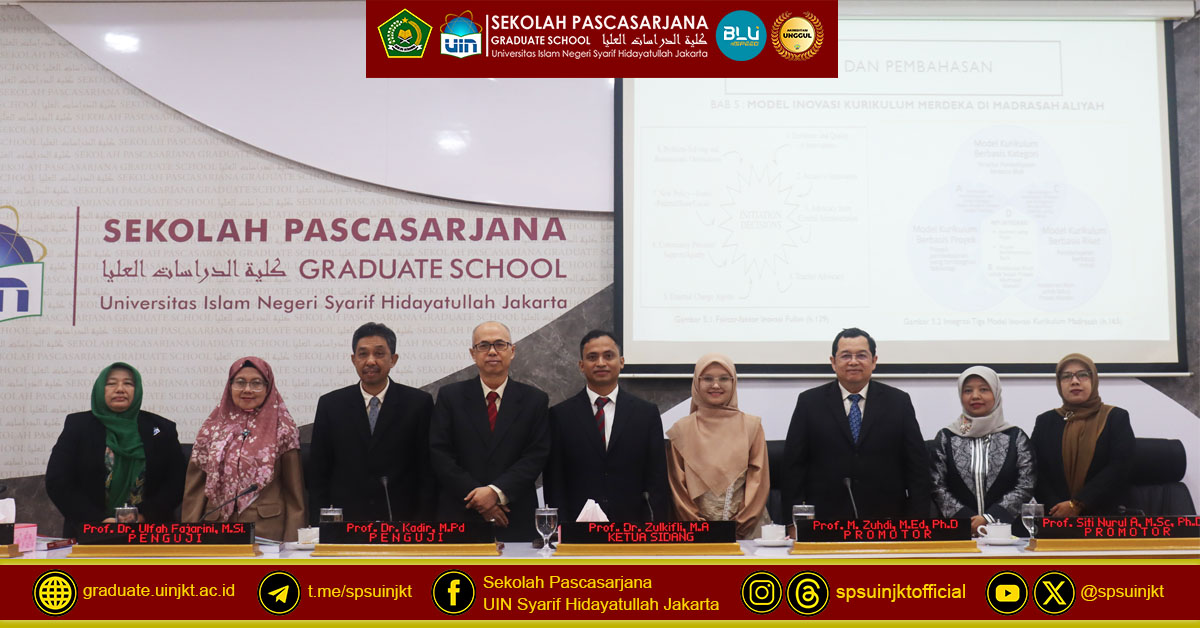
Doctoral Promotion Exam Dinil Abrar Sulthani, a Model of Curriculum Innovation of Madrasah Aliyah Negeri in the Implementation of the Independent Curriculum
Auditorium of Prof. Dr. Suwito, MA SPs UIN Jakarta, SPs NEWS – The Graduate School (SPs) of UIN Syarif Hidayatullah Jakarta held the 1681st Doctoral Promotion Exam in the Auditorium Room of Prof. Dr. Suwito, MA on Wednesday, June 3, 2026 with the promovendus of Dinil Abrar Sulthani.
Dinil is a student of the Doctoral program in Islamic Studies with a concentration in Islamic Religious Education. His dissertation is entitled "Madrasah Aliyah Negeri Curriculum Innovation Model in the Implementation of the Independent Curriculum (Case Study on MAN 4 South Jakarta, MAN 7 South Jakarta, and MAN 9 East Jakarta)". This research is present as a critical academic response that is very contextual in the midst of the ongoing transformation of the national education system in Indonesia.
This comparative research specifically aims to comprehensively analyze how the curriculum innovation model of Madrasah Aliyah Negeri (MAN) is developed and implemented within the framework of the Independent Curriculum. As a research locus, Dinil selected three leading madrassas in the DKI Jakarta area that are considered to have unique and representative characteristics, namely MAN 4 South Jakarta, MAN 7 South Jakarta, and MAN 9 East Jakarta.
Through empirically collected field data, the researcher dissected the three main focuses that became the pillars of his dissertation. The focus includes an in-depth analysis of how the real response of aliyah madrasas in the face of rapid changes in times, the variety of curriculum innovation models that are actually applied by each madrasah, and the formulation of Islamic education integration models in the implementation of the Independent Curriculum.
In order to dissect the structural and cultural dynamics in the three madrasas, Dinil adopted the grand theory of the leading sociologist of education, Michael Fullan. This theory emphasizes that any substantive systemic change must lead to an adaptive, organic, and fully compliant model of curriculum innovation and implementation that is completely in accordance with the spectrum of real needs faced by the aliyah madrasah institution.
Not only based on one theoretical axis, the analysis of this dissertation is further strengthened by the integration of two complementary supporting theories, namely the theory of planned behavior and Vygotsky's theory of social-cognitive development. These two theories are strategically placed to elaborate the psychological aspects of educator behavior as well as socio-cultural interaction in strengthening the concept of change of view innovation initiated by Michael Fullan.
The methodology applied in this research is descriptive qualitative with a multiple case study approach. To dig up rich and authentic data, Dinil conducted an intensive and rigid data collection process for months in the field through participatory observation techniques, in-depth interviews, and studies of valid institutional documentation.
The methodological strength of this research is also seen from the involvement of rich data sources, by capturing the aspirations of a total of 24 authoritative key informants. The composition of the informants includes 3 elements of madrasah leaders who determine policy, 6 practitioner teachers who design classroom learning, and 15 madrasah students who directly feel the impact of curriculum implementation, where each portion is divided equally from the three research locations.
One of the crucial findings in this study shows that the response from MAN in Jakarta in general is still mandatory. This characteristic reflects an institutional attitude that tends to be linear and obedient in following every policy line or regulation from superiors, which in the context of madrasah governance is under the full auspices of the Ministry of Religion of the Republic of Indonesia.
Despite showing high compliance, implementation in the field did not go completely smoothly because this research managed to map a number of significant obstacles. The biggest challenge actually arises from senior teachers who experience resistance due to limited digital understanding, coupled with the perception that the P5RA program policy (Pancasila and Rahmatan lil 'Alamin Student Profile Strengthening Project) is a new administrative burden, and is exacerbated by the lack of supporting facilities.
Despite facing similar challenges, the three madrasas managed to give birth to very interesting differentiation of innovation models. MAN 4 South Jakarta dominantly implements curriculum innovation and research-based learning, which requires students to think scientifically critically from an early age.
On the other hand, MAN 7 South Jakarta shows a different tendency by applying curriculum-learning innovations based on cross-disciplinary categories or cross content studies. Meanwhile, MAN 9 East Jakarta stands out through the development of curriculum innovations and project-based learning that are oriented towards real products and actual problem solving.
Analytically, Dinil concluded that the three innovation models in the madrasas actually have a common point in optimizing the use of digital technology and strengthening collaboration among the academic community. However, the fundamental distinction between the three lies in their respective main anchor focuses—whether they focus on research tradition, category depth, or project output.
Regarding the model of integration of Islamic education in the Independent Curriculum, this research formulates three holistic approaches that are interlocking. First, in a critical way of thinking, the integration of Islamic values is carried out through consistent habituation of religious activities; second, in the way of socializing, Islamic integration is manifested through the P5RA program; and third, in how students adapt to be able to align themselves with global developments and the current of changing times.
The scientific novelty of this dissertation is manifested in three main distinctions that clearly distinguish it from previous researches. The novelty lies in the study of the implementation of the Independent Curriculum specifically on the type of madrasah education in a comparatively multi-location manner, the use of in-depth double case study qualitative methods, and the application of the three-theory framework (triangulation theory) as well as a knife for analyzing data findings.
Through the results of these findings, Dinil argues that macro curriculum policies will always trigger the birth of new innovations at the micro level of Islamic education institutions, even though in reality the government is often not ready with its tactical regulatory tools. Therefore, curriculum and learning innovation is a non-negotiable absolute in order to keep up with regulatory volatility while responding to the challenges of the times.
Dinil successfully defended his dissertation under the guidance of Prof. Muhammad Zuhdi, M.Ed, Ph.D, and Prof. Siti Nurul Azkiyah, M.Sc, Ph.D, and was tested in front of a board of examiners consisting of Prof. Dr. Zulkifli, MA, Prof. Muhammad Zuhdi, M.Ed, Ph.D, Prof. Siti Nurul Azkiyah, M.Sc, Ph.D, Prof. Dr. Ulfah Fajarini, M.Si, Prof. Dr. Sururin, M.Ag, Prof. Dr. Kadir, M.Pd.
After paying attention to the dissertation writing, the comments of the examiner team and the answers of the promovendus, the examiner team determined that Dinil Abrar Sulthani graduated with the predicate of Very Satisfactory. Dinil Abrar Sulthani is the 1681st Doctor in the field of Islamic Studies, a doctoral program at the Graduate School of UIN Syarif Hidayatullah Jakarta. (JA)