
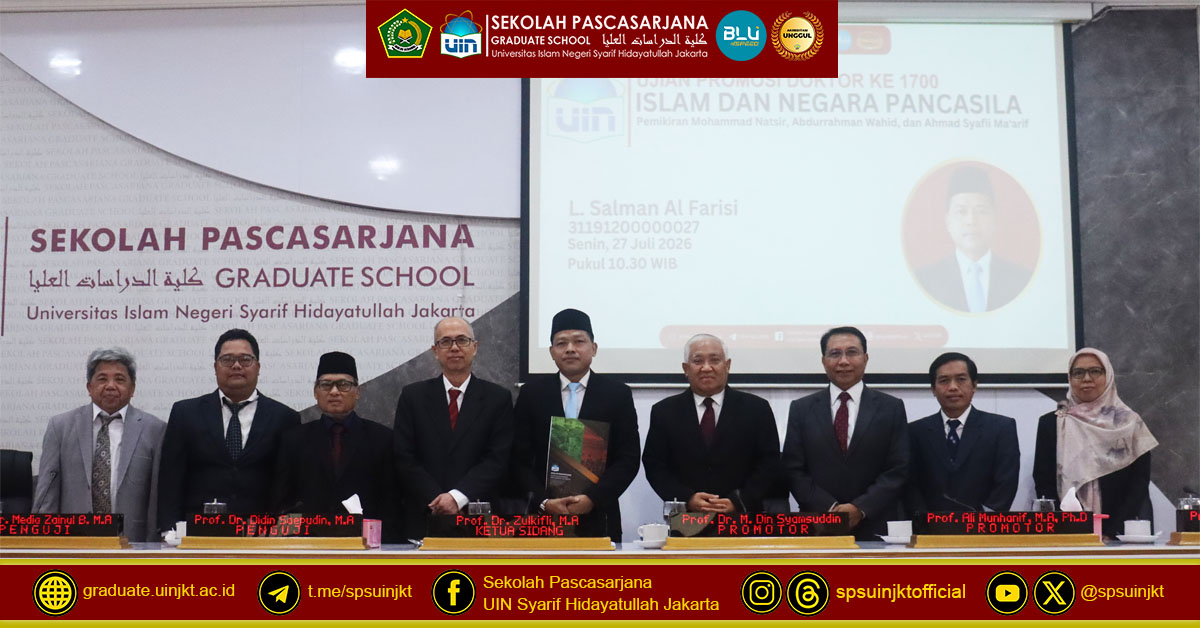
Doctoral Promotion Exam L. Salman Al Farisi, Islam and the State of Pancasila: The Thoughts of Mohammad Natsir, Abdurrahman Wahid, and Ahmad Syafii Maarif
Auditorium of Prof. Dr. Suwito, MA SPs UIN Jakarta, SPs NEWS – The Graduate School (SPs) of UIN Syarif Hidayatullah Jakarta held the 1700th Doctoral Promotion Exam in the Auditorium Room of Prof. Dr. Suwito, MA on Monday, July 27, 2026 with promovendus L. Salman Al Farisi.
Salman is a student of the Doctoral program in Islamic Studies with a concentration in Religion and Politics. His dissertation is entitled "Islam and the State of Pancasila: The Thoughts of Mohammad Natsir, Abdurrahman Wahid, and Ahmad Syafii Maarif".
This dissertation thoroughly explores the complex relationship between Islam and Pancasila through the lens of the thoughts of three prominent Muslim figures. Salman's research focuses on the dynamics of the meaning of the Pancasila state, which has often been labeled theologically and politically as a country that is "not a religious state, but also not a secular state."
To formulate a complete theoretical conception, this study explores three main domains. First, how do the three intellectuals interpret Pancasila's unique position between the dichotomy of religious and secular states. Second, how the three formulate the conception of secularism within the framework of Pancasila. Third, the extent of the relevance of their ideas to the dynamics of contemporary Islamic politics in the country.
The method used is qualitative with an interpretive approach through an in-depth literature study of the works of Natsir, Gus Dur, and Buya Syafii. Through the exploration of the theoretical, philosophical, and theological postulates behind it, this research succeeds in presenting a framework of understanding that is more neutral, objective, comprehensive, and in-depth regarding the Islamic political perspective on Pancasila.
The results of Salman's research revealed interesting findings regarding the spectrum of the meaning of Pancasila secularism from the three figures. In Natsir's view, the state of Pancasila is understood as a secular state symbolically and in substance from an ideological perspective. Meanwhile, Gus Dur views it as symbolic secularism from a political perspective, and Buya Syafii sees it as symbolic secularism from a moral-ethical perspective.
These differences in viewpoints have direct implications for the variety of Islamization strategies in Indonesia. Natsir offers a constitutional-structural Islamization approach or the Islamization of the state. On the other hand, Gus Dur carries cultural Islamization that focuses on community empowerment, while Buya Syafii chooses the path of moral-ethical Islamization or improving the substantive quality of the ummah.
This variety of approaches puts the ideas of the three thinkers in a very significant position in determining the direction and strategy of Islamic politics in Indonesia. The choice of strategy taken by the Islamic movement, whether through the path of state structure, culture, or moral reform, directly shapes the face of democracy and tolerance in the country.
One of the core arguments of this dissertation asserts that the ideology of Pancasila is not fundamentally born purely from Islamic political thought, which makes it factually adhering to symbolic secularism. Therefore, in order to maintain the existence and sustainability of the Pancasila state, the legitimacy of Indonesia's Islamic religiopolitical forces is a necessity that is urgently needed.
The basis of this argument is supported by the studies of leading geopolitical and religious experts, such as Robert Hefner (2001), R. William Liddle (2001), and strengthens the conclusions of Abdullahi Ahmed An-Na'im (2007). Salman's findings reaffirm how crucial the role of Islamic elements is in guarding and sustaining the sustainability of the national consensus.
In the end, the findings of this research correct the classic conclusions of researchers Nader Hashemi (2010) and Bahtiar Effendy (1998). Salman argues that the foundation of Pancasila secularism can actually be found in Islamic political thought itself, not solely imposed by the nature of the Pancasila ideology. In addition, the choice of Islamization strategy is the key to harmonizing relations between Islam and the state, while the ambivalence of the formula "not a religious state and not a secular state" risks triggering a negative stigma against Islamic political movements.
Salman successfully defended his dissertation under the guidance of Prof. Dr. M. Sirajuddin Syamsuddin, MA, Prof. Ali Munhanif, MA, Ph.D, Prof. Dr. A. Bakir Ihsan, M.Si, and was tested in front of a board of examiners consisting of Prof. Dr. Zulkifli, MA, Prof. Dr. M. Sirajuddin Syamsuddin, MA, Prof. Ali Munhanif, MA, Ph.D, Prof. Dr. A. Bakir Ihsan, M.Si, Prof. Dr. Didin Saepudin, MA, Prof. Dr. Media Zainul Bahri, MA, Prof. Dr. Idris Thaha, M.Si.
After paying attention to the writing of the dissertation, the comments of the examiner team and the answers of the promovendus, the examiner team determined that L. Salman Al Farisi graduated with the predicate of Very Satisfactory. L. Salman Al Farisi is the 1700th Doctor in the field of Islamic Studies, doctoral program of the Graduate School of UIN Syarif Hidayatullah Jakarta. (Jay A)