
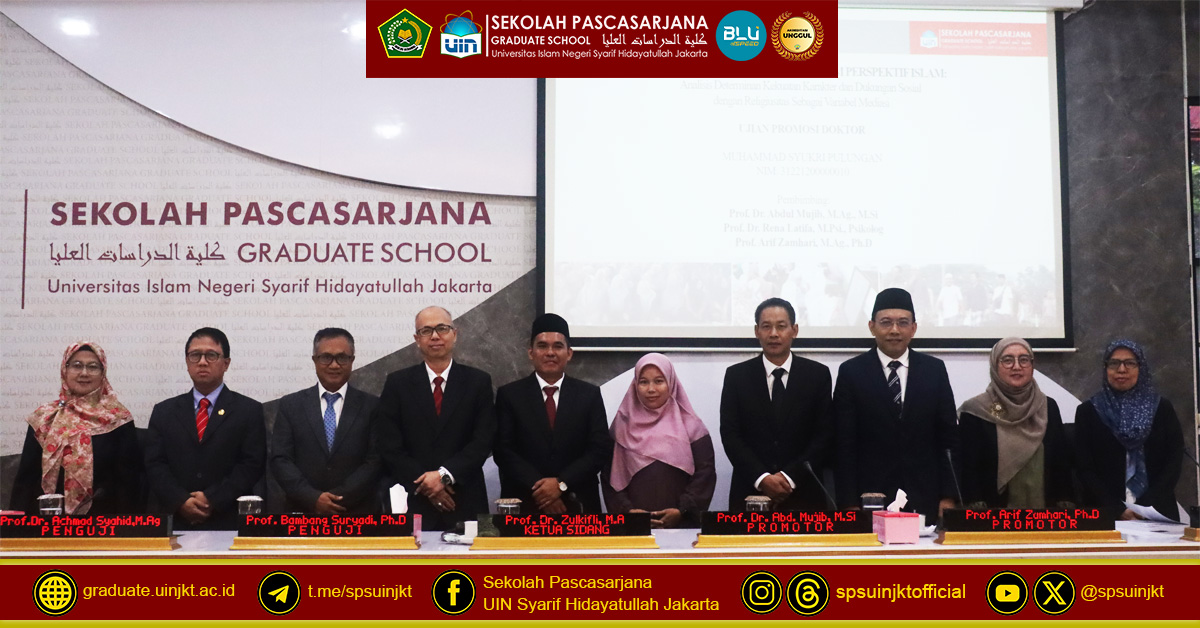
Doctoral Promotion Exam Muhammad Syukri Pulungan: School Well-Being Model in Islamic Perspective
Auditorium of Prof. Dr. Suwito, MA SPs UIN Jakarta, SPs NEWS - The Graduate School (SPs) of UIN Syarif Hidayatullah Jakarta held the 1648th Doctoral Promotion Exam in the Auditorium Room of Prof. Dr. Suwito, MA on Monday, December 22, 2025 with promovendus Muhammad Syukri Pulungan.
Syukri is a student of the Doctoral program in Islamic Studies with a Concentration in Islamic Psychology. His dissertation is titled "School Well-Being Model in Islamic Perspective: An Analysis of Determinants of Character Strength and Social Support with Religiosity as a Mediating Variable".
This research highlights the importance of students' psychological well-being within the framework of Islamic values, an issue that is highly relevant to the dynamics of modern education today.
The main purpose of this research is to test the extent to which the welfare model in the school environment or campus (school well-being) can be aligned with the Islamic perspective. Syukri focuses her analysis on the influence of character strength and social support, by placing religiosity as a bridge or mediating variable that connects these factors.
The methodology used is classified as comprehensive with a sequential explanatory approach. Syukri combined the numerical strength of 320 student samples in the quantitative phase, then explored it with the narrative of 10 informants in the qualitative phase. This approach ensures that the research findings are not only statistically valid, but also theoretically rich.
Using the SEM-PLS analysis tool, the quantitative results showed very solid findings. The research model was stated to be in accordance with empirical data with an SRMR value of 0.065. This figure proves that the framework of thought built by Syukri has very good accuracy in describing the reality of student welfare in the field.
Statistically, character strength does not have a significant effect directly on school well-being. This is inversely proportional to social support which actually has a positive and significant impact on the happiness and comfort of students during their education.
This is where the important role of religiosity emerges as the "hero" in the model. The mediation analysis reveals that religiosity functions as a full mediator for character strength. This means that a strong character will only produce prosperity if it is based on spiritual values or a qualified level of religiosity in students.
Meanwhile, in the social support variable, religiosity plays a role as a partial mediator. These findings indicate that although the support from the surrounding environment has been very helpful, the touch of religious values still provides an additional boost that strengthens the sense of well-being of students in the campus and dormitory environment.
Entering the qualitative stage, Syukri used Interpretative Phenomenological Analysis (IPA) to dissect the experience of boarding students. Three major themes that dominate their lives are revealed: a dynamic adaptation process, the challenges of living independently in the dormitory, and coping strategies that involve social support and character strength that is integrated with religion.
The results of this study correct the conventional positive psychology assumptions initiated by Peterson & Seligman (2004). If Western theory places character strength as a direct predictor of well-being, Syukri's findings show that in the context of religious Indonesian society, character must first transform through religious values to achieve true happiness.
This synergy between Western psychological theory and Islamic perspective is considered a fresh new approach. The integration of SEM statistical analysis and the depth of phenomena through science succeeded in constructing a school well-being model that is more humane, comprehensive, and in accordance with the cultural roots of Indonesian society.
In closing, Syukri recommended the development of a multi-component dormitory ecosystem. He emphasized that adequate physical facilities must go hand in hand with character building, social support, and an atmosphere of religiosity in order to create an ideal learning environment for future generations.
Muhammad Syukri Pulungan successfully defended his dissertation under the guidance of Prof. Dr. Abdul Mujib, M.Ag, M.Si, Prof. Dr. Rena Latifa, M.Psi, Psychologist and Prof. Arif Zamhari, M.Ag, Ph.D, and was tested in front of a board of examiners consisting of Prof. Dr. Zulkifli, MA, Prof. Dr. Abdul Mujib, M.Ag, M.Si, Prof. Dr. Rena Latifa, M.Psi, Psychologist, Prof. Arif Zamhari, M.Ag, Ph.D, Prof. Dr. Achmad Syahid, M.Ag, Prof. Bambang Suryadi, Ph.D and Prof. Dr. Ulfah Fajarini, M.Si.
After paying attention to the writing of the dissertation, the comments of the examiner team and the answers of the promovendus, the examiner team determined that Muhammad Syukri Pulungan graduated with the title of Very Satisfactory. Muhammad Syukri Pulungan is the 1648th Doctor in the field of Islamic Studies, in the doctoral program of the Graduate School of UIN Syarif Hidayatullah Jakarta. (JA)