
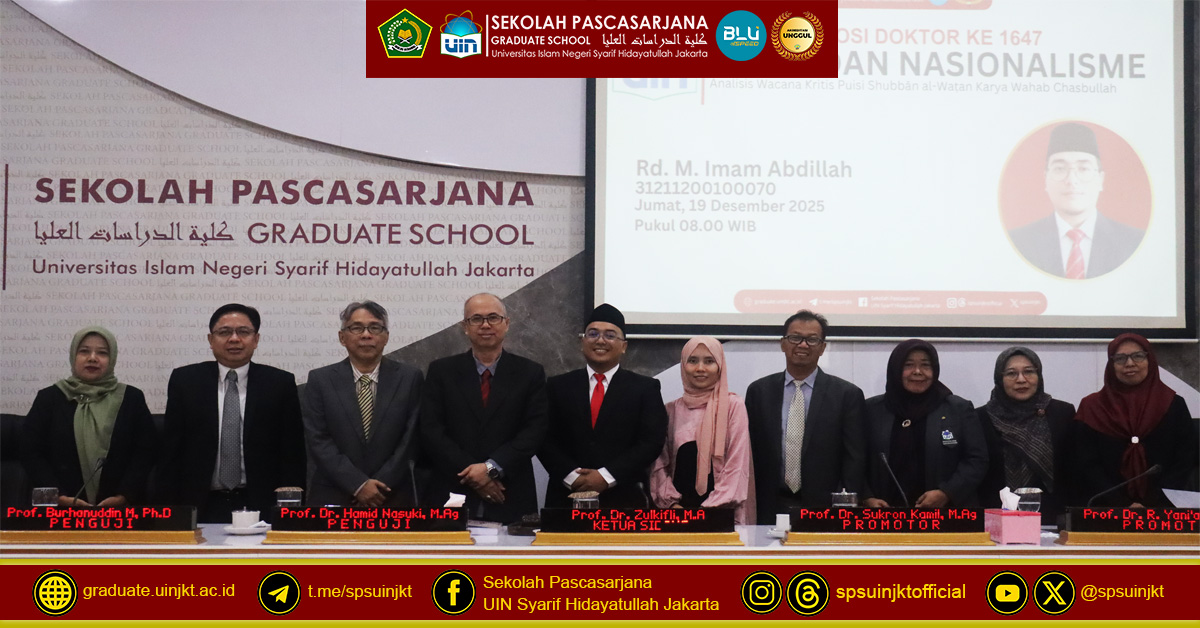
Doctoral Promotion Exam Rd. M. Imam Abdillah: Islam and Nationalism: A Critical Discourse Analysis of the Poetry of Shubbān al-Waṭan by Wahab Chasbullah
Auditorium of Prof. Dr. Suwito, MA SPs UIN Jakarta, SPs NEWS - The Graduate School (SPs) of UIN Syarif Hidayatullah Jakarta held the 1647th Doctoral Promotion Exam in the Auditorium Room of Prof. Dr. Suwito, MA on Friday, December 19, 2025 with promovenda Rd. M. Imam Abdillah.
Imam is a student of the Doctoral program in Islamic Studies with a Concentration in Arabic Language and Literature. His dissertation is entitled "Islam and Nationalism: A Critical Discourse Analysis of the Poetry of Shubbān al-Waṭan by Wahab Chasbullah". This research dissects how a literary work can become a spirit for the national movement in Indonesia.
In his presentation, Imam revealed that the relationship between Islam and nationalism is not something that happens by chance. Through a critical reading of the poem Shubbān al-Wa ṭan, he reveals how the text functions as a very powerful ideological medium. This poem is not just a beautiful arrangement of words, but an instrument that is deliberately created to shape the collective consciousness of the nation in fighting the grip of colonialism.
This study uses the Norman Fairclough model Critical Discourse Analysis (AWK) knife. Imam traces the text through three very in-depth levels: the micro level that looks at the structure of the text, the meso level that observes the practice of discourse, and the macro level that reviews the socio-cultural context in which the poem was born. This approach allows researchers to see how religion, politics, and literature are intertwined in one power arena.
One of the main findings in this dissertation is KH Wahab Chasbullah's clever strategy in using Arabic. By choosing a language that is considered sacred by Muslims, Kyai Wahab succeeded in internalizing the values of nationalism into the hearts of the people. As a result, loving one's homeland is no longer seen as a secular affair, but part of a mutually reinforcing religious doctrine, or known as the jargon hubbul wathan minal iman.
Furthermore, Imam explained that this poem builds a unique power relationship between the text and its reader. Kyai Wahab's figurative power as a charismatic scholar, coupled with the legitimacy of the Nahdlatul Ulama (NU) organization as a cultural authority, makes Shubbān al-Waṭan not just a song, but a collective identity for the Muslims of the archipelago. This proves that the text has the authority to mobilize the masses massively and sustainably.
In the contemporary context, this dissertation finds that Shubbān al-Waṭan presents a very relevant discourse on religious nationalism. The ideological formulation offered in the poem is able to be a strong fortress to ward off the currents of transnational ideologies that often conflict between religion and the state. This poem affirms that being a devout Muslim and being a nationalist citizen can go hand in hand without contradiction.
The novelty of Rd. M. Imam Abdillah's research lies in his courage to read Islamic literary texts from the perspective of power production. So far, the study of Islamic literature in Indonesia tends to be fixated on aesthetic and spiritual aspects alone. However, Imam succeeded in proving that literature is a space for ideological and political negotiation of culture that consciously constructs Indonesia's national identity.
This study is also a critical response to the tendency of academics to often ignore the ideological dimension of authors in the formation of public discourse. By referring to the thoughts of world figures such as Leila Ahmad and Loumia Ferhat, Imam emphasized that religiosity functions as a symbolic force. This power is able to articulate the relationship between Islam and nationality in a transformative manner according to the development of the times.
Imam's findings are considered to make a great contribution to strengthening national integration in the midst of diversity. Islamic literature, according to the results of this research, has proven to have a strategic role in the great project of Indonesian nationality which is still in process to this day.
Its success is expected to trigger similar research that is more daring in dissecting the relationship between religion and the state through cultural channels, as well as enriching intellectual treasures within UIN Syarif Hidayatullah Jakarta and the international academic world.
Rd. M. Imam Abdillah successfully defended his dissertation under the guidance of Prof. Dr. Sukron Kamil, M.Ag, Prof. Dr. R. Yani'ah Wardani, M.Ag and Yeni Ratna Yuningsih, MA, Ph.D, and was tested in front of a board of examiners consisting of Prof. Dr. Zulkifli, MA, Prof. Dr. Sukron Kamil, M.Ag, Prof. Dr. R. Yani'ah Wardani, M.Ag, Yeni Ratna Yuningsih, MA, Ph.D, Prof. Dr. Hamid Nasuki, M.Ag, Prof. Burhanuddin Muhtadi, MA, Ph.D and Dr. Rizqi Handayani, MA.
After paying attention to the writing of the dissertation, the comments of the examiner team and the answers of the promovendus, the examiner team determined that Rd. M. Imam Abdillah graduated with the predicate of Laude. Rd. M. Imam Abdillah is the 1647th Doctor in the field of Islamic Studies, in the doctoral program of the Graduate School of UIN Syarif Hidayatullah Jakarta. (JA)