
Doctoral Promotion Test Edi KUrniawan, Fatwa of MUI Jambi 2012-2024 in Response to the Social Dynamics of the Jambi Malay Community
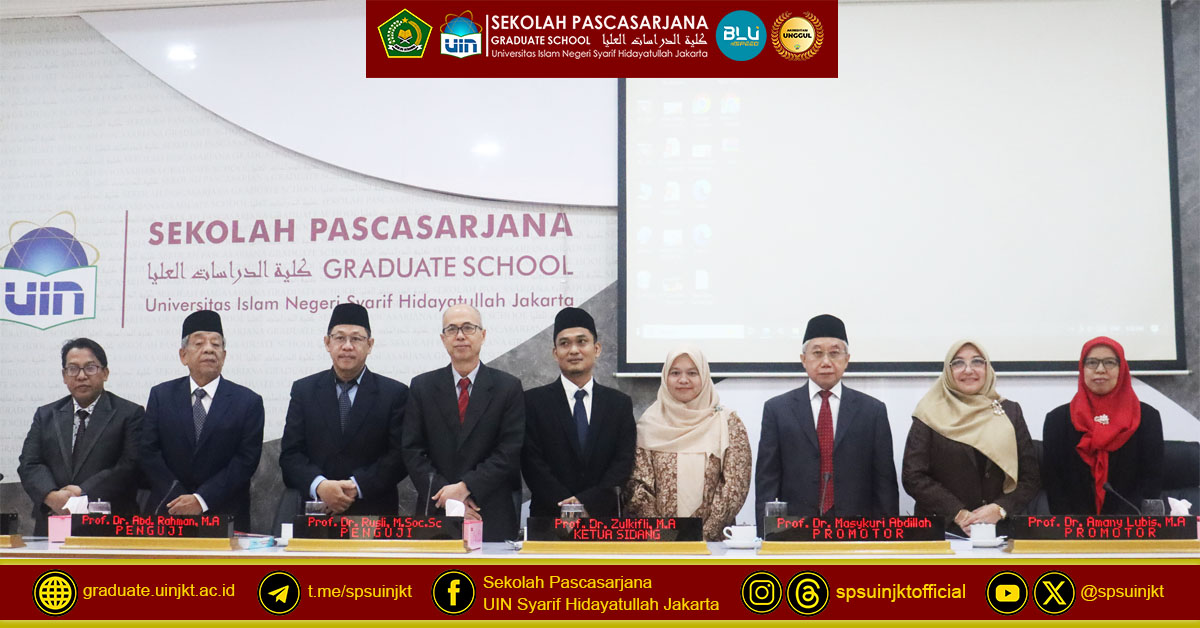
Auditorium of Prof. Dr. Suwito, MA SPs UIN Jakarta, SPs NEWS – The Graduate School (SPs) of UIN Syarif Hidayatullah Jakarta held the 1694th Doctoral Promotion Exam in the Auditorium Room of Prof. Dr. Suwito, MA on Wednesday, July 22, 2026 with promovendus Edi Kurniawan.
Edi is a student of the Doctoral program in Islamic Studies with a concentration in Sharia. His dissertation is titled "Fatwa of MUI Jambi 2012-2024 in Responding to the Social Dynamics of the Jambi Malay Community."
In his presentation, Edi examined in depth the fourteen fatwa products issued by the Indonesian Ulema Council (MUI) of Jambi Province during the period 2012 to 2024. The focus of the study covers four crucial issues in the public space, namely intra-religious relations, inter-religious relations, inheritance law, and waqf management. This study plays an important role considering that the discourse of fatwa in Indonesia has almost always been centered on fatwa products at the national level, while the characteristics of reasoning and the social function of fatwa at the local level have not been comprehensively mapped.
To dissect the complexity of the problem, this study applies a qualitative method through a normative legal approach. Data collection was carried out systematically through the study of fatwa documents, in-depth interviews with key parties, and field observations. Theoretically, Edi combines the framework of uṣūl al-fiqh with the theory of legal pluralism, conflict theory, and symbolic power theory to understand how a fatwa is formulated and works in a society that coexists with three legal systems at once, namely syarak, customs, and state law.
The results of the study show that the birth of the fatwas of the MUI Jambi for the period 2012-2024 cannot be separated from the pressure and sociological dynamics of the local community. This context is colored by the entry of the Salafi/Wahhabi movement that tends to reject local traditions, the rise of schools that are considered deviant from mainstream teachings, and the emergence of clashes between religious norms, customary values, and government regulations. This condition requires regional fatwa institutions to adapt responsively and wisely.
Responding to these challenges, MUI Jambi does not use a rigid approach, but applies a multi-layered fatwa formulation methodology. The determination of the law is carried out by combining the postulates of the Qur'an and hadith, the rules of fiqh and usul al-fiqh, the opinions of classical and contemporary scholars, to refer to the rules of state law and the noble values of the Malay customs of Jambi. This combination is precisely adjusted to the character of the problems that the community is facing.
This compromising and integrative reasoning pattern is articulated in this dissertation as "maqāṣid-based harmonization". This concept describes a model of Islamic law reasoning that is simultaneously able to maintain the basic principles of sharia (hifz ad-din), accommodate local wisdom that lives in the community, while respecting the national legal framework that applies in Indonesia.
This research convinces the academic public that Jambi—which has often been positioned as a peripheral or peripheral region in Indonesian Islamic historiography—actually presents very strong empirical evidence. The MUI fatwa at the regional level has proven to be able to maintain an ideal balance between the absolute (qaṭʻī) and the flexible (ẓannī). This approach has proven to be effective in realizing justice, reducing the risk of conflict, and maintaining social stability in the midst of pluralism.
Theoretically, Edi Kurniawan's findings make a critical contribution by correcting the views of a number of prominent academics, such as Mun'im Sirry (2013), Syafiq Hasyim (2013 & 2020), Piers Gillespie (2007), Ahmad Najib Burhani (2014), and Fariz Alnizar (2025). In contrast to the generalizations of previous studies that tend to view the MUI fatwa as a trigger for conflict, a driver of conservatism, or a threat to minority groups, the fatwa at the regional level actually shows an inclusive and dialogical face.
The presence of this research reaffirms the strategic role of regional fatwa institutions as a bridge between Islamic law, custom, and state law in the public space. Edi Kurniawan's dissertation not only enriches the treasury of fatwa studies in Indonesia, but also offers a conflict resolution model based on local wisdom and the principles of maqāṣid asy-syarī'ah that are relevant to be applied in various regions of the archipelago.
Edi Kurniawan successfully defended his dissertation under the guidance of Prof. Dr. Masykuri Abdillah and Prof. Dr. Hj. Amany Lubis, MA, and was tested in front of a board of examiners consisting of Prof. Dr. Zulkifli, MA, Prof. Dr. Masykuri Abdillah, Prof. Dr. Hj. Amany Lubis, MA, Prof. Dr. Rusli, S.Ag, M.Soc.Sc, Prof. Dr. H. Abd. Rahman, MA, Dr. Afwan Faizin, MA.
After paying attention to the dissertation writing, the comments of the examiner team and the answers of the promovendus, the examiner team determined that Edi Kurniawan graduated with the title of Very Satisfactory. Edi Kurniawan is the 1694th Doctor in the field of Islamic Studies, doctoral program of the Graduate School of UIN Syarif Hidayatullah Jakarta. (Jay A)