
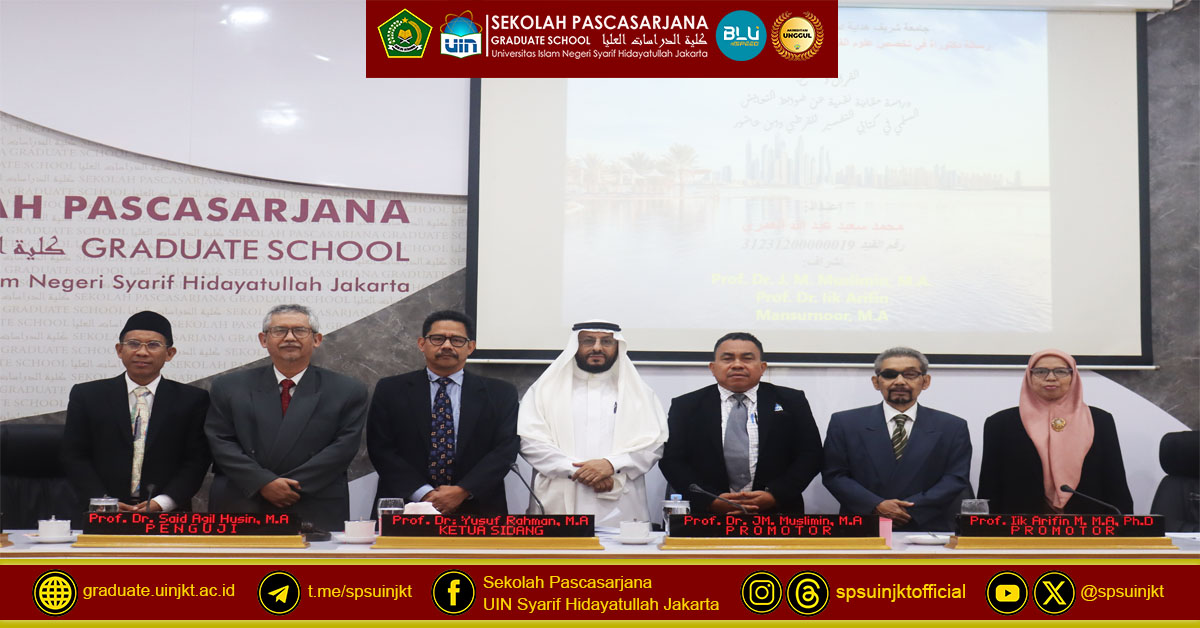
Doctoral Promotion Test of Mohammed Saeed A. Alamri, Principles of Peaceful Coexistence in the Book of Tafsir by Al-Qurtubi and Ibn Asyur
Auditorium of Prof. Dr. Suwito, MA SPs UIN Jakarta, SPs NEWS – The Graduate School (SPs) of UIN Syarif Hidayatullah Jakarta held the 1679th Doctoral Promotion Exam in the Auditorium Room of Prof. Dr. Suwito, MA on Wednesday, May 13, 2026 with promovendus Mohammed Saeed A. Alamri.
Saeed is a student of the Doctoral program in Islamic Studies with a Concentration in Tafsir. His dissertation was titled "القران والمجتمع: دراسة مقارنة نقدية عن ضوابط التعايش السلمي في كتابي التفسير للقرطبي وابن عاشور" (The Qur'an and Society: A Critical Comparative Study of the Limits of Peaceful Coexistence in the Tafsir of Al-Qurtubi and Ibn 'Asyur). This research is present as an oasis in the midst of a global discourse on pluralism and peace between religions.
The essence of this research is to dissect the concept of peaceful coexistence through the lens of social science combined with the perspective of Qur'anic interpretation. Saeed conducted a sharp comparative study of the thought of the leading classical mufasir, Imam al-Qur'an ṭubī, and the revolutionary modern mufasir, al-Ṭ āhir Ibn 'Āsyūr, to find common ground for the life of a pluralistic society.
The focus of the research is not only theoretical, but is directed at the formulation of concrete principles in the internal relations between Muslims and non-Muslims. Saeed observantly examines how the political context and intellectual landscape during the lives of the two mufasir contributed to the construction of the interpretation they produced.
In the process of data extraction, this study uses the thematic interpretation method (al-tafsīr al-mawḍū'ī) and a comparative method with an inductive-critical approach. As the main source, the promovendus dissects in depth the books Al-Jāmi' li Aḥkām al-Qur'ān by Al-Qur'ānṭubī and Al-Taḥrīr wa al-Tanwīr by Ibn 'Āsyūr, with an emphasis on the verses of peace, tolerance, and justice.
The strong argument built in this study confirms that peaceful coexistence in Islam is not just a complementary concept, but a normative principle rooted in the value of justice. This principle is closely integrated with the highest goal of the shari'a (maqāṣid al-syarī'ah), which is the protection of human dignity and the common good.
The results of the research reveal the unique character of each character. The Qur'an ṭubī, with its classical background, emphasizes coexistence as an ethical and juridical mechanism for maintaining social stability. For him, tolerance is a fortress to stem extremism, while still adhering to the legal dimension and authority of the previous clerics.
On the other hand, Ibn 'Āsyūr offers a fresher perspective through the maqāṣidī approach. He views peaceful coexistence as a human trait and the main foundation of a civilization. In his view, dialogue and social harmony are the main keys to the progress of a nation in the modern era.
This research explicitly aligns itself with the line of thought of great figures such as Al-Shāṭibī to Jasser Auda. These figures place the protection of human dignity as the main foundation of social relations, a view that is very relevant to answer the challenges of social fragmentation that often occur today.
Emphatically, Saeed through his research rejects a rigid and ahistorical approach to literal-exclusive interpretation. He criticized the scripturalist mindset that often ignores the historical context in interpreting differences in faith, which, if left unchecked, can undermine the order of pluralistic harmony of society.
The novelty of this dissertation lies in its success in integrating classical and modern interpretation analysis into a practical framework. This dissertation is expected to be an important reference for academics and social practitioners in formulating contextual peace frameworks for modern societies around the world.
Saeed successfully defended his dissertation under the guidance of Prof. Dr. JM Muslimin, MA and Prof. Dr. Iik Arifin Mansurnoor, MA, and was tested in front of a board of examiners consisting of Prof. Dr. Yusuf Rahman, MA, Prof. Dr. JM Muslimin, MA, Prof. Dr. Iik Arifin Mansurnoor, MA, Prof. Dr. Said Agil Husin Al Munawar, MA, Prof. Kusmana, MA, Ph.D, Prof. Dr. Hamka Hasan, MA.
After paying attention to the writing of the dissertation, the comments of the examiner team and the answers of the promovendus, the examiner team determined that Mohammed Saeed A. Alamri graduated with the predicate of Very Satisfactory. Mohammed Saeed A. Alamri is the 1679th Doctor in the field of Islamic Studies, a doctoral program at the Graduate School of UIN Syarif Hidayatullah Jakarta. (JA)