
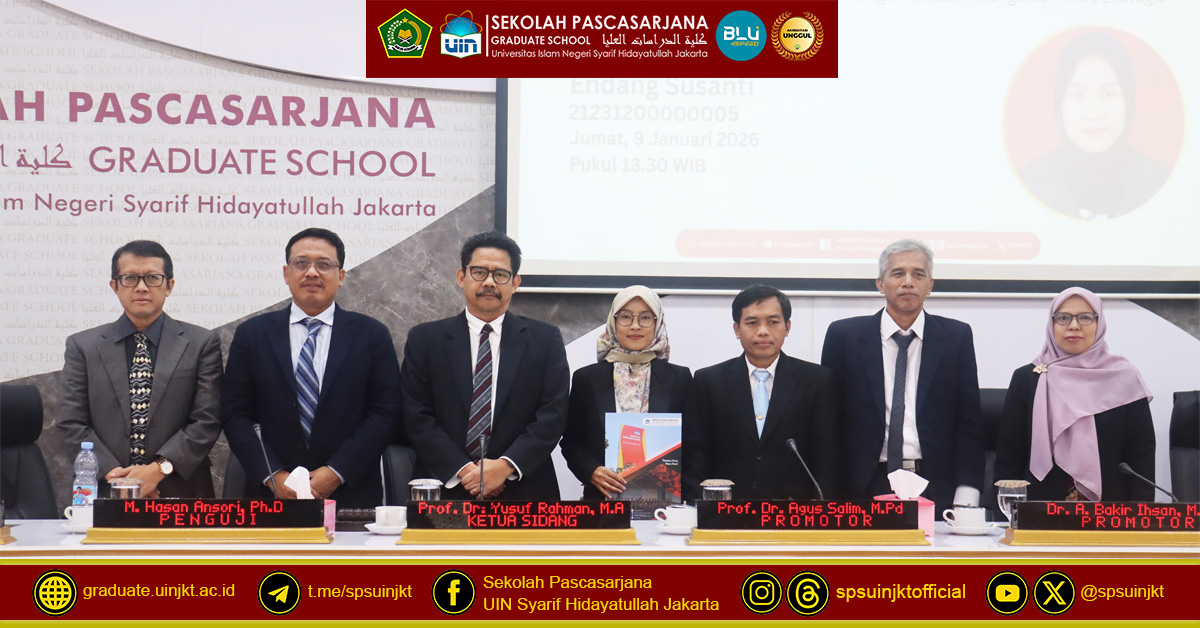
Endang Susanti Thesis Exam: The Politics of Environmental Conservation in Waqf Forests
Auditorium Prof. Dr. Suwito, MA SPs UIN Jakarta, SPs NEWS: The Graduate School of Syarif Hidayatullah State Islamic University Jakarta held the 2792nd Thesis Exam in the Auditorium Room of Prof. Dr. Suwito, MA, on Friday, January 9, 2025 with candidate Endang Susanti.
Endang is a student of the Master of Islamic Studies study program with a concentration in Islamic Political Thought. Endang wrote a thesis entitled "The Politics of Environmental Conservation in Waqf Forests (The Role of Religion-Based Civil Society in Overcoming the Ecological Crisis)".
In his presentation, Endang raised the title "The Politics of Environmental Conservation in Waqf Forests (The Role of Religion-Based Civil Society in Overcoming the Ecological Crisis)". The research was born out of anxiety about global ecological crises such as deforestation and worsening climate change, while the role of states and market mechanisms is often considered to have failed to provide sustainable solutions because they are stuck on the orientation of short-term economic growth.
The main focus of this research is to analyze the phenomenon of waqf forests as a religion-based social movement that emerged as a concrete response to environmental degradation. Endang specifically dissected the role of the Bogor Waqf Forest Foundation in developing this idea, where religious sacred values are transformed into real actions to save the earth through a conservation land waqf scheme.
Using a qualitative method with a phenomenological approach, Endang collected data through in-depth interviews, field observations, and comprehensive documentation. As a result, this study succeeded in photographing the practice of waqf forests as a unique collective action because it is able to integrate three pillars at once: theological values, environmental conservation, and local community empowerment.
Endang's analysis based on social movement theory shows that the success of waqf forests is triggered by three crucial factors, namely political opportunities, strong mobilization structures, and cultural framing. These three elements allow environmental issues that look technical to be more easily accepted by the wider community because they are wrapped in the language of faith.
Interestingly, this thesis highlights that the weakening of state effectiveness in environmental governance, which is often characterized by pro-investment policies and top-down approaches, actually opens up strategic gaps. This empty space left by the state is filled by non-state actors such as the Bogor Waqf Forest Foundation to offer a more organic alternative environmental preservation model.
In academic discourse, Endang's findings provide an antithesis to Tetiana Kyselava's research that civil society tends to be weak due to political repression or financial dependence. On the contrary, waqf forests in Bogor prove their independence through the integration of ecological conservation models combined with economic empowerment and a strong social da'wah mission.
This research is in line with the thinking of Jens Koehrsen who emphasizes how crucial the role of faith-based organizations is in strengthening social solidarity. Endang emphasized that religion has extraordinary potential as a basis for social transformation, where nature conservation is seen not only as an administrative obligation, but as a form of manifestation of deep faith practice.
In conclusion, this thesis reinforces the argument that waqf forests have strong moral legitimacy to answer the global ecological crisis. By taking advantage of political opportunities and self-sustaining resource mobilization, waqf forests prove that religion can be present as a sustainable force that moves beyond market interests and state bureaucracy for a greener future of the earth.
Marifat Kilwakit successfully defended her thesis under the guidance of Dr. A. Bakir Ihsan, M.Si and Prof. Dr. Agus Salim, S.Ag, M.Si, and tested in front of a board of examiners consisting of Prof. Dr. Yusuf Rahman, MA, Dr. A. Bakir Ihsan, M.Si, Prof. Dr. Agus Salim, S.Ag, M.Si, M. Zaki Mubarak, M.Si, Ph.D and Mohammad Hasan Ansori, Ph.D.
After paying attention to the thesis writing, the comments of the examiner team and the candidate's answers, the examiner team determined that Endang Susanti graduated with the title of Very Satisfactory. Endang Susanti is the 2792nd master in the field of Islamic Studies, in the master's program of the Graduate School of UIN Syarif Hidayatullah Jakarta. (JA)