
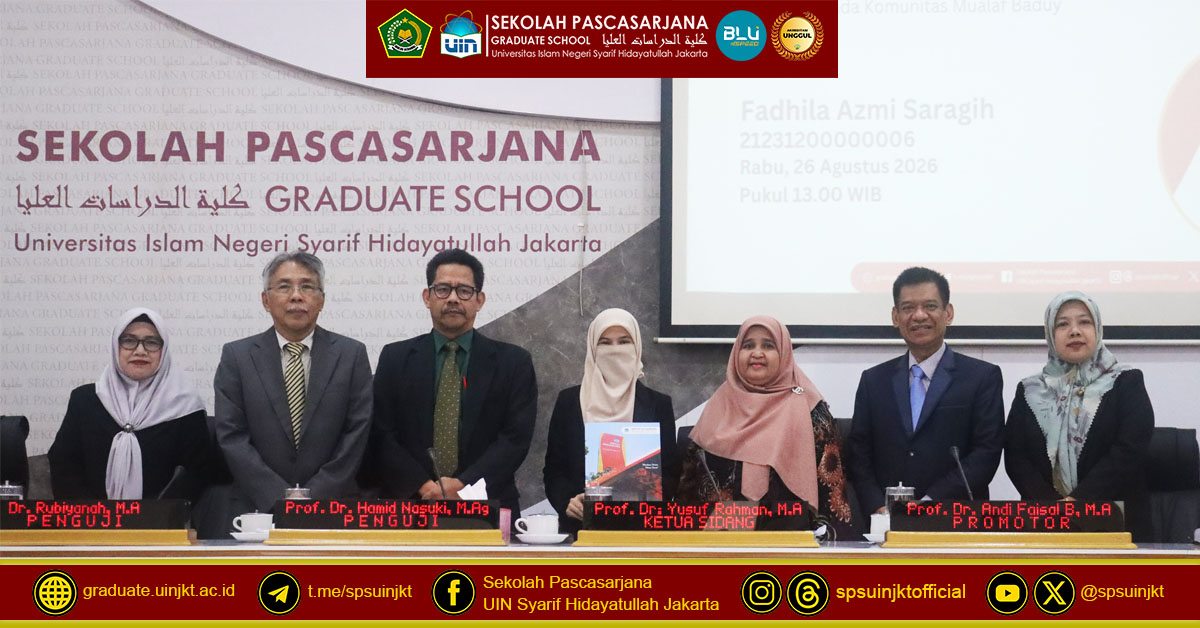
Fadhila Azmi Saragih's Thesis Exam, Synthesis of Cultural Da'wah in the Land of Baduy: Muhammadiyah Institutional Structuring, NU Personal Closeness
Auditorium of Prof. Dr. Suwito, MA SPs UIN Jakarta, SPs NEWS - The Graduate School (SPs) of UIN Syarif Hidayatullah Jakarta held the 2840th Thesis Exam at the Auditorium Room of Prof. Dr. Suwito, MA SPs UIN Jakarta on Wednesday, August 26, 2026 with candidate Fadhila Azmi Saragih.
Fadhila is a student of the Master of Islamic Studies program with a concentration in Da'wah and Communication, her thesis is entitled "Communicative Cultural Da'wah Strategy of the Muhammadiyah Central Executive Community Da'wah Institution and Nahdlatul Ulama in the Baduy Converts Community".
This qualitative-based field research is designed to uncover in detail how the Community Da'wah Institute (LDK) of Muhammadiyah Central Government and Nahdlatul Ulama (NU) da'wah leaders carry out da'wah activities in the midst of the Baduy traditional converts community. Through the constructivism paradigm and ethnomethodological approach, Fadhila explores the construction of da'wah communication that is built from the meaning of local culture.
To obtain precise data, primary data collection is carried out directly in the field through in-depth observation, intensive interviews, and authentic documentation. The researcher also strengthens his analysis using secondary data from relevant literature reviews so that the foundation of his academic argument is more solid.
Theoretically, this research combines two main frameworks of thought. The adjustment of the communication patterns of the dai was analyzed using Communication Accommodation Theory from Howard Giles, while the process of interpreting the symbols and customary values of the Baduy people was read through the perspective of Clifford Geertz's Cultural Interpretation.
The findings of this research indicate that both Muhammadiyah and NU apply the convergence of communication and symbolic reinterpretation, but have a very distinctive character and orientation approach. This difference in style shows the rich dynamics of Islamic da'wah in customary territories.
Muhammadiyah is recorded as choosing a convergence path that is structural-institutionally oriented. This approach is manifested through the assignment of official dai, the alignment of local languages and symbols, which is balanced with selective divergence, namely taking a firm distance from customary practices that are considered detrimental or not in line with sharia principles.
On the contrary, NU prioritizes relational-personal convergence that relies on individual example and closeness. NU da'wah leaders chose a culturalization strategy by maintaining the sustainability of local traditions, while inserting an emphasis on new religious meanings gradually, naturally, and organically.
This research confirms the main argument that the benchmark for the success of cultural da'wah does not actually lie in the formality of the institution or the personal popularity of the dai. The main key is the consistency of communication adjustment and the depth of cultural interpretation, so that Islamic values can be absorbed as an integral part of the pulse of indigenous peoples' lives.
The results of Fadhila's research also enrich the existing academic discourse. Unlike Komarudian (2021) who sees the relationship between Islam and Baduy as limited to a conversion process with religious status as the end point, this study positions cultural da'wah as a process of negotiating meaning that continues to flow. This research also expands on the findings of Arianto (2021) on the importance of language accommodation and Fauzi (2024) on the central role of da'wah communication, by presenting a new theoretical synthesis: that communication accommodation and cultural interpretation are two sides of the currency that complement each other in the strategy of cultural da'wah.
Fadhila successfully defended her thesis under the guidance of Prof. Dr. Andi Faisal Bakti, MA, and was tested in front of a board of examiners consisting of Prof. Dr. Yusuf Rahman, MA, Prof. Dr. Andi Faisal Bakti, MA, Prof. Dr. Hamid Nasuki, M.Ag, Dr. Rubiyanah, MA.
After paying attention to the thesis writing, the comments of the examiner team and the candidate's answers, the examiner team determined that Fadhila graduated with the predicate of Very Satisfactory. Fadhila Azmi Saragih is the 2840th Master in the field of Islamic Studies, in the Master's program of the Graduate School of UIN Syarif Hidayatullah Jakarta. (Jay A)