
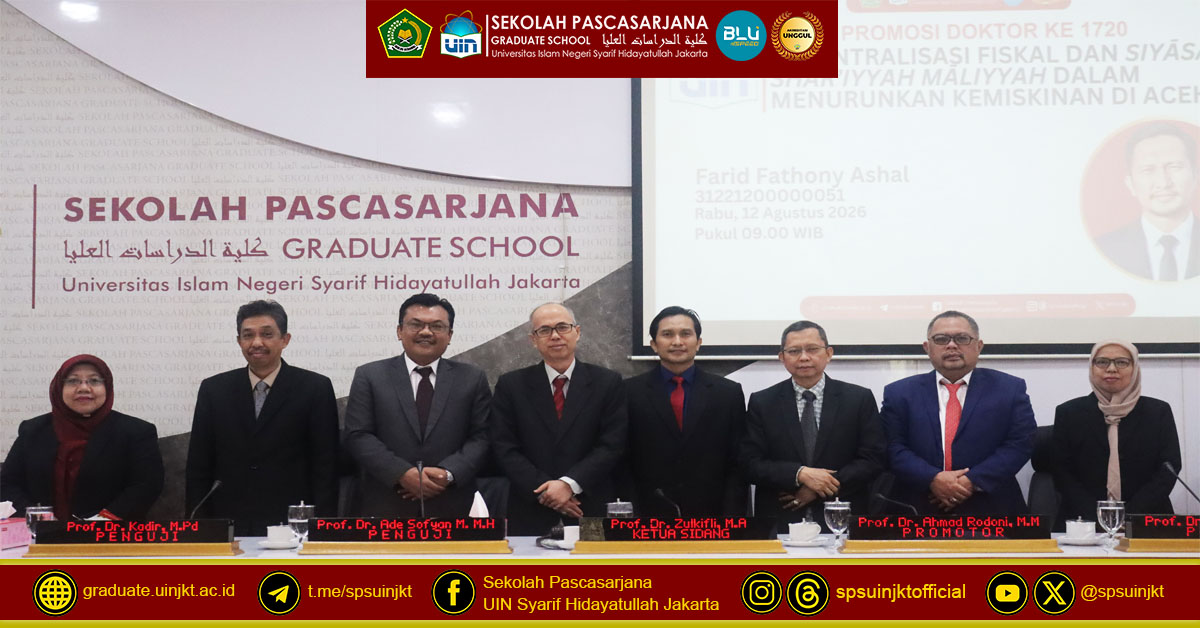
Farid Fathony Ashal's Doctoral Promotion Exam, Fiscal Decentralization and Siyāsah Shar'iyyah Māliyyah in Reducing Poverty in Aceh
Auditorium of Prof. Dr. Suwito, MA SPs UIN Jakarta, SPs NEWS – The Graduate School (SPs) of UIN Syarif Hidayatullah Jakarta held the 1720th Doctoral Promotion Exam in the Auditorium Room of Prof. Dr. Suwito, MA Graduate School on Wednesday, August 12, 2026 with promovendus Farid Fathony Ashal.
Farid is a student of the Doctoral program in Islamic Studies with a concentration in Islamic Economics. His dissertation is entitled "Fiscal Decentralization and Siyāsah Shar'iyyah Māliyyah in Reducing Poverty in Aceh".
Aceh Province is still facing the public with a development paradox that is quite attention-grabbing. Despite having a special autonomy status with an abundant flow of transfer funds and the comprehensive implementation of a sharia-based economic system, Aceh still survives as the province with the highest poverty rate on the island of Sumatra.
In his presentation, Farid highlighted that Islamic financial transformations such as the conversion of Bank Aceh Syariah to the implementation of the Qanun of Sharia Financial Institutions (LKS) have not had a significant direct impact on reducing poverty rates. The region's fiscal capacity, which soared after the Helsinki MoU, has not been able to unravel the roots of poverty that has settled for more than a decade.
In order to dissect these dynamics, this study uses a mixed method approach with an exploratory sequential design. The research began with qualitative exploration through observation, in-depth interviews, documentary studies, and literature review, which was then continued with quantitative testing based on Structural Equation Modeling Partial Least Squares (SEM-PLS) using time series data for the period 2012–2024.
In the model structure, the Fiscal Decentralization variable is measured through the indicator of transfer funds or central balance funds. Meanwhile, the variables of Siyāsah Shar'iyyah Māliyyah are comprehensively constructed into seven main dimensions, namely maṣlaḥah (benefit), allocation, rationality, flexibility, qānūn (regulation), ḥisbah (supervision), and tanmiyah (development).
The results of quantitative and qualitative analysis reveal that the implementation of Fiscal Decentralization in Aceh has so far been predominantly administrative. As a result, the existence of new regional transfer funds is able to encourage economic transformation at a moderate level and is not sharp enough to alleviate people from poverty.
On the other hand, the Shi'āsah Shar'iyyah Māliyyah has been shown to have a negative and significant effect on the poverty rate. These findings confirm that when sharia-based financial governance values and instruments are applied substantively, these variables are visibly able to reduce poverty rates in the regions.
Overall, the integrative model built in this study was able to explain 36.3% of the variation in poverty reduction in Aceh. Although the mediation role of sharia governance is at a near-moderate level, fiscal decentralization has been shown to have a very strong correlation with the strengthening of the implementation of Siyāsah Shar'iyyah Māliyyah.
Through these findings, Farid concluded that strengthening Siyāsah Shar'iyyah Māliyyah can be the main key to increasing the effectiveness of fiscal decentralization in Aceh. However, such integration requires a more consistent governance commitment, budget accountability, targeted program allocation, and strong regional institutions in order to produce a real economic impact on the community.
Farid successfully defended his dissertation under the guidance of Prof. Dr. Ahmad Rodoni, MM, Prof. Dr. M. Arief Mufraini, Lc., M.Si, and was tested in front of a board of examiners consisting of Prof. Dr. Zulkifli, MA, Prof. Dr. Ahmad Rodoni, MM, Prof. Dr. M. Arief Mufraini, Lc., M.Si, Prof. Dr. Ade Sofyan Mulazid, S.Ag, MH, Prof. Dr. Kadir, M.Pd, Prof. Dr. Afidah Wahyuni M.Ag.
After paying attention to the writing of the dissertation, the comments of the examiner team and the answers of the promovendus, the examiner team determined that Farid graduated with the title of Very Satisfactory. Farid Fathony Ashal is the 1720th Doctor in the field of Islamic Studies, doctoral program at the Graduate School of UIN Syarif Hidayatullah Jakarta. (Jay A)