
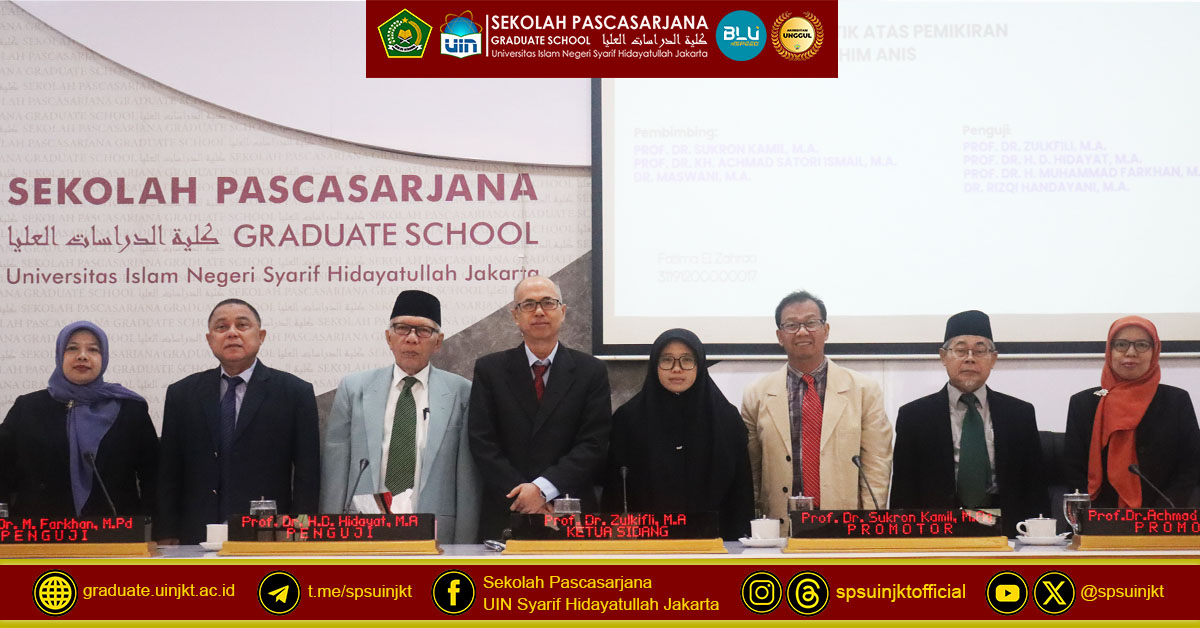
Fatima El Zahraa's Doctoral Promotion Test, Phonetic Variations of Arabic in Social Contexts
Auditorium of Prof. Dr. Suwito, MA SPs UIN Jakarta, SPs NEWS – The Graduate School (SPs) of UIN Syarif Hidayatullah Jakarta held the 1709th Doctoral Promotion Exam in the Auditorium Room of Prof. Dr. Suwito, MA on Thursday, July 30, 2026 with promovenda Fatima El Zahraa.
Fatima is a student of the Doctoral program in Islamic Studies with a concentration in Arabic Language Education. His dissertation is entitled "Phonetic Variations of Arabic in Social Contexts: A Sociolinguistic Study of the Thought of Sibawayh and Ibrāhīm Anīs". This research is here to answer the challenge of monodiscipline in the study of Arabic language which often separates pure linguistic structure from the social phenomena of the speaking community.
In her presentation, Fatima explained that this study aims to bridge the thinking of two great figures across eras: Sibawayh from the classical era and Ibrahim Anis from the modern era. His main focus is to examine the common points and differences in points of view between the two, as well as interpret the social backgrounds that influence the concepts of phonetic variations such as fatḥ, imālah, hamz, and idgām.
Although juxtaposed two great thinkers, this study does not assume the existence of equality of historical context in a raw way. The differences in the intellectual landscape, namely the Hellenistic influence in the Sibawayh era and the wave of modernism and the value of liberty in the era of Ibrahim Anis are positioned as an epistemic framework that formulates the ideas of each figure on the same object of study.
Methodologically, this study is designed as a literature study with a qualitative sociolinguistic approach. Fatima excavated the main data from the monumental works Kitāb Sibawayh and Fī al-Lahajāt al-'Arabiyyah by Ibrahim Anis. To strengthen the analysis, the data was read through the lens of Émile Durkheim's sociology, especially the concept of social facts and collective representation, and was triangulated with variations of Qur'anic qiraat and open-access datasets.
The results of the study show that Sibawayh and Ibrahim Anis agree that fatḥ, imālah, hamz, and idgām are real phonetic phenomena in the reality of Arabic speech. However, the two are opposite in terms of epistemological foundations, study objectives, and data sources. Sibawayh focuses on formulating the rules of the standard language (fusha), while Ibrahim Anis sees these variations as a scientific-natural phenomenon in the Arabic dialect that is analyzed descriptively.
Fatima concluded that the thoughts of these two linguists do not negate each other, but are complementary or complementary. Sibaldh's normative approach remains a crucial role as the main foundation of Arabic grammar, while Ibrahim Anis's descriptive view manages to broaden the horizons in understanding the dynamics of dialects and the use of Arabic in the modern era.
This research also enriches the sociolinguistic literature by strengthening the ranks of previous studies, such as the works of Alfozan (2024) and Sara (2019) related to classical phonetic studies, to the theory of social variation by Labov (1969, 1991). On the other hand, Fatima's findings expressly reject the views of Magidow (2021) and Owens (2006) who tend to separate dialectal variations from the socio-religious dimension of Arab society.
Furthermore, this dissertation succeeded in proving that the variation of speech sounds (phonetics) functions as a social fact that lives in society. Meanwhile, the conceptualization and grammatical formulation produced by linguists is essentially a form of collective representation of academic communities bound by their respective spaces and times.
As a practical implication, Fatima recommends a reorientation in today's Arabic language learning. Arabic language learning is encouraged to position phonetic variations proportionally in their socio-historical context without ignoring the strictness of linguistic rules, so as to be able to foster a complete sociolinguistic awareness for learners.
Fatima successfully defended her dissertation under the guidance of Prof. Dr. Sukron Kamil, M.Ag, Prof. Dr. Achmad Satori Ismail, MA, Dr. Maswani, MA, and was tested in front of a board of examiners consisting of Prof. Dr. Zulkifli, MA, Prof. Dr. Sukron Kamil, M.Ag, Prof. Dr. Achmad Satori Ismail, MA, Dr. Maswani, MA, Prof. Dr. H.D. Hidayat, MA, Prof. Dr. Muhammad Farkhan, M.Pd, Dr. Rizqi Handayani, MA.
After paying attention to the dissertation writing, the comments of the examiner team and the promovenda's answers, the examiner team determined that Fatima graduated with the title of Very Satisfactory. Fatima El Zahraa is the 1709th Doctor in the field of Islamic Studies, a doctoral program at the Graduate School of UIN Syarif Hidayatullah Jakarta. (Jay A)