
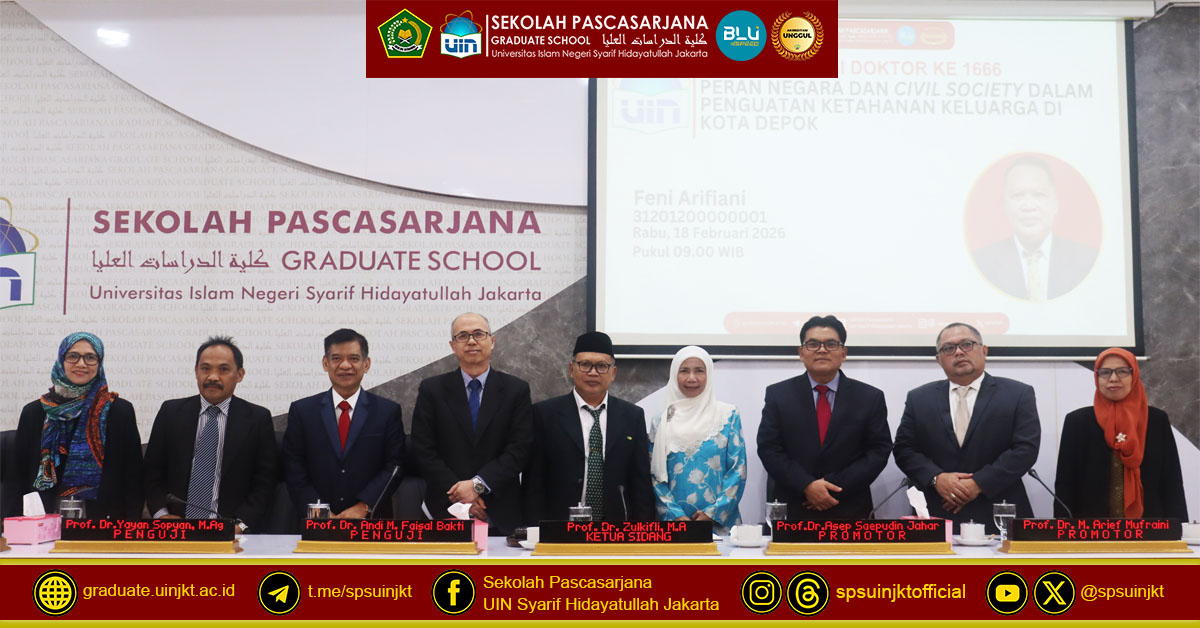
Feni Arifiani Doctoral Promotion Exam: The Role of the State and Civil Society in Strengthening Family Resilience in Depok City
Auditorium of Prof. Dr. Suwito, MA SPs UIN Jakarta, SPs NEWS – The Graduate School (SPs) of UIN Syarif Hidayatullah Jakarta held the 1666th Doctoral Promotion Exam in the Auditorium Room of Prof. Dr. Suwito, MA on Wednesday, February 18, 2026 with promovendus Feni Arifiani.
Feni is a student of the Doctoral program in Islamic Studies with a Concentration in Sharia. His dissertation is entitled "The Role of the State and Civil Society in Strengthening Family Resilience in Depok City". This research was born out of academic anxiety about the complexity of the challenges faced by Muslim families in increasingly dynamic urban areas.
The main objective of this in-depth research is to critically analyze how the roles of the state and civil society organizations intersect with each other. Feni dissects this phenomenon through various levels of systems, ranging from microsystems, mesosystems, ecosystems, to macrosystems, to map the ideal family resilience ecosystem.
More than just photographing structures, this study examines the changing functions and social dynamics of urban Muslim families. Feni highlighted how government regulations and initiatives of interfaith community organizations (CSOs) interact in building resilient, adaptive, and socially just resilience.
The main idea carried out in this study is based on the assumption that family resilience is not single. A family's success in dealing with shocks is not only determined by the internal dynamics of the household, but is also strongly influenced by the interaction of public policies and socio-religious initiatives.
In his frame of mind, Feni positions the state as a regulator and facilitator in charge of setting the direction of development. Meanwhile, civil society is present as a value engine, a guardian of solidarity, and a motor of moral participation in a heterogeneous society.
The synergy between these two major actors is considered crucial in forming a strong family organizational and communication pattern. Through the integration of religiosity values, policy support, and community solidarity, urban Muslim families are expected to be able to adapt to rapidly changing social changes.
The methodology used in this research is qualitative, descriptive-analytical with an empical perspective. Feni conducted a data dive through in-depth interviews with various parties, ranging from government officials, judicial officials, to family service managers and beneficiary communities.
The field data is then combined with secondary data in the form of national and regional regulations. All data were analyzed inductive-deductively using a sharp analytical knife from the theoretical framework of Walsh, Bronfenbrenner, Janoski, to the perspective of Maqāṣid al-sharī'ah.
The findings of the study reveal an interesting fact that family resilience in Depok City is a product of layered interactions. The state plays a role in providing normative tools through various flagship programs such as Pre-Marriage Schools (SPN), Marriage Guidance (Bimwin), PUSPAGA, to social assistance such as PKH and BPNT.
On the other hand, civil society takes a role in internalizing essential values such as sakinah, mawaddah, wa rahmah. This is done massively through educational channels, self-counseling services, and community-based economic empowerment programs.
This research strongly supports the idea of experts regarding the urgency of premarital education, but Feni rejects the existence of a monopoly of a single role by the state. For him, reducing the family only as an object of policy or a market commodity is a mistake that must be avoided.
As a theoretical contribution, this research emphasizes the importance of Islamic family law reconstruction and the strengthening of productive philanthropy. This is considered a long-term solution to provide more real protection for vulnerable groups in society.
This study concludes that strengthening family resilience in the future requires an equal partnership between the state and society as policy co-creators. In addition, there is a need to update the family education curriculum that is more inclusive, gender-sensitive, and responsive to mental health and digital literacy issues.
Feni successfully defended her dissertation under the guidance of Prof. Asep Saepudin Jahar, MA, Ph.D, Prof. Dr. M. Arief Mufraini, Lc., M.Si, Prof. Nur Hidayah, S.Ag, SE, MA, MA, Ph.D, and was tested in front of a board of examiners consisting of Prof. Dr. Zulkifli, MA, Prof. Asep Saepudin Jahar, MA, Ph.D, Prof. Dr. M. Arief Mufraini, Lc., M.Si, Prof. Nur Hidayah, S.Ag, SE, MA, MA, Ph.D, Prof. Dr. Andi Faisal Bakti, MA, Prof. Dr. Dzuriyatun Toyibah, M.Si, MA, Prof. Dr. Yayan Sopyan, SH, M.Ag.
After paying attention to the dissertation writing, the comments of the examiner team and the promovendus' answers, the examiner team determined that Feni Arifiani graduated with the title of Very Satisfactory. Feni Arifiani is the 1666th Doctor in the field of Islamic Studies, a doctoral program at the Graduate School of UIN Syarif Hidayatullah Jakarta. (JA)