
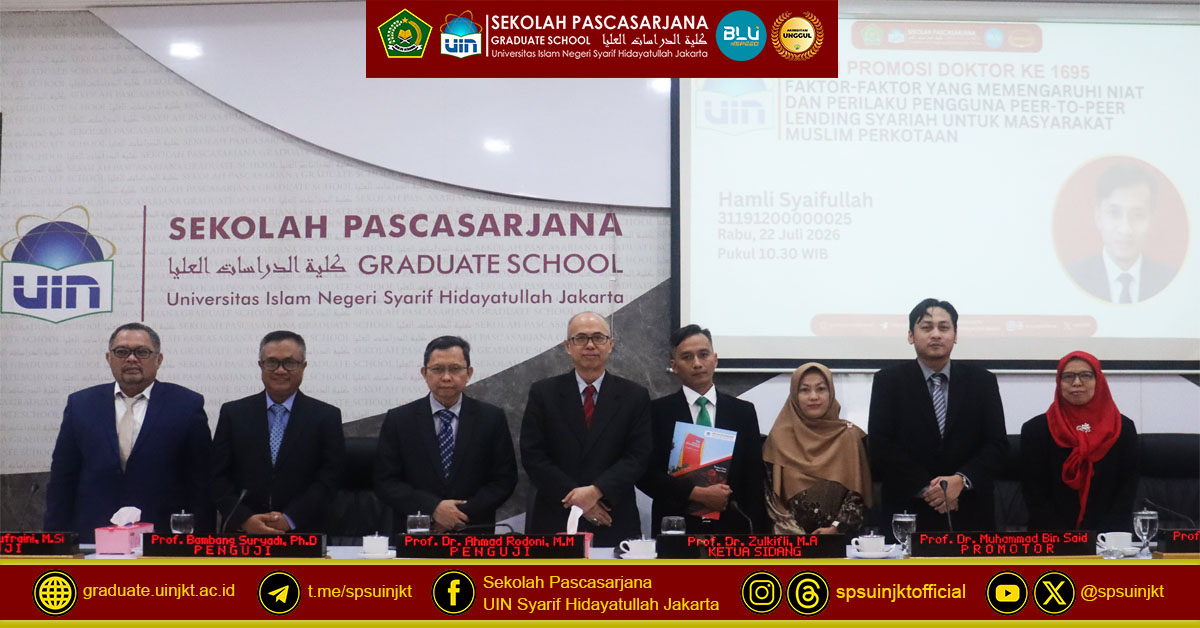
Hamli Syaifullah's Doctoral Promotion Exam, Factors Influencing the Intentions and Behaviors of Sharia Peer-to-Peer Lending Users for Urban Muslim Communities
Auditorium of Prof. Dr. Suwito, MA SPs UIN Jakarta, SPs NEWS – The Graduate School (SPs) of UIN Syarif Hidayatullah Jakarta held the 1695th Doctoral Promotion Exam in the Auditorium Room of Prof. Dr. Suwito, MA on Wednesday, July 22, 2026 with promovendus Hamli Syaifullah.
Hamli is a student of the Doctoral program in Islamic Studies with a concentration in Islamic Banking and Financial Management. His dissertation is titled "Factors Influencing the Intentions and Behaviors of Sharia Peer-to-Peer Lending Users for Urban Muslim Communities".
This study specifically analyzes the factors that drive the intention and acceptance of sharia lending peer-to-peer (P2P) user behavior among urban Muslim communities by integrating the shari'ah compliance and religiosity variables into the UTAUT3 Model.
In order to produce comprehensive findings, Hamli applied a mixed methods approach that combines quantitative and qualitative analysis. Quantitative data collection was carried out through the distribution of questionnaires to 450 respondents who are users of sharia P2P lending in the Jakarta, Bogor, Depok, Tangerang, and Bekasi (Jabodetabek) areas.
Meanwhile, qualitative data was collected through in-depth interviews with key informants representing various stakeholders. The informants include active users, sharia P2P lending industry players , regulators, academics, and Islamic economics and finance practitioners.
Quantitative data processing was tested using the Partial Least Squares-Structural Equation Modeling (PLS-SEM) technique. On the other hand, qualitative data is analyzed using the Miles & Huberman interactive model which is strengthened by a cross-sectoral data triangulation process to maintain the validity and depth of the analysis.
The results of the quantitative analysis show that social influence, hedonic motivation, habit, and sharī'ah compliance are proven to have a positive and significant influence on behavioral intention. These factors are the main drivers of public interest in sharia P2P lending platforms.
Furthermore, the findings of the study confirm that sharī'ah compliance, religiosity, and behavioral intention have a positive and significant effect on use behavior . This proves that the aspect of sharia compliance and the level of religiosity of a person is not just a formality, but the main determinant in transaction decisions.
In terms of demographics, this study maps the main profiles of sharia P2P lending users in urban areas. The majority of users are Muslim people from Generation Z and Generation Y who live in the capital city of Jakarta with a high school to undergraduate education background.
Hamli affirms his main argument that the existence of sharī'ah compliance and religiosity factors make a real contribution to the formation of actual user behavior. Therefore, strengthening the implementation of sharia principles and mapping religious consumers is a key strategy to expand the market share of sharia fintech in the country.
These findings also strengthen previous research from Maria Todorof, Mohammad Nur Rianto Al Arif and Dede Yati, as well as Ade Sofyan Mulazid et al., who stated that sharia compliance is an essential foundation that should not be ignored in the sharia P2P lending industry.
Theoretically, this research provides a new scientific contribution in the form of the formation of the UTAUT Sharia Model as a development of the UTAUT3 model (Farooq et al., 2017), UTAUT2 (Venkatesh et al., 2012), and UTAUT1 (Venkatesh & Davis, 2003). Practically, this finding is a strategic reference for industry players to design product and marketing innovations that are more focused on the characteristics of Generation Z and Generation Y.
Hamli successfully defended his dissertation under the guidance of Prof. Dr. Muhammad Bin Said, Prof. Dr. Muhammad Nur Rianto Al Arif, M.Si, and was tested in front of a board of examiners consisting of Prof. Dr. Zulkifli, MA, Prof. Dr. Muhammad Bin Said, Prof. Dr. Muhammad Nur Rianto Al Arif, M.Si, Prof. Dr. Ahmad Rodoni, MM, Prof. Dr. M. Arief Mufraini, Lc., M.Si, Prof. Bambang Suryadi, Ph.D.
After paying attention to the writing of the dissertation, the comments of the examiner team and the answers of the promovendus, the examiner team determined that Hamli Syaifullah graduated with the title of Very Satisfactory. Hamli Syaifullah is the 1695th Doctor in the field of Islamic Studies, a doctoral program at the Graduate School of UIN Syarif Hidayatullah Jakarta. (Jay A)