
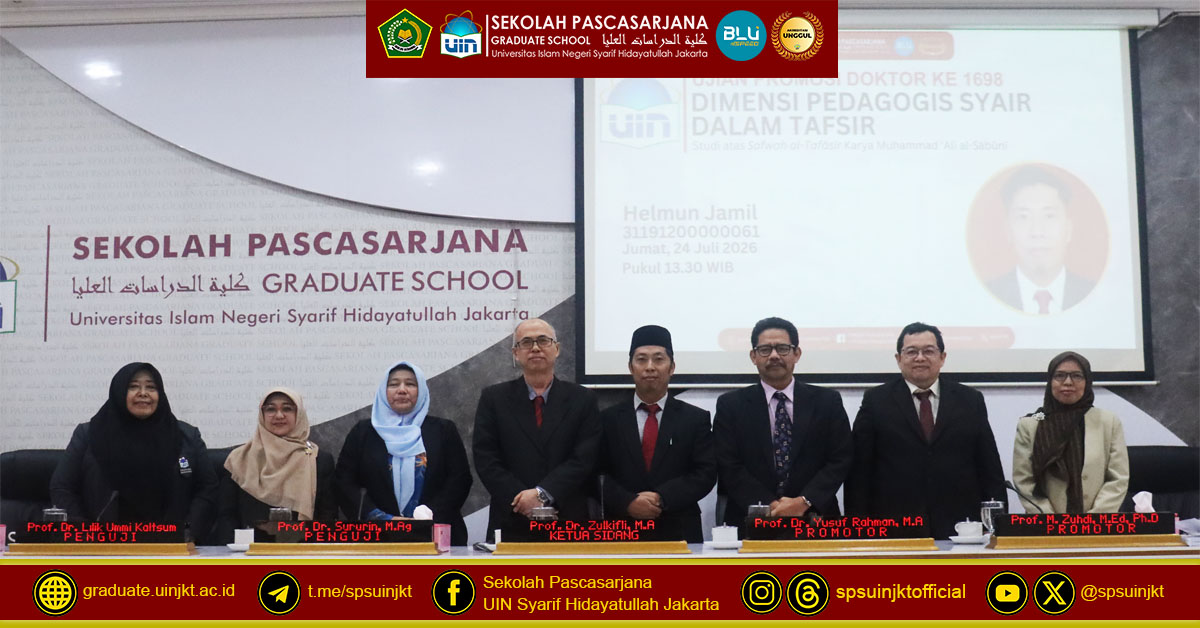
Helmun Jamil's Doctoral Promotion Test, The Pedagogical Dimension of Poetry in Tafsir
Auditorium of Prof. Dr. Suwito, MA SPs UIN Jakarta, SPs NEWS – The Graduate School (SPs) of UIN Syarif Hidayatullah Jakarta held the 1698th Doctoral Promotion Exam in the Auditorium Room of Prof. Dr. Suwito, MA on Friday, July 24, 2026 with promovendus Helmun Jamil.
Helmun is a student of the Doctoral program in Islamic Studies with a concentration in Interdisciplinary Interpretation. His dissertation is entitled "The Pedagogical Dimension of Poetry in Tafsir: A Study of Ṣafwah al-Tafāsīr by Muḥammad 'Alī al-Ṣābūnī".
Its main focus is simple but sharp: to unravel how the Arabic verses embedded in the book of Ṣafwah al-Tafāsīr are not mere ornaments of language, but an effective medium in transmitting the noble values of the Qur'an to its readers.
Specifically, the study is designed to answer three main missions. First, to unravel the stylistic and semiotic structure of poetry in forming the pedagogical dimension of interpretation. Second, to map precisely the educational values contained in it. Third, it explains the construction and operational function of the pedagogical dimension of the poem when transforming the divine teachings into the reader's heart.
Using a qualitative approach based on literature review, Helmun made the book Ṣafwah al-Tafāsīr as the main estuary of his analysis. A total of 44 verses spread across three special segments of Fawā'id, Laṭā'if, and Tanbīhāt are carefully dissected. Uniquely, this study applies a dialectical approach that treats each verse as a test case for its own theoretical framework, rather than simply matching theory with text.
The analysis framework used is also fairly comprehensive. From a stylistic perspective, Helmun dissects the diction, metaphors, imagery, irony, and rhetorical structure of the verses. Meanwhile, from the point of view of Charles Sanders Peirce's semiotics, he traces the flow of representation-object-interpretant and the categorization of signs ranging from qualisigns to symbols. All of these findings were then combined with Islamic education theory, including the concept of internalization of value in three stages (transformation, transaction, and transinternalization).
From this academic hard work, Helmun made three major findings. First, the interaction between stylistics and semiotics turns out to give birth to a distinctive pedagogical pattern in each of its segments: normative-didactic in the Fawā'id segment, reflective-symbolic in Laṭā'if, and corrective-instructional in Tanbīhāt. Interestingly, this pedagogical dimension is born from the dynamic tension between theory and the reality of the text, not from the rigid imposition of theory.
The second finding reveals that the verses in Ṣafwah al-Tafāsīr carry the five groups of Islamic educational values in their entirety. These groups include the values of tarbiyah īmāniyyah (faith), akhlāqiyyah (morals), rūḥiyyah (spiritual), 'aqliyyah (intellectual), and ijtimā'iyyah (social). This means that the poem verses in it are able to summarize the entire spectrum of needs for the formation of human character.
In the third finding, it was revealed that the pedagogical construction of poetry works through three main functions: value transmission, reflection of meaning, and clarification-correction. These functions revolve in an achievement-based cycle, starting from setting value targets, designing verse-interpretation-verse narratives, activating semiotic signs, the process of reception by readers, to evaluation. Uniquely, this process honestly accommodates variations in outcomes, such as interruptions and limited representation as a legitimate part of learning dynamics.
In terms of scientific maps, this research strengthens the view of Nurhamim (2017) regarding the role of Arabic poetry as a medium for value education. However, Helmun went further methodologically. He reads verses as an integral part of the structure of interpretation, not just an independent literary text that stands alone as studied by Nurhamim or Juwariyah (2008).
On the other hand, this research is in line with the findings of Mukhlis (2023), Jauhar Azizy (2021), Sherly Devani et al. (2017), Rahmad Sani (2017), and Muhammad Arsyad Nastiar (2023) who dissect Ṣafwah al-Tafāsīr from the perspective of hermeneutics, munāsabah, to balagah. However, the position is different from the studies of Abdul Halim, Kafrawi (2026), Nurul Habiburrahmanuddin (2022), and Ach. Jamiluddin (2020) who positions the Qur'an and tafsir as a source of value without placing poetry as the main object of study.
The culmination of this dissertation was the birth of the idea of "edu-poetic Qur'ani". An achievement-based reading model that places poetry as an aesthetic, semiotitic, and pedagogical device.
Helmun successfully defended his dissertation under the guidance of Prof. Dr. Yusuf Rahman, MA, Prof. Muhammad Zuhdi, M.Ed, Ph.D, and was tested in front of a board of examiners consisting of Prof. Dr. Zulkifli, MA, Prof. Dr. Yusuf Rahman, MA, Prof. Muhammad Zuhdi, M.Ed, Ph.D, Prof. Dr. R. Yani'ah Wardani, M.Ag, Prof. Dr. Sururin, M.Ag, Prof. Dr. Lilik Ummi Kaltsum, MA.
After paying attention to the dissertation writing, the comments of the examiner team and the answers of the promovendus, the examiner team determined that Helmun Jamil graduated with the predicate of Very Satisfactory. Helmun Jamil is the 1698th Doctor in the field of Islamic Studies, doctoral program of the Graduate School of UIN Syarif Hidayatullah Jakarta. (Jay A)