
Hendrikus Maku's Doctoral Promotion Exam: Acculturation of Ata Wa Wae with Ata Eta Golo in the Practice of Manggarai Traditional Marriage
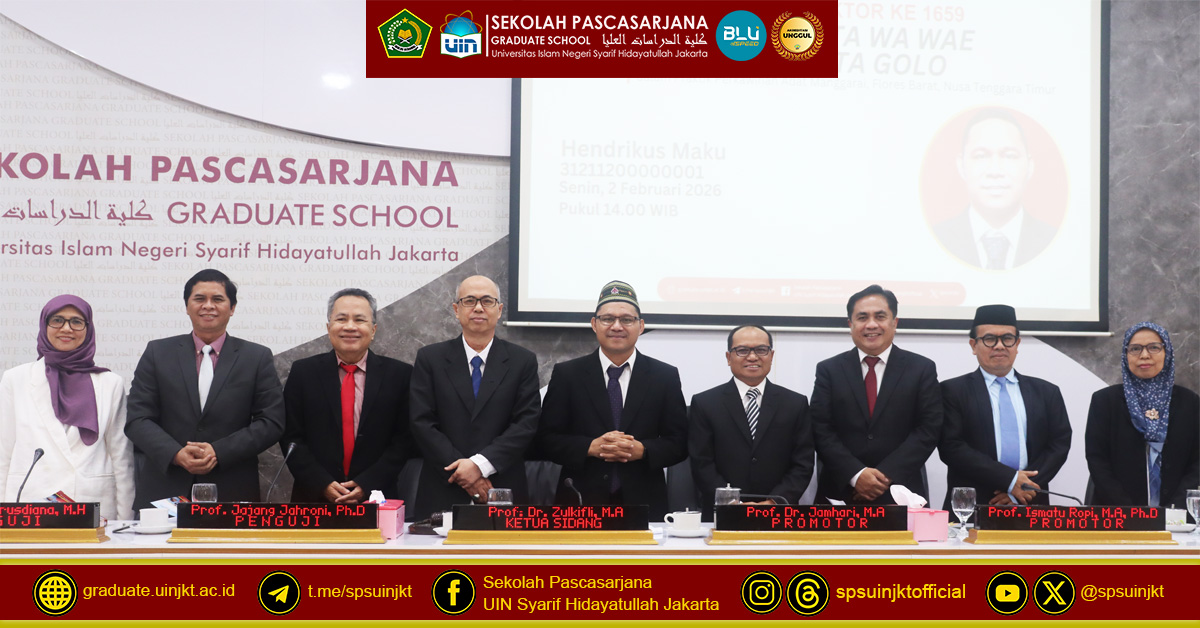
Auditorium of Prof. Dr. Suwito, MA SPs UIN Jakarta, SPs NEWS – The Graduate School (SPs) of UIN Syarif Hidayatullah Jakarta held the 1659th Doctoral Promotion Exam in the Auditorium Room of Prof. Dr. Suwito, MA on Monday, February 2, 2026 with the promovendus Hendrikus Maku.
Hendrikus is a student of the Doctoral program in Islamic Studies with a concentration in Islamic History and Civilization. His dissertation is entitled "Acculturation of Ata Wa Wae with Ata Eta Golo in the Practice of Manggarai Traditional Marriage, West Flores, East Nusa Tenggara". Hendrikus explained an in-depth research that captures the beauty of dialogue between religion and tradition in the western tip of Flores Island.
Philosophically, Hendrikus raised the term Ata wa Wae to represent the identity of Islam and Ata eta Golo for the local culture of Manggarai. This research departs from a fundamental epistemic anxiety: to what extent is Islam compatible with the cultural structure of Manggarai that has been established for centuries?
Through the lens of history, this research traces the long history of the presence of Islam in Manggarai since the 17th century. Brought through the trade and da'wah routes of the Gowa-Tallo and Bima Sultanates, Islam entered not as a conqueror of culture, but as a guest who slowly built a space for interaction with contemporary modernity.
Hendrikus uses a qualitative-ethnographic approach that is very intimate. The data were collected through participatory observation and in-depth interviews, then dissected with domain, taxonomy, and component analysis models. The result is an authentic argument that rejects a single narrative of the clash of civilizations.
In his presentation, Hendrikus emphasized that tensions between Islam and customs often overshadow the Islamization process in various regions. However, in Manggarai, conflict or harmony is highly determined by the ability of cultural structures and agents to play their ideological strategies in the field.
Interestingly, this acculturation takes place through a mechanism of symbolic reciprocity that is fluid and without the barriers of suspicion. This can be seen in the practice of dowry or belis (paca), the ritual of wagal, and traditional prayers (torok/tudak) which begin to dialogue openly with Islamic values.
This research found that Islam in Manggarai does not negate customs, but rather makes them transformative energy. The practice of local culture actually affirms the principles of Maqashid Sharia, namely maintaining religion, soul, intellect, descendants, and property, all of which are neatly wrapped in the frame of local wisdom.
The social innovations that were born were also unique, such as the replacement of sacrificial animals from pigs (ela) to goats (mbe) in traditional processions. In addition, there is an integration between traditional prayers and dhikr, as well as the reinterpretation of old symbols to be in harmony with halal principles without losing the essence of culture.
Theoretically, Hendrikus' findings further strengthen the flexibility of Islam as a religion that is ṣāliḥ li kulli zamān wa makān (relevant at all times and places). This research enriches the discourse of Islam of the archipelago while strengthening the concept of Islamic privatization which has long been a characteristic of Islam in Indonesia.
Practically, the success of this acculturation made Manggarai a portrait of Dār al-Salām or the House of Peace. There, society managed to maintain plurality firmly and collectively resist the dominance of puritanical hegemony that often fueled division.
In the midst of the onslaught of globalization and the shadow of radicalism, this study comes as a powerful counter-narrative. Hendrikus proved that religion and culture are not two poles that negate each other, but two great currents that can combine to create harmony in life.
Hendrikus interprets this acculturation as an orchestration or collaborative art without losing identity. It is in this spectacular symphony that Islam finds its most beautiful face (al-Islām jamīl): universal, humanist, and truly grounded in the land of Manggarai.
Hendrikus Maku successfully defended his dissertation under the guidance of Prof. Dr. Jamhari, MA, Prof. Ismatu Ropi, MA, Ph.D and Hamdani, M.Ag, Ph.D, and was tested in front of a board of examiners consisting of Prof. Dr. Zulkifli, MA, Prof. Dr. Jamhari, MA, Prof. Ismatu Ropi, MA, Ph.D, Hamdani, M.Ag, Ph.D, Prof. Dr. Kamarusdiana, MH, Prof. Jajang Jahroni, MA, Ph.D and Prof. Dr. Dzuriyatun Toyibah, M.Si, MA.
After paying attention to the writing of the dissertation, the comments of the examiner team and the answers of the promovendus, the examiner team determined that Hendrikus Maku graduated with the title of Very Satisfactory. Hendrikus Maku is the 1659th Doctor in the field of Islamic Studies, the doctoral program of the Graduate School of UIN Syarif Hidayatullah Jakarta. (JA)