
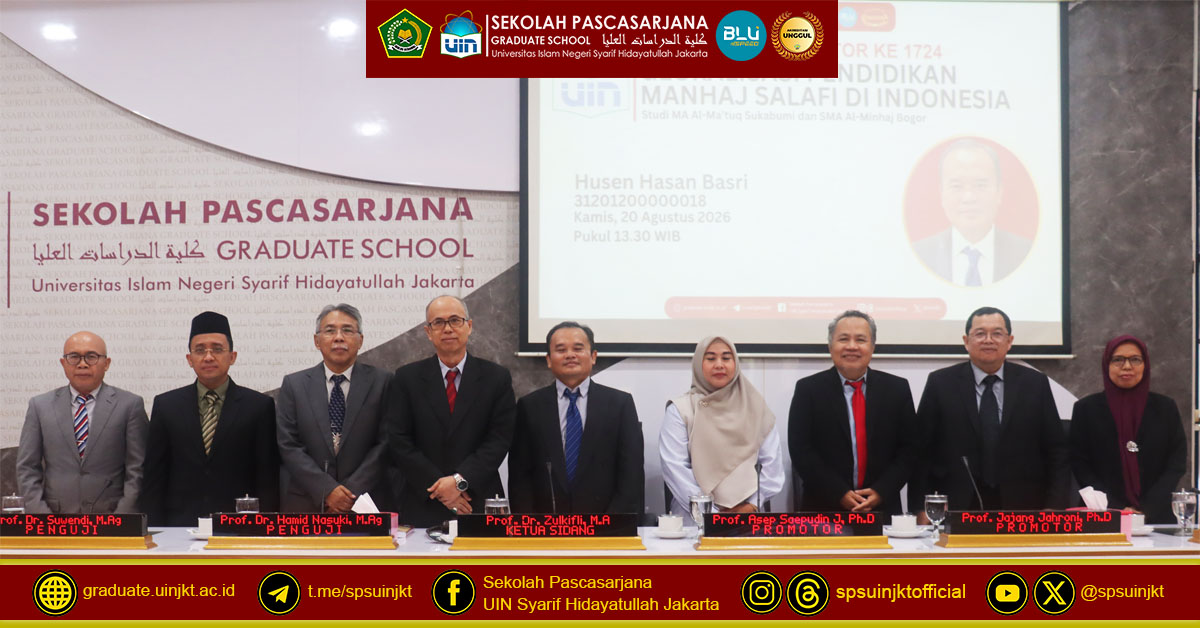
Husen Hasan Basri Doctoral Promotion Exam, Progressive Law and Obligatory Wills
Auditorium of Prof. Dr. Suwito, MA SPs UIN Jakarta, SP NEWS – The Graduate School (SPs) of UIN Syarif Hidayatullah Jakarta held the 1724th Doctoral Promotion Exam in the Auditorium Room of Prof. Dr. Suwito, MA Graduate School on Thursday, August 20, 2026 with the promovendus Husen Hasan Basri.
Husen is a student of the Doctoral program in Islamic Studies with a concentration in Sharia. His dissertation is entitled "Progressive Law and Mandatory Wills: A Study of Supreme Court Decisions in 2011-2018".
Husen's research in-depth constructs the concept of educational glocalization in salafi manhaj educational institutions in Indonesia. The main focus is on how global salafi values interact with local dynamics in Indonesia, as well as the direct impact of the glocalization process on the formation of institutional religious identity. Through this study, Husen seeks to dissect the limits of ideological adaptation in the formal education space.
Using a qualitative approach with a multi-site case study method, this research comprehensively explores primary data. Key informants involved include mudīr 'ām, foundation administrators, principals of schools or madrasas, mushrif/mushrifah, teachers, students, and the community around the institution. This data is supported by secondary documents such as books, scientific articles, and relevant supporting journals.
To gain a holistic understanding, data collection techniques are carried out through in-depth interviews, field observations, documentation studies, and digital ethnographic approaches. All the data collected were then analyzed using the theoretical framework of educational glocalization to unravel the negotiations that occurred between the idea of global salafi and the local reality of Indonesian society.
Taking the location of the research at Al-Ma'tuq MA and Al-Minhaj High School, Husen's research confirms that the global salafi value remains firmly rooted in the principles of taṣfiyah (purification of teachings) and ittibā' (adherence to the sunnah). These values are transmitted consistently through the diniyyah curriculum, the dominance of religious texts, the authority of scholars, as well as learning patterns based on memorization and textual comprehension.
Interestingly, practice in the field shows that these ideological principles are not rigidly applied. These institutions actively negotiate with government regulations, the demands of the national education system, and the social dynamics of the surrounding communities. This compromise gives birth to a form of educational hybridization that is adaptive and responsive to the demands of the times.
This form of hybridization is evident from the implementation of a dual curriculum, the use of hybrid learning methods, and institutional governance that combines traditional elements with modern management systems. This move allows the institution to maintain its primary identity while meeting applicable national education standards.
Furthermore, glocalization is realized through a wise social accommodation strategy. Salafi educational institutions apply a non-confrontational approach, build harmonious social relations with the surrounding environment, and strengthen public legitimacy. This pattern forms a hybrid and contextual religious identity, not completely imitating the global Salafism model, but also not losing its characteristic features in local culture.
Husen's dissertation concluded that these interactions gave birth to a new configuration called "glocal salafi education". This concept describes an educational model that successfully maintains the purity of religious ideology while adapting strategically to the social reality in Indonesia.
The findings of this dissertation not only confirm the early theories of experts such as Quintan Wiktorowicz, Noorhadi Hasan, and Din Wahid, but also provide important expansions and revisions. This research proves that Salafi educational movements and institutions in Indonesia have high flexibility in responding to modernization and state rules.
Husen successfully defended his dissertation under the guidance of Prof. Asep Saepudin Jahar, MA, Ph.D, Prof. Jajang Jahroni, MA, Ph.D and Prof. Muhammad Zuhdi, M.Ed, Ph.D, and was tested in front of a board of examiners consisting of Prof. Dr. Zulkifli, MA, Prof. Asep Saepudin Jahar, MA, Ph.D, Prof. Jajang Jahroni, MA, Ph.D, Prof. Muhammad Zuhdi, M.Ed, Ph.D, Prof. Dr. Hamid Nasuki, M.Ag, Prof. Dr. Suwendi M.Ag, Din Wahid, MA, Ph.D.
After paying attention to the writing of the dissertation, the comments of the examiner team and the answers of the promovendus, the examiner team determined that Husen Hasan Basri graduated with the title of Very Satisfactory. Husen Hasan Basri is the 1724th Doctor in the field of Islamic Studies, doctoral program of the Graduate School of UIN Syarif Hidayatullah Jakarta. (Jay A)