
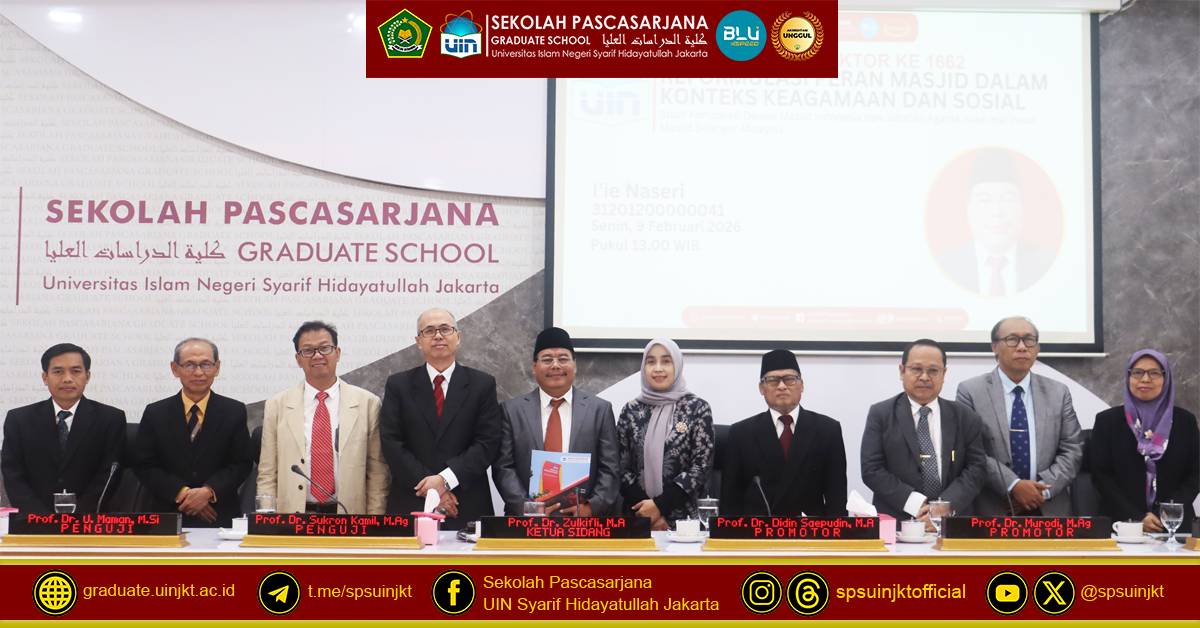
I'ie Naseri's Doctoral Promotion Exam: Reformulation of the Role of Mosques in Religious and Social Contexts
Auditorium of Prof. Dr. Suwito, MA SPs UIN Jakarta, SP NEWS – The Graduate School (SPs) of UIN Syarif Hidayatullah Jakarta held the 1662nd Doctoral Promotion Exam in the Auditorium Room of Prof. Dr. Suwito, MA on Monday, February 9, 2026 with promovendus I'ie Naseri.
I'ie is a student of the Doctoral program in Islamic Studies with a Concentration in Sharia. His dissertation is entitled "Reformulation of the Role of Mosques in the Religious and Social Context (Comparative Study of Indonesian Mosque Councils and Islamic Religious Positions in Selangor Mosque Affairs, Malaysia)".
This research was born from academic anxiety about the extent to which mosques are currently able to carry out their function as a center of civilization, as exemplified by the Prophet Muhammad SAW.
In his presentation, I'ie emphasized that the presence of the Indonesian Mosque Council (DMI) carries a big mission to restore the mosque as the center of community activities. The main focus of this research is to dissect how the role of mosques is reformulated so that it is not only a place for mahdah worship rituals, but also a driving force for solutions to social problems in society.
This study uses comparative glasses by comparing two major institutions in two cognate countries, namely DMI in Indonesia and the Selangor Islamic Religious Department (JAIS) in Malaysia. Through a qualitative approach, I'ie conducted an in-depth observation to see the difference in managerial and policy styles between the voluntary system in Indonesia and the more structured system in Malaysia.
There are five fundamental aspects that are the main highlights in this study. Starting from the extent of DMI's role in reformulating the function of mosques, the contribution of the Mosque Prosperity Council (DKM) in solving the problems of the people, to the level of community participation. In addition, transparency and accountability in financial management and JAIS policies in Selangor are also significant points of comparison.
I'ie also relies his argument on various previous studies that emphasize the importance of modern mosque management but still sharia. By referring to case studies such as the Namira Lamongan Mosque to the Al-Azhar Grand Mosque, he proved that optimizing the role of administrators is the main key so that mosques can be relevant in the millennial era.
The results of the study show an interesting finding: DMI in Indonesia has been working hard to reformulate the role of mosques amid limited funding and challenges of public participation. The spirit of volunteerism is the main breath of the mosque movement in the country, although it has to continue to struggle in terms of standardization of management.
In contrast to Indonesia, Selangor through JAIS shows a very structured management face. Strong government policies allow the integration of social and religious aspects to run more systematically. This gives an idea that well-established regulatory support can accelerate the transformation of mosque functions into centers of economic and social empowerment.
Despite the differences in leadership styles, I'ie found that the Mosque Prosperity Council in both regions has a very vital role. Successful mosques are those that are able to run community-based empowerment programs, so that mosques are truly present as helpers when people face difficulties in life.
I'ie also provides critical notes on transparency and accountability aspects. In both regions, the management of people's funds is still the main concern that must continue to be improved. Public trust is highly dependent on how open and professional the mosque administrators are in accounting for the mandate they receive.
In closing, this study concludes that the reformulation of the role of mosques is a historical imperative. Both DMI and JAIS have a great contribution in maximizing social and religious functions. With proper management, the mosque will return to its khitah as the heart of people's lives, just like the pattern built in the time of the Prophet PBUH.
I'ie Naseri successfully defended his dissertation under the guidance of Prof. Dr. Didin Saepudin, MA, Prof. Dr. Murodi, M.Ag and Dr. Arief Subhan, M.Ag, and was tested in front of a board of examiners consisting of Prof. Dr. Zulkifli, MA, Prof. Dr. Didin Saepudin, MA, Prof. Dr. Murodi, M.Ag, Dr. Arief Subhan, M.Ag, Prof. Dr. Sukron Kamil, M.Ag, Prof. Dr. U. Maman, M.Si and Prof. Dr. A. Bakir Ihsan, M.Si.
After paying attention to the dissertation writing, the comments of the examiner team and the promovendus' answers, the examiner team determined that I'ie Naseri graduated with the title of Very Satisfactory. I'ie Naseri is the 1662nd Doctor in the field of Islamic Studies, doctoral program of the Graduate School of UIN Syarif Hidayatullah Jakarta. (YES)