
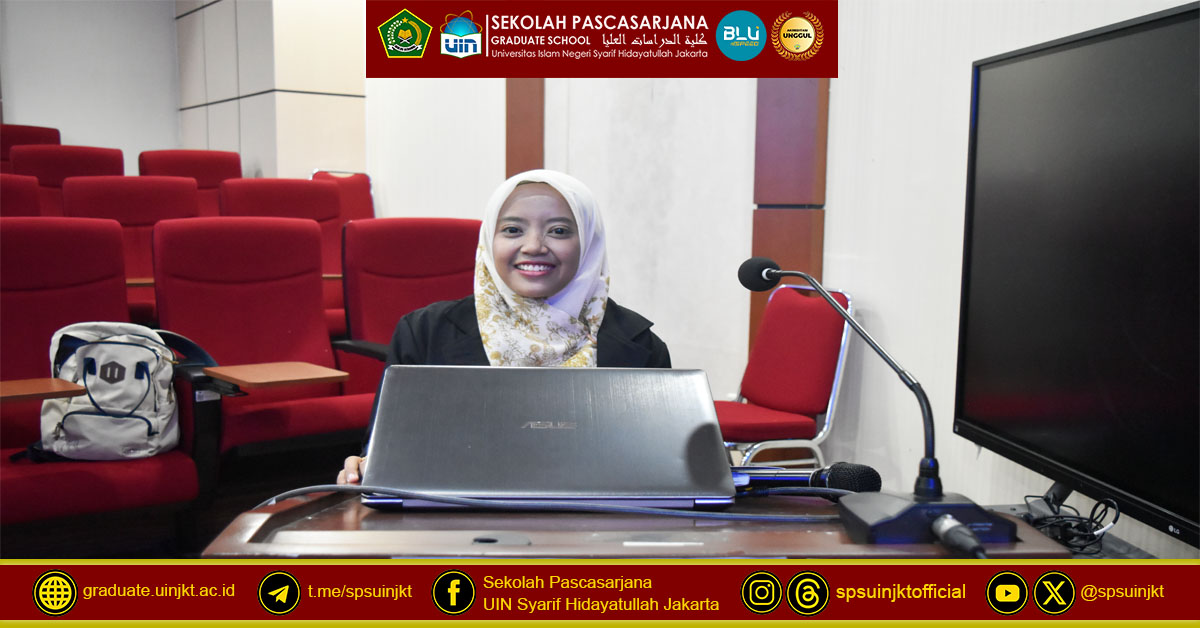
Imas Nur Kholida's Thesis Exam, Ecotheocentric Ideas in Tafsir al-Sha'rāwī
SPs Theater Room UIN Jakarta, SPs NEWS - The Graduate School (SPs) of UIN Syarif Hidayatullah Jakarta held the 2843rd Thesis Exam at the SPs Theater Room of UIN Jakarta on Friday, August 28, 2026 with candidate Imas Nur Kholida.
Imas is a student of the Master of Islamic Studies with a Concentration in Tafsir, his thesis is entitled "Ecological Interpretation: A Critical Study of Tafsīr wa Khawāṭir al-Imām Muḥammad Mutawallī al-Sha'rāwī". This research is present as a form of attention to the global environmental crisis through the perspective of interpreting the holy book of the Qur'an.
In particular, this study aims to analyze the construction of ecological thought of the famous Egyptian scholar, Muḥammad Mutawallī al-Sha'rāwī, in his monumental work Tafsīr wa Khawāṭīr. Imas carefully dissects the interpretation of verses related to the concepts of fasād (damage) and khalīfah (leader/manager) in order to formulate the paradigm of environmental ethics that underlies it.
In order to sharply skin this thought, Imas uses a qualitative method based on library research. This research combines an ecotheocentric approach with the theory of ecological hermeneutics developed by Norman C. Habel.
Through his research, Imas makes the basic argument that the relationship between God, man, and nature in the Qur'an is essentially built on the principle of man's attachment to the divine order. Therefore, the predicate of khalīfah held by man is not a form of granting absolute and unlimited authority, but a mandate full of moral responsibility in order to maintain the sustainability of Allah's creation.
The main findings of this thesis show that the concepts of fasād, khalīfah, taskhīr (subjugation of nature), and 'imārat al-arḍ (prosperity of the earth) are intertwined to form a whole unity of ecological thought. The concept of fasād describes human moral deviations that have a direct impact on the destruction of ecosystems, while khalīfah emphasizes the active role of humans in managing and caring for nature.
Furthermore, the concept of taskhīr exists to regulate the use of natural resources to remain within an ethical corridor, while 'imārat al-arḍ directs the function of the caliphate towards the sustainable prosperity of the earth. A comprehensive synthesis of these concepts results in a model of "ecological trust" based on monotheism as an ontological basis, khalīfah and trust as an anthropological basis, as well as mīzān (balance), raḥmah (compassion), and 'adālah (justice) as the axiological basis.
The scientific findings produced by Imas provide a new color that is different from previous research, such as the thesis by Fakhrijal Ali Azhar (2022) which had categorized al-Sha'rāwī's thought as theocentric-anthropocentric.
On the contrary, Imas succeeded in proving that al-Sha'rāwī's ecological thought is more appropriately understood in an ecotheocentric framework. This is based on the argument that human ethical responsibility for the environment never stands alone, but is always firmly rooted in the divine relationship manifested in the caliphate's mandate.
Imas successfully defended his thesis under the guidance of Prof. Dr. Yusuf Rahman, MA, and was tested in front of a board of examiners consisting of Hamdani, M.Ag, Ph.D, Prof. Dr. Yusuf Rahman, MA, Prof. Dr. Bambang Irawan, M.Ag and Dr. Eva Nugraha, M.Ag.
After paying attention to the thesis writing, the comments of the examiner team and the candidate's answers, the examiner team determined that Imas graduated with the title of Very Satisfactory. Imas Nur Kholida is the 2843rd Master in the field of Islamic Studies, in the Master's program of the Graduate School of UIN Syarif Hidayatullah Jakarta. (Jay A)