
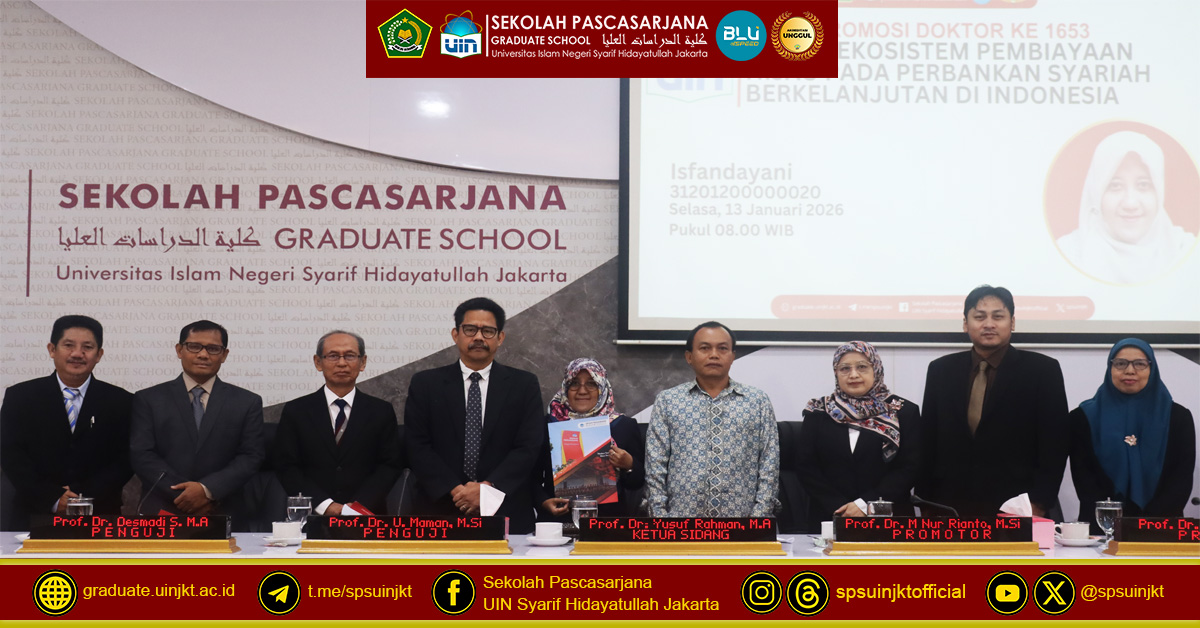
Isfandayani Doctoral Promotion Exam: Green Financing Ecosystem Model in Sustainable Islamic Banking in Indonesia
Auditorium of Prof. Dr. Suwito, MA SPs UIN Jakarta, SPs NEWS - The Graduate School (SPs) of UIN Syarif Hidayatullah Jakarta held the 1653rd Doctoral Promotion Exam in the Auditorium Room of Prof. Dr. Suwito, MA on Tuesday, January 13, 2026 with promovenda Isfandayani.
Isfandayani is a student of the Doctoral program in Islamic Studies with a concentration in Islamic Economics. His dissertation is titled "Green Financing Ecosystem Model in Sustainable Sharia Banking in Indonesia".
In his presentation, Isfandayani emphasized that the implementation of green financing is no longer just a trend, but an urgent need. This is a strategic key in mitigating the increasingly worrying impact of global climate change. Islamic banks, with their principles of ethics and justice, are considered to have a moral responsibility and great opportunity to lead the environmentally friendly investment movement.
This research is designed comprehensively to examine the extent to which Islamic banks have implemented green financing, identify obstacles in the field, and formulate their development strategies. Through a qualitative and quantitative approach, Isfandayani has succeeded in mapping complex ecosystems into a model that is applicable to stakeholders in Indonesia.
The strength of this research methodology lies in the use of the Analytical Network Process (ANP) model. Data was collected through in-depth interviews with 22 expert respondents, consisting of banking practitioners and academic experts. Of these, 14 experts made specific contributions through filling out questionnaires to quantify the priorities of the strategies that must be taken.
The research sample focuses on three large Islamic banks in Indonesia. The model construction process is carried out systematically, starting from in-depth literature review, intensive interviews, to the data quantification stage. This ensures that the resulting ecosystem model has high validity and is in line with the current reality of the banking industry.
Important findings in this study reveal that the success of green financing depends on the synergy of three main actors: Sharia Banks, Communities, and Regulators. Isfandayani underlined that each actor still faces unique challenges that have been hindering the acceleration of the growth of environmentally friendly financing in the sharia sector.
Furthermore, Isfandayani gave birth to a new theory that progressive green financing requires regulations that are harmoniously connected between institutions. This must be supported by increasing education and human resource capacity, strengthening cross-sector cooperation, and innovation in finding more varied and efficient sources of green funds.
In addition, this study recommends the need for stronger risk management, the presence of sharia general insurance with a large capital capacity, and the support of specific National Sharia Council (DSN) Fatwas. These elements are considered the main foundation for Islamic banking to be able to finance green projects with a sense of security and legal certainty.
One very interesting finding is the identification of the position of Indonesia's green financing ecosystem which is in the mild wild west status. This condition illustrates a very dynamic environment, where the opportunities for green financing development can move much faster than other sectors, provided they are managed with the right orchestration.
Isfandayani also emphasized that the state must take a central role as a "conductor" in orchestrating this ecosystem. The government is expected not only to make policies, but also to ensure that the implementation of the strategy is properly conveyed to business actors and the wider community, for the sake of creating an inclusive green economy.
Academically, the results of this study reinforce theories from world experts such as Vikas Nath to Olaf Weber who emphasize the importance of the role of banks in sustainability. However, Isfandayani provides an antithesis to Hasanah's findings, by proving that through the right ecosystem model, green financing is actually a profitable long-term investment.
The novelty of Isfanandayani's research lies in the combination of priority strategies with an Islamic perspective in sustainable development. With the end of this promotional exam, it is hoped that the green financing ecosystem model can be immediately adapted by the national Islamic banking industry in order to realize a greener and more sustainable Indonesia.
Isfandayani successfully defended her dissertation under the guidance of Prof. Dr. Euis Amalia, M.Ag; Prof. Dr. Muhammad Nur Rianto Al Arif, M.Si, and tested in front of a board of examiners consisting of Prof. Dr. Yusuf Rahman, MA; Prof. Dr. Euis Amalia, M.Ag; Prof. Dr. Muhammad Nur Rianto Al Arif, M.Si; Prof. Dr. U. Maman, M.Si; Prof. Dr. Desmadi Saharuddin, MA; Prof. Dr. Ambran Hartono, M.Si.
After paying attention to the writing of the dissertation, the comments of the examiner team and the promovenda's answers, the examiner team determined that Isfandayani graduated with the title of Very Satisfactory. Isfandayani is the 1653rd Doctor in the field of Islamic Studies, in the doctoral program of the Graduate School of UIN Syarif Hidayatullah Jakarta. (JA)