
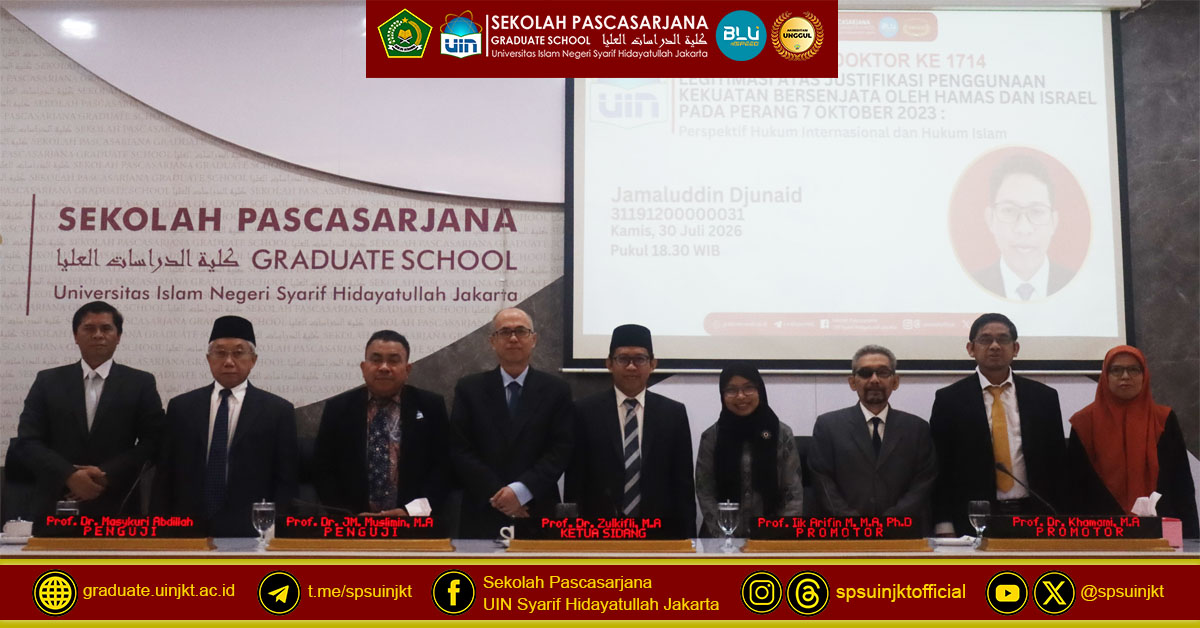
Jamaluddin Djunaid Doctoral Promotion Test, Legitimacy of the Justification of the Use of Force by Hamas and Israel in the War October 7, 2023
Auditorium of Prof. Dr. Suwito, MA SPs UIN Jakarta, SPs NEWS – The Graduate School (SPs) of UIN Syarif Hidayatullah Jakarta held the 1714th Doctoral Promotion Exam in the Auditorium Room of Prof. Dr. Suwito, MA Graduate School on Thursday, July 30, 2026 with promovendus Jamaluddin Djunaid.
Jamal is a student of the Doctoral program in Islamic Studies with a concentration in Religion and Law. His dissertation is titled "The Legitimacy of the Justification of the Use of Force by Hamas and Israel in the October 7, 2023 War: Perspectives on International Law and Islamic Law".
This research is here to dissect the normative dimension behind conflict. The October 7, 2023 incident between Hamas and Israel was not just a military battle, but a very complex legal narrative battle.
In his presentation, Jamaluddin explained that the incident was an armed conflict that did not only have political, security, and humanitarian dimensions. Furthermore, the event sparked a sharp normative debate about the extent to which the use of armed force by both sides is legally justified.
Both warring sides have proven to be building a juridical narrative to justify their military actions. Hamas bases the use of force on claims of resistance to the Israeli occupation, self-defense from prolonged aggression, and the exercise of the right to self-determination for the Palestinian people.
On the other hand, Israel justifies large-scale military operations on the basis of the right to self-defense and efforts to eradicate terrorism. Each party claims that their actions have a legitimate moral and legal basis.
In order to unravel this complexity, this qualitative research uses a juridical-normative method with a comparative legal research approach. The primary data source is taken directly from official documents that contain claims and arguments for the use of force from both actors.
On the Hamas side, the study examined the official document Hādhihi Riwāyatunā: Limādhā Ṭūfān al-Aqṣā (Our Narrative: Why the Storm of al-Aqṣā?), the Hamas Charter, and various speeches of its leaders. Meanwhile, from the Israeli side, the data was dug up from the Israeli Government's official letter to the UN Security Council dated October 7, 2023 along with the government's official statement.
The analysis instruments used are very comprehensive. In the realm of international law, the research refers to the UN Charter, international humanitarian law, the law of occupation, and the decisions of the International Court. As for the realm of Islamic law, the analysis is based on the Qur'an, Sunnah, fiqh al-siyār, and the thoughts of the fuqahā on the cause of sharʿī li al-qitāl.
The results revealed a crucial finding: both sides' justification claims faced serious legitimacy issues when tested. Hamas' justification is disputed because of its status as a non-state armed actor, the issue of authority (wilāyah), and alleged violations of the principles of noncombatant protection and proportionality.
On the other hand, the legitimacy of Israel's self-defense claims is very problematic because it is carried out in the context of a prolonged occupation. Its military operations are considered not to meet the parameters of necessity, proportionality, and the obligation to protect the civilian population as stipulated in international law and Islamic law.
Interestingly, this study found a strong common denominator between international law and Islamic law. Both legal systems affirm that the use of armed force is essentially a valid exception only if it has valid reasons, is carried out by the competent authorities, is oriented towards the protection of humanity, and complies with the principle of proportionality.
However, fundamental differences remain in the source of legitimacy, the concept of authority to use force, and the normative basis of the right to resist occupation. As an academic contribution, this dissertation offers an integrated comparative analysis model that combines the parameters of international law and Islamic law to evaluate future war claims.
Jamal successfully defended his dissertation under the guidance of Prof. Dr. Iik Arifin Mansurnoor, MA and Prof. Dr. Khamami, MA, and was tested in front of a board of examiners consisting of Prof. Dr. Zulkifli, MA, Prof. Dr. Iik Arifin Mansurnoor, MA, Prof. Dr. Khamami, MA, Prof. Dr. Masykuri Abdillah, Prof. Dr. JM Muslimin, MA and Prof. Dr. Kamarusdiana, MH.
After paying attention to the writing of the dissertation, the comments of the examiner team and the promovendus' answers, the examiner team determined that Jamal graduated with the predicate of Very Satisfactory. Jamaluddin Djunaid is the 1714th Doctor in the field of Islamic Studies, a doctoral program at the Graduate School of UIN Syarif Hidayatullah Jakarta. (Jay A)