
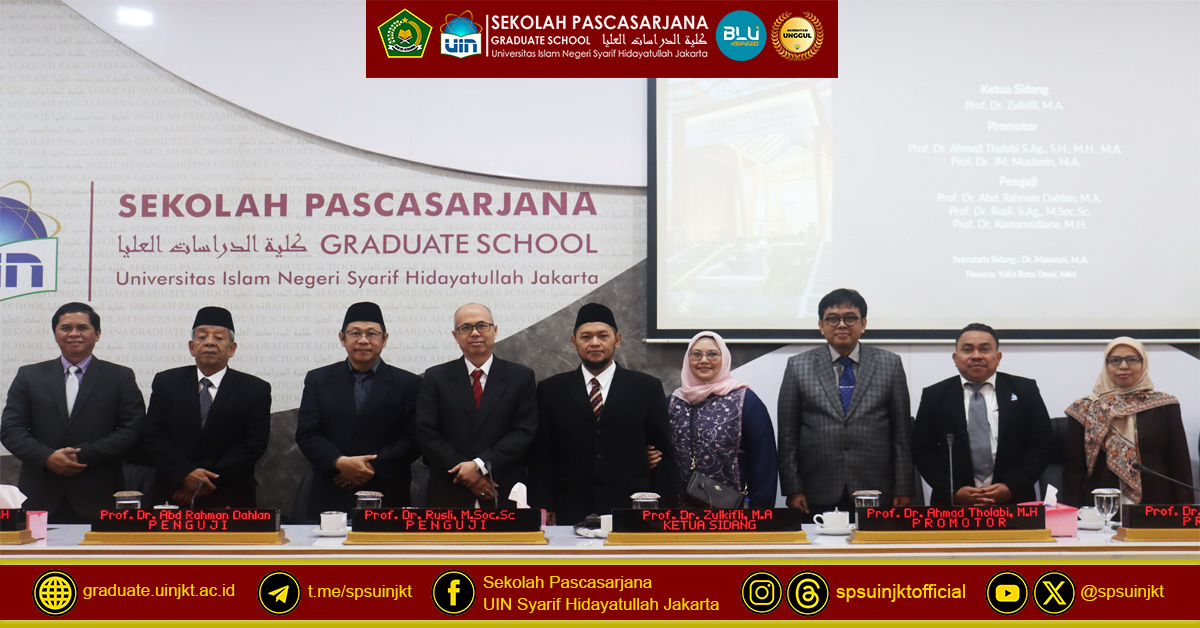
Jantarda Mauli Hutagalung Doctoral Promotion Exam: Jurisdictional Conflict, Certainty, and Legal Solutions to the Authority of Sharia Bankruptcy Disputes
Auditorium of Prof. Dr. Suwito, MA SPs UIN Jakarta, SPs NEWS - The Graduate School (SPs) of UIN Syarif Hidayatullah Jakarta held the 1651st Doctoral Promotion Exam in the Auditorium Room of Prof. Dr. Suwito, MA on Monday, January 12, 2026 with promovendus Jantarda Mauli Hutagalung.
Jantarda is a student of the Doctoral program in Islamic Studies with a Concentration in Sharia. His dissertation is entitled "Jurisdictional Conflicts, Certainty, and Legal Solutions: An Analysis of Norm Conflicts in the Authority of Sharia Bankruptcy Disputes and Alternative Resolution Models". This research departs from academic anxiety about the rapid growth of the sharia economy which has not been accompanied by a synchronous legal umbrella.
In his presentation, Jantarda highlighted serious obstacles in the form of dualism of judicial authority in bankruptcy disputes and sharia-based Suspension of Debt Payment Obligations (PKPU). This problem has become a "sharp pebble" for business actors who run businesses based on Islamic principles in Indonesia.
The main focus of this research is the conflict of norms between Law No. 37 of 2004 concerning Bankruptcy which gives authority to the Commercial Court, and Law No. 3 of 2006 concerning Religious Courts. The last law expressly establishes the absolute competence of the Religious Court in all forms of sharia economic disputes.
This insynchrony, according to Jantarda, creates a fatal legal disharmony. Often, sacred sharia contracts are actually judged through the lens of conventional law in the Commercial Court, which is philosophically and operationally very different from the basic principles of muamalah.
This research aims to dissect the root causes of the conflict and formulate an alternative model of legal settlement. Jantarda emphasized the importance of ensuring legal certainty and justice rooted in the principle of taflis (bankruptcy in Islam), not simply adopting western procedures.
Using normative juridical methods, Jantarda conducts an in-depth analysis of the coherence of positive legal norms, legal principles, and applicable legal doctrines. He uses legislative, conceptual, and case study approaches to build a solid argument.
The descriptive qualitative analysis carried out reveals the fact that the principle of lex specialis is often overlooked. Although the Constitutional Court Decision No. 93/PUU-X/2012 has given the "green light" to the authority of the Religious Court, in practice the Commercial Court still dominates the handling of the case.
The findings in this dissertation show that the decisions of the Commercial Court tend to ignore the unique characteristics of sharia contracts, such as Mudharabah and Musyarakah. The profit-sharing mechanism is often simplified into conventional debts and receivables, which clearly injures the value of justice for the parties.
Furthermore, Jantarda identified that the biggest technical obstacle at the moment is the vacuum of the special procedural law for sharia bankruptcy in the Religious Court. In the absence of a specific procedural law, judges in the Religious Court face great challenges in executing bankruptcy cases effectively.
As a solution offering, Jantarda proposes an integrated settlement model. He encouraged the strengthening of the role of the Religious Court supported by the presence of certified Sharia Curators and made the Fatwa of the National Sharia Council (DSN-MUI) as the main material reference.
The big conclusion of this study confirms that Indonesia needs immediate regulatory harmonization. The revision of the Bankruptcy Law or the issuance of special regulations is a dead price to give absolute attribution of authority expressly to the Religious Courts in deciding disputes between sharia entities.
Theoretically, these findings strengthen the discussion on the integration of Islamic law into the national legal system through the concept of harmonious legal pluralism. This proves that Islamic law is able to adapt and provide concrete solutions to modern economic challenges.
Meanwhile, practically, Jantarda's dissertation provides a foundation for policymakers to carry out institutional reform of the one roof system. It is hoped that sharia business people in the future will get legal certainty that their disputes will be resolved in accordance with the contract that has been agreed upon at the beginning.
Jantarda Mauli Hutagalung successfully defended his dissertation under the guidance of Prof. Dr. Ahmad Tholabi Kharlie, S.Ag, SH, MH, MA and Prof. Dr. JM Muslimin, MA, and tested in front of a board of examiners consisting of Prof. Dr. Zulkifli, MA; Prof. Dr. Ahmad Tholabi Kharlie, S.Ag, SH, MH, MA; Prof. Dr. JM Muslimin, MA; Prof. Dr. Rusli, S.Ag, M.Soc.Sc; Prof. Dr. Kamarusdiana, MH; Prof. Dr. H. Abd. Rahman, MA.
After paying attention to the writing of the dissertation, the comments of the examiner team and the answers of the promovendus, the examiner team determined that Jantarda Mauli Hutagalung graduated with the predicate of Very Satisfactory. Jantarda Mauli Hutagalung is the 1651st Doctor in the field of Islamic Studies, in the doctoral program of the Graduate School of UIN Syarif Hidayatullah Jakarta. (JA)