
Kamilah's Thesis Exam: Conflict and Adaptation of Immigrant Hadith Scholars in the Dynamics of Hadith Transmission in Kufah
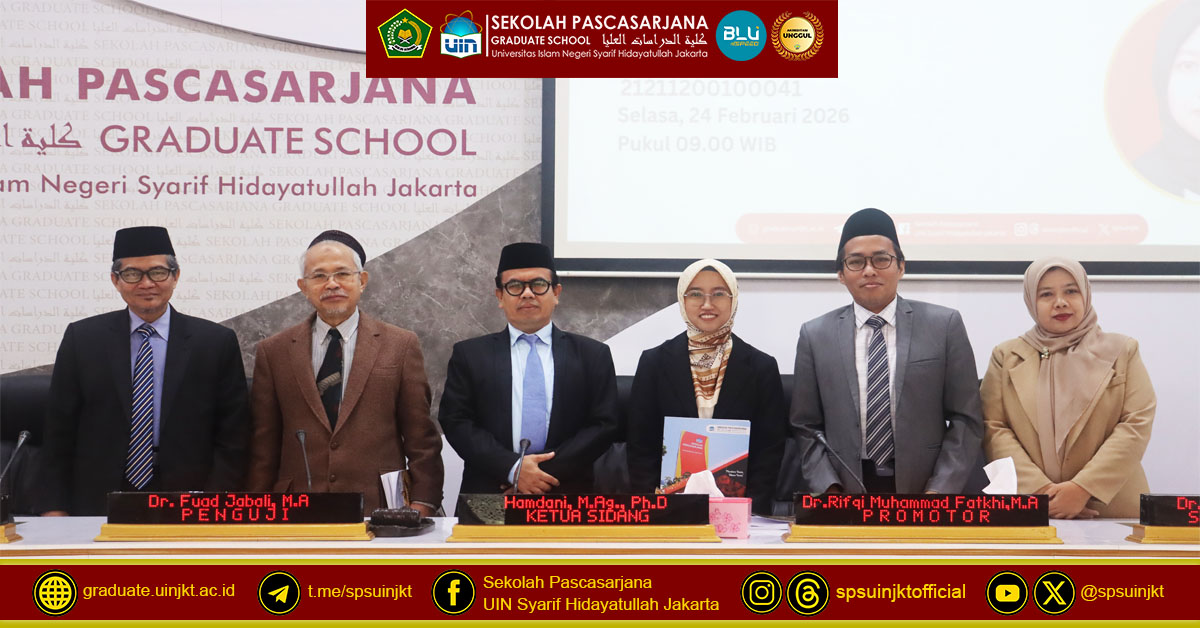
Auditorium of Prof. Dr. Suwito, MA SPs UIN Jakarta, SPs NEWS - The Graduate School (SPs) of UIN Syarif Hidayatullah Jakarta held the 2806th Thesis Exam at the Auditorium Room of Prof. Dr. Suwito, MA SPs UIN Jakarta on Tuesday, February 24, 2026 with the candidate Kamilah.
We are students of the Master of Islamic Studies program with a Concentration in Hadith Interpretation. His thesis is entitled "Conflict and Adaptation of Immigrant Hadith Experts in the Dynamics of Hadith Transmission in Kufa".
We take the audience back to the first and second centuries of the Hijri, an era in which Kufa was not just an administrative city, but the epicenter of political and intellectual upheaval. The focus of this research is to dissect how the hadith narrators who migrated to Kufa were able to survive and maintain their scientific integrity in the midst of the storms of conflict that often hit the region.
There are three crucial points that become lives in this study. First, we examine the credibility and characteristics of the narrators. Second, he dissects how conflict itself has become a driving engine for the migration of hadith experts. Third, this study reveals the unique adaptation strategies carried out by these immigrants to continue to exist in the region.
We use qualitative methods through a socio-historical approach. He searched through data from Ibn Ḥajar al-Asqalānī' s Taqrīb al-Tahdhīb, the rijāl al-ḥadīth books, and various other classical historical sources to reconstruct the lives of past historians.
We combine the theory of push-pull migration, Lewis A. Coser's theory of social conflict, and the fundamental theory in the study of hadith, namely al-jarḥ wa-al-taʾdīl. This combination allows him to see hadith data not only as religious texts, but also as dynamic social phenomena.
The majority of immigrant historians from Makkah and Medina who migrated to Kufa turned out to still hold the predicate of positive credibility, such as thiqah, ṣadūq, and maqbūl. Although, Kamilah noted that there were four narrators who were actively involved in the vortex of conflict at that time.
The most interesting thing is Kamilah's argument that the socio-political and economic conflicts of the early centuries of Islam did not automatically destroy the reputation of a historian. On the contrary, conflict often served as a trigger for extraordinary social-scientific adaptations, forcing the narrators to be more selective and resilient in guarding their sanad.
The adaptation strategy of the immigrants in Kufa was carried out very systematically. They not only settled, but also actively disseminated hadiths, built a network of sanad (transmission), and integrated with the local scientific community. This step proved effective because the hadith was seen as a symbol of the highest integrity in the eyes of the people at that time.
In the midst of a stressful atmosphere, these narrators show the adaptive side of humanity. Even though integration with the local community occurs, they still enforce strict differentiation and selectivity. This means that they are able to blend socially but still maintain the scientific filter so that it is not mixed with practical political interests.
Kamilah's research makes a fresh argument that conflict is not always destructive to the Islamic intellectual tradition. In Kufa, conflict has been the catalyst that shapes the dynamics of migration and helps build the scholarly authority of the immigrants. Conflict actually strengthens the "resilience" of the narration tradition itself.
We are the ones who point out that the label "Kufa" does not necessarily make the credibility of a narrator have to be blindly rejected. He proved that behind the turbulent city, there is a transmission chain that is very authentically maintained through a sophisticated adaptation process.
This research brilliantly strengthens and develops the findings of Novizal Wendry (2016). We have succeeded in refuting the stereotypes of past critics who tend to reject the Kufa narration in general due to conflicting sentiments. With the completion of this exam, Kamilah not only earned a master's degree, but also opened up a new space for discussion about how science and religion adapt in conflict areas.
We successfully defended his thesis under the guidance of Dr. Rifqi Muhammad Fatkhi, MA, and tested in front of a board of examiners consisting of Hamdani, M.Ag, Ph.D, Dr. Rifqi Muhammad Fatkhi, MA, Dr. Fuad Jabali, MA, Dr. Ahmad Fudhaili, M.Ag.
After paying attention to the thesis writing, the comments of the examiner team and the candidate's answers, the examiner team determined that Kamilah graduated with the predicate of Very Satisfactory. We are the 2806th Master in the field of Islamic Studies, in the Master's program of the Graduate School of UIN Syarif Hidayatullah Jakarta. (JA)