
Lecturer of SPs UIN Jakarta Emphasizes the Importance of Constructive Relations to Prevent Sexual Violence
SPs UIN Jakarta Building, SPs NEWS – Lecturer of the Graduate School as well as the Head of the Islamic Religious Education Study Program, Faculty of Tarbiyah and Teacher Training UIN Syarif Hidayatullah Jakarta, Dr. Suwendi, M.Ag., emphasized that various cases of sexual violence that occur in educational institutions in general are rooted in unhealthy power relations. Therefore, it is necessary to build constructive relationships and protection mechanisms that are able to prevent abuse of authority.
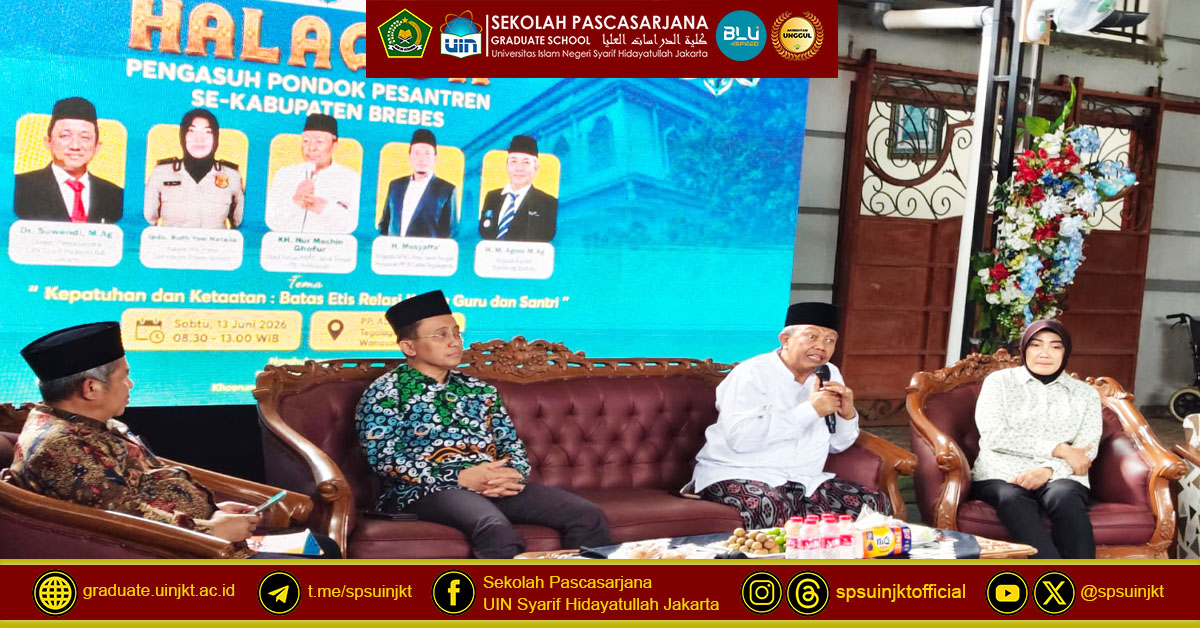
This statement was conveyed when he was a resource person in the Halaqah of Caregivers of Islamic Boarding Schools throughout Brebes Regency which was held at the Al-Fattah Islamic Boarding School, Tegalgandu, Wanasari, Brebes, Saturday (13/6/2026). This activity was attended by hundreds of kiai and nyai caretakers of Islamic boarding schools from various regions in Brebes Regency.
Halaqah presented a number of speakers, namely the Deputy Chairman of PWNU Central Java KH. Nur Machin Chudlori, Head of the Office of the Ministry of Religion of Brebes Regency H. M. Aqso, M.Ag., Ipda Ruth Yosi Natalia from the Brebes Police, and Dr. Suwendi, M.Ag.
According to Suwendi, every power relationship always has the potential to be abused if it is not accompanied by an adequate control mechanism. Therefore, Islamic boarding schools and other educational institutions need to strengthen the violence prevention system through transparent and accountable institutional governance.
"Educational institutions need to build mechanisms to prevent violence, provide a safe complaint system, and provide education about healthy relationships so that every member of the institution understands their rights and responsibilities," he said.
He explained that in the pesantren environment there are very complex relationships, including spiritual, academic, social, economic, and psychological dimensions. This condition puts teachers or caregivers in a position that has greater authority than students, so a control mechanism is needed to prevent abuse of power.
According to him, the pesantren community must be able to avoid various forms of relationship deviation, such as intimidation, physical violence, verbal violence, spiritual manipulation, economic exploitation, sexual exploitation, and threats that use religious legitimacy as a tool of justification.
Suwendi also emphasized that pesantren education must still instill the value of ta'zhim or respect for teachers as part of the Islamic scientific tradition. However, this respect should not be interpreted as unlimited obedience that closes the space for students to express objections to actions that are contrary to religious, legal, or ethical teachings.
"Students need to be educated to be polite and respectful to teachers, but also have the courage and ability to raise objections when facing actions that are contrary to religion, law, and ethics," he said.
At the end of his presentation, Suwendi reminded the importance of distinguishing between discipline and violence in the educational process. According to him, discipline is an educational instrument that aims to form character through proportional, measurable, and educational methods. On the contrary, violence hurts, humiliates, intimidates, and degrades human dignity.
"Islamic boarding schools must be able to clearly distinguish between discipline and violence. Discipline is part of character education, while violence is a violation of human values and has no place in educational institutions," he concluded.