
Lecturer of SPs UIN Jakarta: The Islamic Boarding School Law Forms State Recognition of the Tradition, Independence, and Science of Islamic Boarding Schools
Malang - The presence of Law Number 18 of 2019 concerning Islamic Boarding Schools is an important milestone in the history of Islamic education in Indonesia. This regulation is considered not only to provide legal certainty for the implementation of Islamic boarding schools, but also to be a form of state recognition of scientific traditions, independence, and the contribution of Islamic boarding schools in building the nation's character.
"The Islamic Boarding School Law ends the long phase when Islamic boarding schools were only positioned as socially recognized educational institutions, but have not yet gained full recognition in the national legal system. Now pesantren is placed as a strategic subject for the development of national education without losing its identity and scientific tradition," said a lecturer at the Graduate School and Head of the Islamic Religious Education Study Program, Faculty of Tarbiyah and Teacher Training UIN Syarif Hidayatullah Jakarta, Dr. Suwendi, M.Ag.
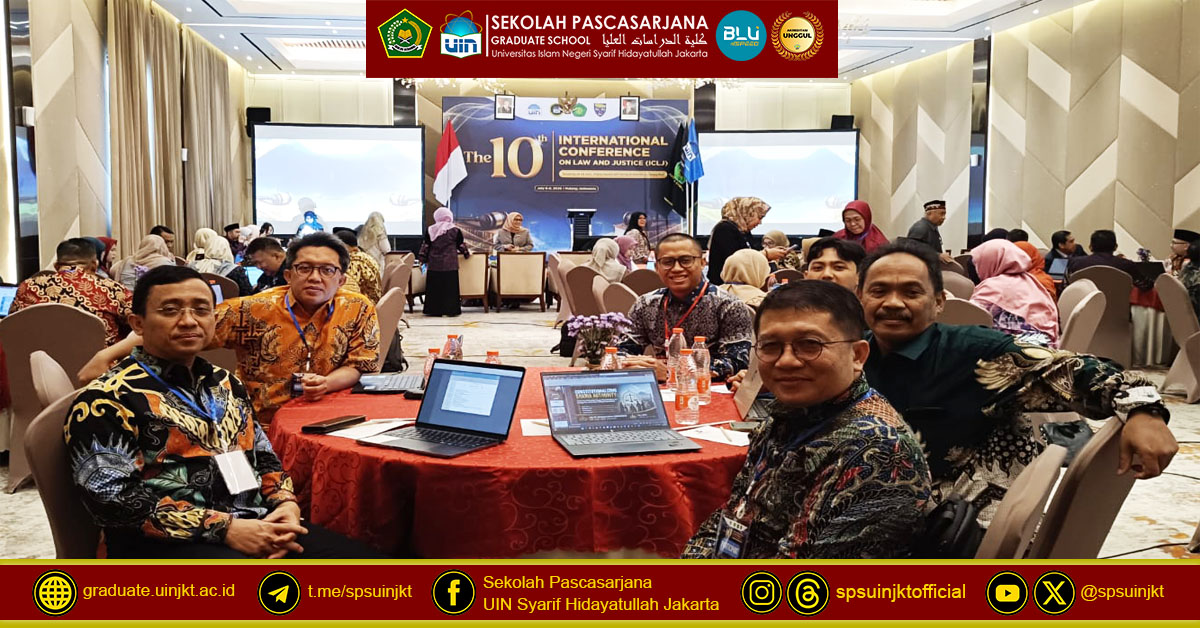
This statement was conveyed when presenting the results of his research entitled "Islamic Education as an Instrument of State Legal Politics in Indonesia: A Case Study of the Pesantren Law and Minister of Religious Affairs Decrees Number 183 and 184 of 2019" in the 10th International Conference on Law and Justice (ICLJ) 2026 organized by the Faculty of Sharia and Law UIN Syarif Hidayatullah Jakarta in collaboration with the University of Malaya and the Faculty of Sharia UIN Maulana Malik Ibrahim Malang, at Ijen Suites Resort & Convention Malang on 6 – 8 July 2026.
The conference was opened by the Coordinating Minister for Law, Human Rights, Immigration, and Corrections of the Republic of Indonesia, Prof. Dr. Yusril Ihza Mahendra, S.H., M.Sc., and attended by the leaders of UIN Jakarta and the Faculty of Sharia and Law of UIN Jakarta, the leaders of UIN Malang and the Faculty of Sharia of UIN Malang, lecturers and researchers from various campuses in Indonesia.
According to Suwendi, the Islamic Boarding School Law is a form of changing the political paradigm of Islamic education law in Indonesia. The state is no longer present as an administrative regulator, but provides recognition, protection, empowerment, and facilitation of Islamic boarding schools as Islamic educational institutions that have taken root in people's lives.
He explained that the recognition was realized through various policies, ranging from the recognition of Islamic boarding school graduates through the mu'adalah scheme and Formal Early Childhood Education, funding support, to institutional strengthening through the Islamic Boarding School Endowment Fund.
"This is not just government assistance to Islamic boarding schools. State support is a logical consequence of recognizing the great contribution of Islamic boarding schools in educating the nation's life, building public morals, maintaining religious life, and strengthening the social cohesion of Indonesian society," he said.
More importantly, continued Suwendi, the state does not eliminate the typical character of Islamic boarding schools. The tradition of studying the yellow book, the sorogan and bandongan methods, as well as the scientific authority-based leadership of the kiai continues to gain recognition in the national legal system.
"Pesantren remains a pesantren. The state does not standardize the entire model of Islamic education. Instead, the state provides legitimacy so that the uniqueness of pesantren becomes part of the wealth of the national education system," he said.
According to Suwendi, the balance between state regulation and pesantren autonomy can be seen from the establishment of the Masyayikh Council as an institution to guarantee the quality of pesantren education. The existence of this institution shows that the state does not monopolize scientific authority.
"The state carries out administrative, regulatory, and facilitation functions. Meanwhile, academic and religious authority remains in the hands of scholars and the community. This model shows a healthy relationship between the state and Islamic boarding schools," he said.
The results of his research conclude that the legal politics of Islamic education in Indonesia are moving towards a more participatory partnership model. The state carries out the functions of recognition, facilitation, and regulation, while pesantren still hold scientific authority and maintain intellectual traditions that have been inherited for centuries.
For Suwendi, this model is one of Indonesia's strengths in developing Islamic education in the midst of a pluralistic society.
"Indonesia's experience shows that strengthening Islamic boarding schools is not done through subordination, but through partnerships. The state provides legal certainty, institutional support, and policy affirmation, while Islamic boarding schools remain centers for knowledge transmission, moral development, strengthening religious moderation, and community empowerment," he concluded.