
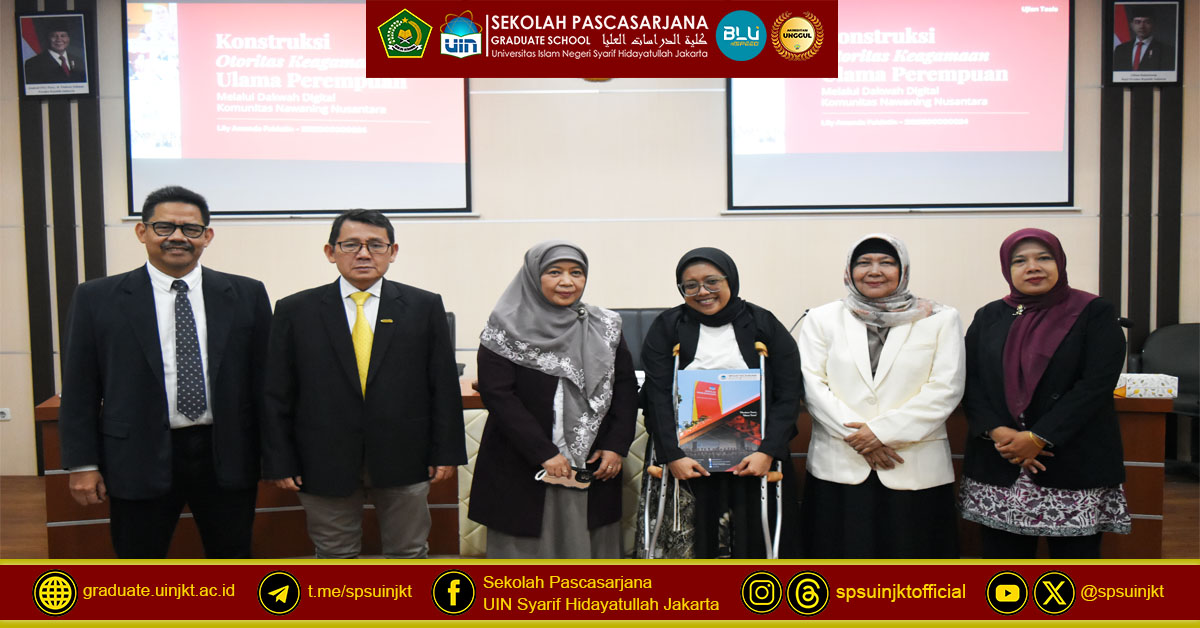
Lily Awanda Faidatin's Thesis Exam, Digital Da'wah: The Role of Nawaning Nusantara in Building the Authority of Women Scholars
Auditorium of Prof. Dr. Suwito, MA SPs UIN Jakarta, SPs NEWS - The Graduate School (SPs) of UIN Syarif Hidayatullah Jakarta held the 2825th Thesis Exam at the SPs Theater Room of UIN Jakarta on Tuesday, July 28, 2026 with candidate Lily Awanda Faidatin.
Lily is a student of the Master of Islamic Studies program with a Concentration in Da'wah and Communication. Her thesis is entitled "The Construction of Religious Authority of Women Ulema through Digital Da'wah of the Nawaning Nusantara Community".
This research focuses on the shifting landscape of da'wah in the modern era, by elaborating in depth the strategy of the Nawaning Nusantara Community in building the religious authority of women scholars through digital platforms. In addition to examining the community's internal strategy, this study also analyzes the dynamics of acceptance and media audiences' views on the presence of female ulama da'wah in cyberspace.
In dissecting this phenomenon, this study adopts a qualitative approach with feminist and sociological analytical frameworks. Lily integrates a number of key theories, including the authority theories of Max Weber and Khaled Abou El-Fadl, the social construction theories of Peter L. Berger and Thomas Luckmann, to the concept of gender performivity of Judith Butler. Research data was collected through documentation of the Instagram content of the Nawaning Nusantara Community as well as in-depth interviews with community administrators, media audiences, and gender and media study experts.
The results of the study revealed that the Nawaning Nusantara Community succeeded in constructing charismatic-collective authority through three main strategic paths. These strategies include strengthening scientific sanad based on pesantren traditions, mobilizing solidarity based on women's collective identity, and contextualizing da'wah that is responsive and relevant to contemporary social issues.
From the point of view of digital media viewers, the presence of this community has reaped significant positive acceptance. Audiences began to judge the religious authority of the nuns epistemicly based on the depth of knowledge and argumentation, rather than on biological considerations of gender. Nevertheless, the media also provided critical notes so that this movement was not isolated in the student environment alone, but could reach a wider and more inclusive public.
These findings have succeeded in filling important gaps in previous literature, such as the studies of Qurrota Ayuni (2022), Arnis Rachmadhani (2021), and Agung Tri Wibawa (2019). While previous studies have tended to focus on the success of digital da'wah on individual capacity and the popularity of a single preacher, Lily's research shows that the power of the digital movement also lies in collective work.
Theoretically, this research strengthens and complements the theses of Monika Andok (2024) and Pauline Hope Cheong (2016) regarding the characteristics and flexibility of religious authority in the digital space. This thesis argues that religious authority in cyberspace is no longer individualistic, but is constructed collectively through a combination of pesantren culture and technological adaptation.
Furthermore, the Da'wah movement of the Nawaning Nusantara Community has proven to play an effective role as a cultural broker. This community has succeeded in connecting the treasures of the yellow book with the intellectual needs of the younger generation, as well as breaking down the dominance of religious interpretations that are still gender-biased.
The broad implications of this finding underscore the democratization process of religious authority today. The digital space now does not only function as a broadcasting medium, but has transformed into an inclusive public space that spreads the idea of moderate and women-friendly Islam.
Lily successfully defended her thesis under the guidance of Dr. Ida Rosyidah, MA, and was tested in front of a board of examiners consisting of Prof. Dr. Yusuf Rahman, MA, Dr. Ida Rosyidah, MA, Dr. Iding Rosyidin, M.Si, Dr. Wiwi Siti Sajaroh, M.Ag.
After paying attention to the thesis writing, the comments of the examiner team and the candidate's answers, the examiner team determined that Lily Awanda Faidatin graduated with the predicate of Very Satisfactory. Lily Awanda Faidatin is the 2825th Master in the field of Islamic Studies, in the Master's program of the Graduate School of UIN Syarif Hidayatullah Jakarta. (Jay A)