
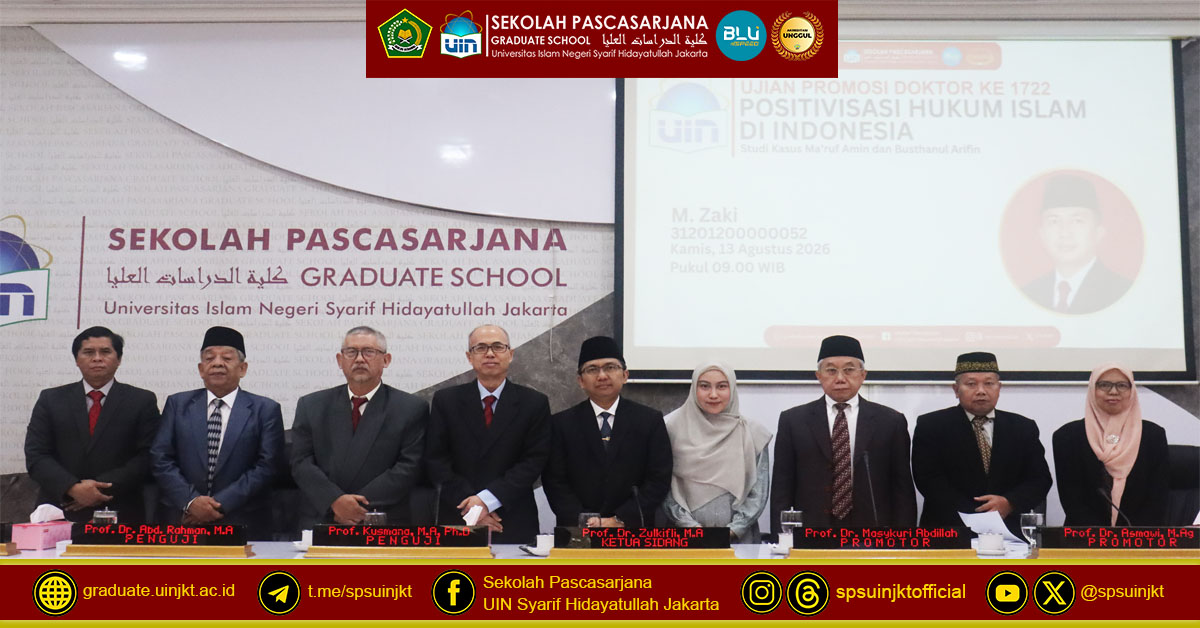
M. Zaki's Doctoral Promotion Exam, Positivization of Islamic Law in Indonesia: A Case Study of Ma'ruf Amin and Busthanul Arifin
Auditorium of Prof. Dr. Suwito, MA SPs UIN Jakarta, SP NEWS – The Graduate School (SPs) of UIN Syarif Hidayatullah Jakarta held the 1722nd Doctoral Promotion Exam in the Auditorium Room of Prof. Dr. Suwito, MA Graduate School on Thursday, August 13, 2026 with promovendus M. Zaki.
Zaki is a student of the Doctoral program in Islamic Studies with a concentration in Sharia. His dissertation is entitled "Positivization of Islamic Law in Indonesia: A Case Study of Ma'ruf Amin and Busthanul Arifin".
This dissertation examines in depth the long journey of positivization of Islamic law in Indonesia throughout the period from 1970 to 2022. In his study, positivization is interpreted as a crucial process of integrating norms or provisions of Islamic law that originally did not become state law to take formal effect. This transformative is realized through the formulation, determination, recognition, and official use by authorized institutions in four main domains: sharia economics, halal product assurance, Religious Courts, and the Compilation of Islamic Law (KHI).
To dissect these dynamics, Zaki's research combines Islamic law, socio-legal, and evaluative-normative approaches comparatively. The research data was collected from in-depth interviews, works of thought of figures, laws and regulations, fatwas, court decisions, and institutional documents. The author also strengthens his analysis with supporting data from the answers of the judges and clerks processed using historical-institutional reconstruction, process tracing, and data triangulation.
One of the main findings of this study reveals that the positivization of Islamic law takes place gradually, across institutions, and is driven by two main patterns. In the case of Ma'ruf Amin, positivization moves through cultural channels. This pattern spreads from fiqh debates, the birth of ulama fatwas, and industrial demands, which then transform into official regulations, business contracts, certifications, and state administrative systems. Ma'ruf Amin's key contribution lies in his ability to reason fiqh as well as translate fatwas into regulatory language.
On the contrary, the case of Busthanul Arifin represents a structural path that is firmly rooted in the authority and instruments of the state. This pattern utilizes the institution of Religious Courts, the codification of KHI, and judges' decisions as the main driving force. Busthanul Arifin's strategic role is evident in strengthening the position of the Religious Courts in the national judicial system and overseeing the establishment of KHI as an applied legal guideline for Muslims.
Zaki emphasized that the cultural path and the structural path are not two separate poles that are opposite each other, but an intersecting process that complements each other. Sociologically, the success of this norm transformation is supported by layered legitimacy and the conversion of scientific, symbolic, network, and political capital into binding juridical power. However, the study also notes that inter-institutional relationships in this process are often unequal, where the provider of legal substance does not necessarily have control over the formal form or implementation of the results.
Another interesting phenomenon is the fact that the state's official recognition of a norm often precedes the readiness of implementation and public acceptance on the ground. On the other hand, the presence of the Sharia Economic Law Compilation (KHES) has proven to be successful in bringing together the substance of sharia economics with judicial forums in court. Although the division of roles between institutions expands the reach of the law, this condition carries the risk of fragmentation of responsibilities in its implementation.
Theoretically, this dissertation provides a new scientific contribution that complements previous studies from experts such as Daniel S. Lev, John R. Bowen, Arskal Salim, Masykuri Abdillah, and Franz von Benda-Beckmann. Zaki's research enriches his scientific treasures by analyzing in detail changes in the position of norms, authority relations, legal workability, and post-positivization risks that often went unnoticed by previous researchers.
In addition, these findings provide a critical view of Wael Hallaq's thinking on the tension between sharia and the modern state. The Indonesian case proves that these tensions can be managed and compromised without having to be contradicted absolutely. As a practical implication, Zaki offers a comparative-evaluative framework that emphasizes that the success of the positivization of Islamic law should not only be measured by the number of legal products that have been passed, but also by the effectiveness of inter-institutional coordination, ease of public access, accountability, fulfillment of citizens' rights, and the availability of fair correction mechanisms.
Zaki successfully defended his dissertation under the guidance of Prof. Dr. Masykuri Abdillah and Prof. Dr. Asmawi, M.Ag, and was tested in front of a board of examiners consisting of Prof. Dr. Zulkifli, MA, Prof. Dr. Masykuri Abdillah, Prof. Dr. Asmawi, M.Ag, Prof. Dr. Kamarusdiana, MH, Prof. Dr. H. Abd. Rahman, MA, Prof. Kusmana, MA, Ph.D.
After paying attention to the writing of the dissertation, the comments of the examiner team and the answers of the promovendus, the examiner team determined that M. Zaki graduated with the title of Very Satisfactory. M. Zaki is the 1722nd Doctor in the field of Islamic Studies, doctoral program of the Graduate School of UIN Syarif Hidayatullah Jakarta. (Jay A)