
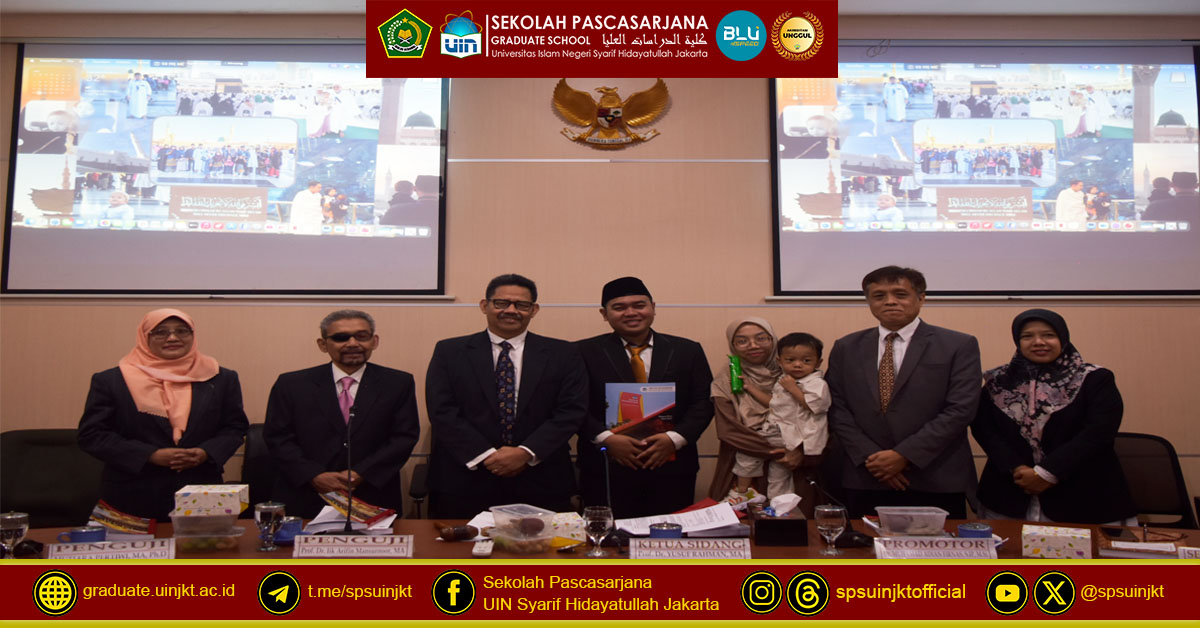
Malik Rahmatullah's Thesis Exam, Islamic Values and Pragmatism in Indonesia's Policy on the Iran-Israel Conflict
Auditorium of Prof. Dr. Suwito, MA SPs UIN Jakarta, SPs NEWS - The Graduate School (SPs) of UIN Syarif Hidayatullah Jakarta held the 2822nd Thesis Exam at the SPs Theater Room of UIN Jakarta on Monday, July 27, 2026 with candidate Malik Rahmatullah.
Malik is a student of the Master of Islamic Studies program with a concentration in Islam and International Relations. His thesis is entitled "Islam in Indonesian Foreign Policy: Regarding Peace in the Iran-Israel Conflict (2023-2025)".
This research examines how Islamic identity and normative foundations are articulated into Indonesia's foreign policy. This study captures Indonesia's unique position as the world's largest Muslim country that does not have diplomatic relations with Israel in responding to the pressures of religious solidarity and domestic strategic interests.
Through the analysis knife of Constructivism theory, Malik explained that Islamic norms and identities are not just complementary, but elements that form national interests. The Foreign Policy Analysis (FPA) approach is operationalized with constructivist logic to unravel how the ideas, conceptions of values, and identities of key domestic and international actors dynamically affect the direction of Indonesian diplomacy.
The main focus of this study highlights the presence of three fundamental Islamic values in the narrative of Indonesian diplomacy: justice (al-'adālah), the call for goodness and the prevention of evil (amar ma'rūf nahi munkar), and Islamic brotherhood (al-ukhuwwah al-islāmiyyah). These three normative values have been proven to color every policy rhetoric, both in the era of President Joko Widodo's leadership and President Prabowo Subianto's leadership.
The qualitative discourse analysis method is applied to various official documents of the Ministry of Foreign Affairs, presidential speeches, UN resolutions, and statements of the Organization of Islamic Cooperation (OIC). The results of this language analysis confirm that Indonesia's foreign policy discourse always associates its diplomatic actions with Islamic ethical principles.
In practice, these Islamic values work on two levels that complement each other. First, it serves as a source of moral legitimacy that strengthens Indonesia's foothold on the international stage. Second, it acts as a soft power capital that has been successfully converted into concrete diplomatic actions, one of which is through the appointment of a special envoy for the Middle East region.
Interestingly, this research reveals the dynamics of continuity and change along with the transition of national leadership from President Joko Widodo to President Prabowo Subianto. Although both eras have upheld the principle of free-active foreign policy, there has been a significant shift in emphasis in the style of diplomacy applied.
The Joko Widodo era (2023–2024) tends to be dominated by a normative-humanitarian approach that focuses on encouraging peaceful settlements based on international law and humanitarian values. On the contrary, the Prabowo Subianto era (2025) began to show a more pragmatic pattern, which was characterized by strengthening defense diplomacy, expanding strategic partnerships such as with Turkey, and open discourse related to normalizing relations with Israel.
The principle of a free-active foreign policy has proven to remain the main foundation of Indonesia's unshakable foreign policy. The change lies more in implementation tactics, moving from a normative approach to a more pragmatic step as a quick response to the increasingly complex global geopolitical landscape.
The findings of this thesis make important theoretical and practical contributions to the treasures of international relations and Islamic studies. Malik Rahmatullah's research emphasizes that Islamic values are not a separate variable from the free-active principle, but an integrated normative resource that consistently affirms Indonesia's role as a bridge builder in the midst of international conflicts.
Malik successfully defended his thesis under the guidance of Dr. Muhamad Adian Firnas, S.IP, M.Si, and was tested in front of a board of examiners consisting of Prof. Dr. Yusuf Rahman, MA, Dr. Muhamad Adian Firnas, S.IP, M.Si, Prof. Dr. Iik Arifin Mansurnoor, MA, Mutiara Pertiwi, MA, Ph.D.
After paying attention to the thesis writing, the comments of the examiner team and the candidate's answers, the examiner team determined that Malik Rahmatullah graduated with the title of Very Satisfactory. Malik Rahmatullah is the 2822nd Master in the field of Islamic Studies, in the Master's program of the Graduate School of UIN Syarif Hidayatullah Jakarta. (Jay A)