
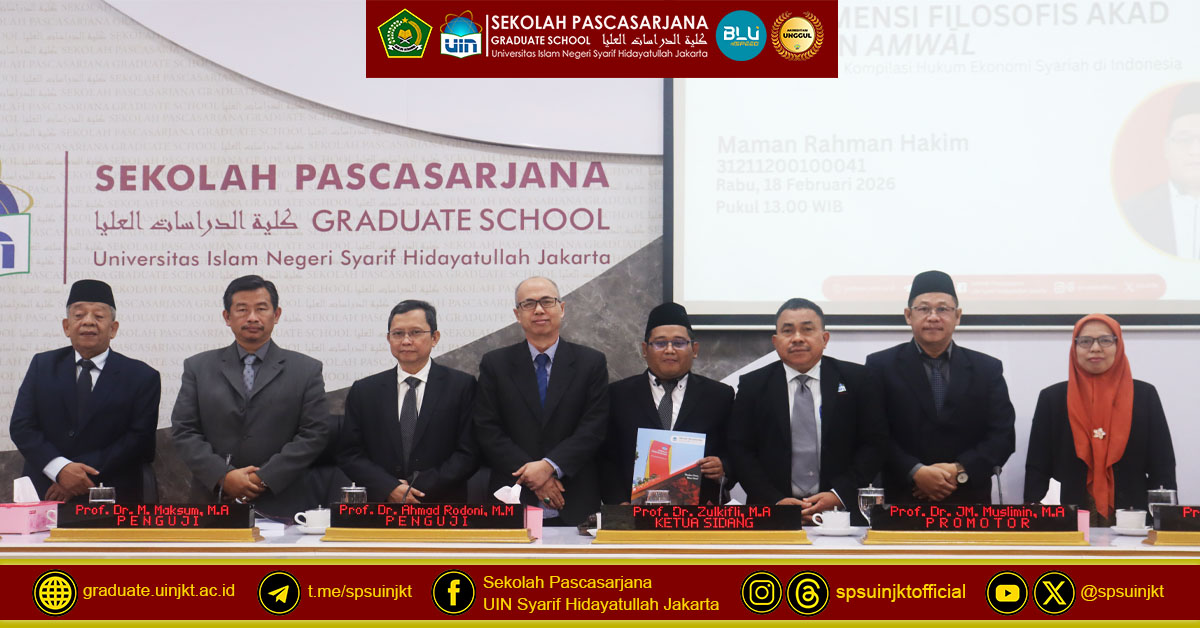
Maman Rahman Hakim Doctoral Promotion Exam: The Philosophical Dimension of Akad and Amwāl in the Compilation of Sharia Economic Law in Indonesia
Auditorium of Prof. Dr. Suwito, MA SPs UIN Jakarta, SPs NEWS – The Graduate School (SPs) of UIN Syarif Hidayatullah Jakarta held the 1667th Doctoral Promotion Exam in the Auditorium Room of Prof. Dr. Suwito, MA on Wednesday, February 18, 2026 with promovendus Maman Rahman Hakim.
Maman is a student of the Doctoral program in Islamic Studies with a concentration in Sharia Economic Law. His dissertation is entitled "The Philosophical Dimension of Akad and Amwāl in the Compilation of Sharia Economic Law in Indonesia".
This research was born out of academic anxiety about the practice of sharia economics which is often only trapped in the symbol of formality without touching the essence of deep justice.
The main focus of this research is to dissect the legal basis and philosophical dimensions that surround the concepts of akad (agreement) and amwāl (property). Maman seeks to explore further how ethical values should animate every sharia economic transaction so that it is not just a copy of the conventional system labeled sharia.
In his presentation, Maman emphasized four crucial goals, one of which is to construct a paradigm that becomes a solid foothold for sharia economic law in the country. He also made sharp criticism of the philosophical aspects of contracts and assets in the Compilation of Sharia Economic Law (KHES) to ensure that the regulation remains relevant to the spirit of the times.
The methodology used in this study is library research with a qualitative approach. Maman collected primary data from the KHES text and compared it with classical and modern Islamic economic literature to produce a comprehensive descriptive analysis.
Maman applies a comprehensive philosophical analysis that touches on aspects of epistemology, ontology, and axiology. He dissects legal issues through the lens of ethics and aesthetics, combining pragmatic philosophical perspectives with statutory and historical approaches.
One of the interesting findings in this study is that the foothold of sharia economic law in Indonesia is rooted in historical and formalistic paradigms. However, Maman emphasized that the spirit of this system still rests on the values of tawḥīd, social justice, the prohibition of gharar (uncertainty), and high social responsibility.
In its philosophical dimension, property is seen not as the absolute property of man, but as a mandate from the Creator. Meanwhile, the contract is positioned as a vital instrument to create justice and benefits for all parties involved in the transaction, not just black on white.
This research also highlights the ethical aspects of legal subjects, especially regarding legal skills (ahliyyah). Maman emphasized the importance of a protection mechanism for parties who are considered legally incompetent so that there is no exploitation in the sale and purchase transaction (al-bay') regulated in the KHES.
Practical problems in the field did not escape the shot. Maman criticized the dualism of competence between the Religious Courts and the General Court in handling Islamic banking disputes. The issue of choice of forum is still considered an obstacle in providing legal certainty for the community.
The peak of his thoughts, Maman offered a novelty called the Contract of Justice Audit Model. This principle emphasizes that any transaction involving assets and agreements must go through a moral audit to ensure it comes down to substantive justice values.
With a comparative study between Islamic and conventional economics, as well as KHES and the Civil Code, this study is expected to be a roadmap for regulators. Maman closed his presentation with the hope that sharia economic law in Indonesia will find a more ideal, contextual, and equitable format for all levels of society.
Maman successfully defended his dissertation under the guidance of Prof. Dr. JM Muslimin, MA, Prof. Dr. Rusli, S.Ag, M.Soc.Sc, Prof. Nur Hidayah, S.Ag, SE, MA, MA, MA, Ph.D, and was tested in front of a board of examiners consisting of Prof. Dr. Zulkifli, MA, Prof. Dr. JM Muslimin, MA, Prof. Dr. Rusli, S.Ag, M.Soc.Sc, Prof. Nur Hidayah, S.Ag, SE, MA, MA, MA, Ph.D, Prof. Dr. Ahmad Rodoni, MM, Prof. Dr. Muhammad Maksum, MA, Prof. Dr. H. Abd. Rahman, MA.
After paying attention to the dissertation writing, the comments of the examiner team and the answers of the promovendus, the examiner team determined that Maman Rahman Hakim graduated with the title of Very Satisfactory. Maman Rahman Hakim is the 1667th Doctor in the field of Islamic Studies, a doctoral program at the Graduate School of UIN Syarif Hidayatullah Jakarta. (JA)