
Marifat Kilwakit Thesis Exam: Interaction between Islam, Social Caste, and Exogamous Marriage in the Kei Islands
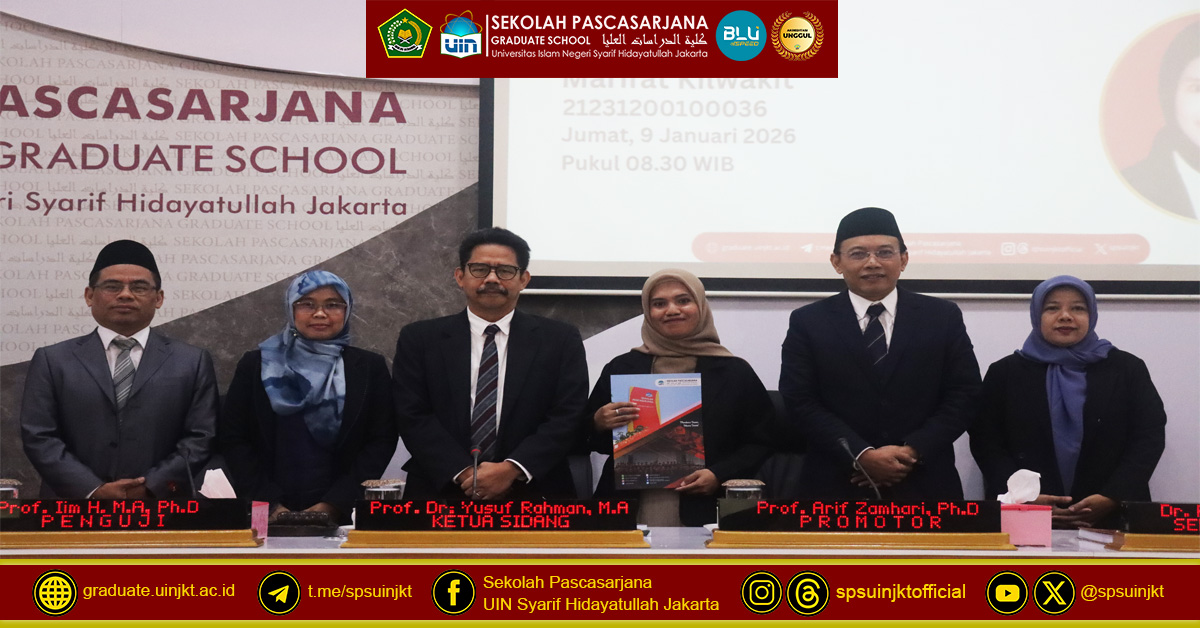
Auditorium Prof. Dr. Suwito, MA SPs UIN Jakarta, SPs NEWS: The Graduate School of Syarif Hidayatullah State Islamic University Jakarta held the 2791st Thesis Exam in the Auditorium Room of Prof. Dr. Suwito, MA, on Friday, January 9, 2025 with candidate Marifat Kilwakit.
Marifat is a student of the Master of Islamic Studies study program with a concentration in Anthropology and Sociology of Religion. Ririn wrote a thesis entitled "The Interaction between Islam, Social Caste, and Exogamous Marriage in the Kei Islands".
This study captures how religion and tradition intertwine, intersect, and sometimes clash in a domestic scope called marriage.
The main objective of this study is to dissect the role of local traditions and social caste systems in shaping exogamous marriage patterns in the Kei Islands. Marifat analyzes how Islamic values deal with established customary structures in influencing decision-making and social sanctions.
Through a qualitative approach based on case studies, Marifat collected primary data through observation and in-depth interviews. Using the snowball sampling technique, he succeeded in exploring the perspectives of 13 key informants consisting of traditional leaders, religious leaders, and local communities who understood the pulse of TKei culture.
This research was also strengthened by the analysis of Larvul Ngabal customary law documents and relevant secondary literature. Marifat brings the main thesis that in religious anthropology, a belief is never present in a vacuum, but always interacts with a deep-rooted configuration of power.
The author argues that the application of Islamic values in various local contexts shows a very dynamic dialectic. Religion not only shapes culture, but at the same time, religion is also "formed" and reinterpreted by the culture in which it is based.
The internalization of these teachings does not take place uniformly throughout the archipelago. Marifat emphasized that every community, including those in the Kei Islands, negotiates the teachings of Islam according to their collective identity and social hierarchy patterns that they have inherited from generation to generation.
Interesting findings in this study highlight the manifestation of Islam in Ohoi (Village) Danar. Marifat found that Islamic practices there do not always reflect the ideals of inclusive and moderate teachings, but often reproduce the inequalities that exist in the structure of society.
The social structure of the Kei society is apparently built on a caste system that is a closed stratification. This system essentially hinders social mobility, creating barriers that are difficult to penetrate between the social classes of the society.
Marifat details the existence of three main castes: Mel-mel who are prominent aristocrats or immigrants, Ren-ren as natives, and Iri-iri, who have historically been placed as slaves or emissaries. This status is hereditary or inherited through lineage.
In its configuration, the Mel-mel group dominated the customary structure and held control of power. On the other hand, the Ren-ren and Iri-iri groups are often in a subordinate inferior position, especially in terms of choosing a life partner and family relationships.
From an Islamic perspective, Marifat sees a "value dissonance." On the one hand, Islam emphasizes equality (al-musawah) and freedom of choice, but on the other hand, local culture hegemonicly restricts individual autonomy in order to maintain caste purity through the prohibition of certain exogamous marriages.
This research also strengthens and enriches the findings of previous academics such as Nur Aida Kubangun to Elly Esra Kudubun. Marifat Kilwakit's work emphasizes that the challenges of da'wah and sociology in the Kei Islands still dwell on a rigid caste system and perpetuate a power-based hierarchy.
Marifat Kilwakit successfully defended her thesis under the guidance of Prof. Arif Zamhari, M.Ag, Ph.D, and was tested in front of a board of examiners consisting of Prof. Dr. Yusuf Rahman, MA, Prof. Arif Zamhari, M.Ag, Ph.D, Prof. Iim Halimatusa'diyah, MA, Ph.D and Ahmad Abrori, M.Si, Ph.D.
After paying attention to the thesis writing, the comments of the examiner team and the candidate's answers, the examiner team determined that Marifat Kilwakit graduated with the predicate of Laude. Marifat Kilwakit is the 2791st master in the field of Islamic Studies, in the master's program of the Graduate School of UIN Syarif Hidayatullah Jakarta. (JA)