
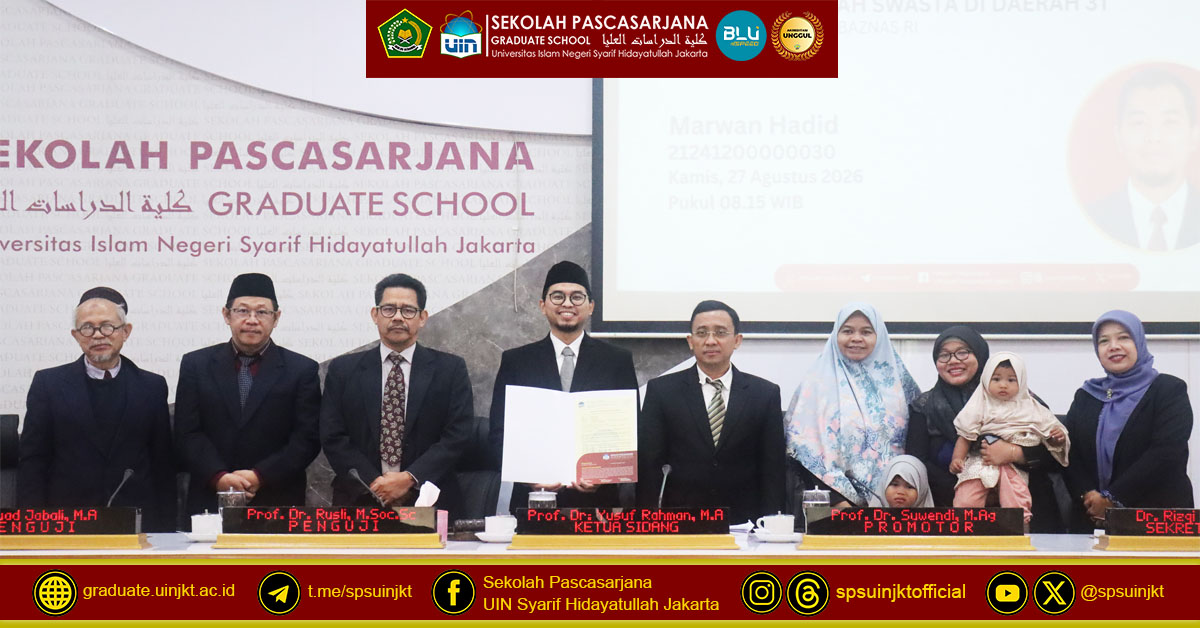
Marwan Hadid's Thesis Exam, Utilization of BAZNAS RI Zakat Changes the Face of Madrasah 3T
Auditorium Prof. Dr. Suwito, MA SPs UIN Jakarta, SPs NEWS - The Graduate School (SPs) of UIN Syarif Hidayatullah Jakarta held the 2841st Thesis Exam at the Auditorium Room of Prof. Dr. Suwito, MA SPs UIN Jakarta on Thursday, August 27, 2026 with candidate Marwan Hadid.
Marwan is a scholarship recipient of the BAZNAS RI scholarship program for the Master of Islamic Studies program with a concentration in Islamic Philanthropy, thesis entitled "Utilization of Zakat for Private Madrasah Infrastructure in the 3T Area: A Case Study of BAZNAS RI". Marwan presented his scientific work that highlighted the effectiveness and religious dimension of educational assistance programs in remote areas.
This study aims to analyze the normative rationality and implementation of zakat utilization for physical development through the BAZNAS RI Learning-Worthy Madrasah Program in disadvantaged, frontier, and outermost areas (3T), as well as explore the meaning of teachers and students on changes in the quality of learning in their schools.
To dissect this phenomenon, Marwan chose a qualitative approach with a case study design based on the analysis of the Miles and Huberman model. Field data was obtained through in-depth interviews with the leaders, management, and implementers of the BAZNAS RI program, as well as madrasah heads, teachers, and students in the 13 Private Ibtidaiyah Madrasah (MIS) beneficiaries in 2024 which were strengthened by a documentation study.
The findings show that BAZNAS RI utilizes zakat funds for the development of educational infrastructure on the basis of comprehensive considerations, including normative, strategic, and institutional aspects. This step is an important concern considering the fundamental difference between zakat and other Islamic philanthropic instruments.
In his argument, Marwan emphasized that zakat is exclusive because its allocation has been expressly determined (naṣṣ) for eight groups (asnaf), different from infak and almsgiving which are more inclusive. This condition often makes the development of madrasah physical infrastructure considered to be beyond the reach of the conventional meaning of asnaf.
However, the insistence of basic needs in the field that threaten the safety of life (ḥifẓ al-nafs) and interfere with the continuity of teaching and learning activities requires benefit-based reading (maṣlaḥah). This interpretation is allocated to the post of fī sabīlillāh by going beyond the classical interpretation that is limited to the meaning of war, so that the distribution of zakat acquires sharia legitimacy through the expansion of the meaning of asnaf. In order not to widen, there are two main filters as a barrier: the assets that are built are in a management status and the benefits must return to the clearly identified mustaḥiq.
However, normative readings that place physical improvement as a means (wasīlah) of maintaining reason (ḥifẓ al-ʿ aql) have only been partially and gradually realized in the field. The contribution of building repairs to improving the quality of learning varies, depending on the extent to which the assistance responds to the most urgent needs in each madrasah.
From the perspective of the beneficiaries, students and teachers interpret the improvement of the infrastructure as capital to support learning comfort, not as the main determining variable that directly improves academic achievement. Nevertheless, the presence of more decent buildings has been proven to create a safer and conducive school climate.
Theoretically, Marwan Hadid's research has succeeded in expanding previous studies of Islamic education philanthropy, such as the study of Latief and Amirrachman (2016), by injecting the dimension of sharia legitimacy into the scope of 3T madrasas. This thesis also answers the doubts of academics such as Diallo and Gundogdu (2021) who reject the use of zakat for physical development, by proving that infrastructure allocation can be justified as long as the principle of its usefulness boils directly down to MustbeIQ.
Marwan successfully defended his thesis under the guidance of Prof. Arif Zamhari, M.Ag, Ph.D and Prof. Dr. Suwendi, M.Ag, and was tested in front of a board of examiners consisting of Prof. Dr. Yusuf Rahman, MA, Prof. Arif Zamhari, M.Ag, Ph.D, Prof. Dr. Suwendi, M.Ag, Prof. Dr. Rusli, S.Ag, M.Soc.Sc, Dr. Fuad Jabali, MA.
After paying attention to the thesis writing, the comments of the examiner team and the candidate's answers, the examiner team determined that Marwan graduated with the predicate of Cum Laude. Marwan Hadid is the 2841st Master's in the field of Islamic Studies, in the Master's program of the Graduate School of UIN Syarif Hidayatullah Jakarta. (Jay A)