
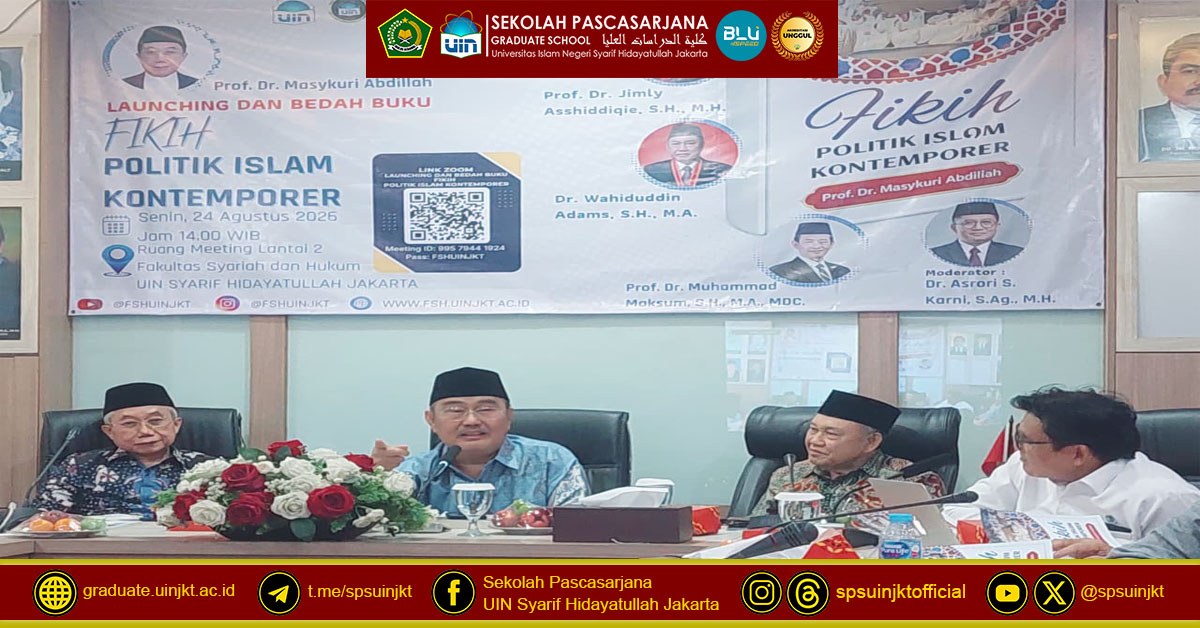
Masykuri Abdillah: Political Fiqh Must Be Contextual, the Form of the State Is Not a Frozen Doctrine
JAKARTA, SPs NEWS — Professor of UIN Syarif Hidayatullah Jakarta Prof. Masykuri Abdillah emphasized that political jurisprudence must be placed as an ijtihad area that is open to change. Islam provides basic principles and values in political life, but does not establish a form of state that must be uniformly enforced throughout Muslim societies.
This view was conveyed by Masykuri when presenting his latest book, Contemporary Islamic Political Fiqh, at the Faculty of Sharia and Law (FSH) UIN Jakarta, Monday (24/8/2026). The book examines the problems of the state and citizens by bringing together Islamic treasures, modern political theory, legal science, and contemporary social developments.
According to Masykuri, political jurisprudence cannot be formulated simply by moving classical concepts into the present reality. The text must be read together with the context in which the opinion was born, the changes in the world that occurred, and the needs of society today.
"We have to look at the text, context, and interpretation. What was the context at that time, how is it now, and how should we behave," said the alumni of the Jombang Sugarcane Ireng Islamic Boarding School.
He called his book's approach a normative study with a contextual fiqh style. Democracy, human rights, political parties, opposition, freedom of opinion, equality of citizens, and political ethics are discussed as issues that must be answered through a new ijtihad.
Masykuri also distinguishes between Islamic countries and Muslim countries. An Islamic state, according to the academic definition it uses, is a country that formally places sharia as a positive law or the primary source of law. The Muslim country is a country where the majority of the population is Muslim, even though the form of the state and its constitution do not use the label of Islam.
"Islamic countries and Muslim countries must be differentiated. The task of academics is to distinguish something that is indeed different," he said.
The distinction is important to avoid the notion that every Muslim-majority country should take the same institutional form. The form of the state, the system of government, and the mechanism of change of power can differ according to the history, culture, and agreement of each society.
In the question and answer session, questions arose about the position of the caliphate and democracy. Masykuri explained that political issues are areas that can change. Therefore, the caliphate is not appropriately placed as the only standard form of state in Islam.
He also assessed that democracy is not sufficiently understood as a Western product that must be accepted or rejected as a whole. Elements of deliberation, participation, power supervision, and accountability of officials can be found in the Islamic tradition. However, its implementation still requires adjustment to the structure and culture of the community.
Masykuri included the opposition as an acceptable part of contemporary political jurisprudence. The opposition should not be seen as an act of breaking unity. Opposition can be a means of power control if it is carried out properly within the framework of amar makruf nahi mungkar.
"Opposition is allowed if it is part of the amar makruf nahi mungkar and is carried out properly," said the son of Kendal, Central Java who completed his doctorate at the University of Hamburg, Germany.
The book also discusses jihad. Masykuri rejects readings that make jihad the basis of an indefinite offensive war. By examining the cause and context of the descent of the verse, he argues that the verses of war are related to defense against threats and attacks.
Prof. Jimly Asshiddiqie considers Masykuri's approach relevant to overcome the view of separation between jurisprudence and law. According to him, political and legal theories that come from outside the Islamic world do not need to be automatically treated as something that is contrary to Islam.
Jimly also asked that the study of the caliphate be placed in a historical perspective. The term was once associated with power that went beyond certain territorial boundaries. In modern history, cross-border power patterns have also emerged in the form of empires, commonwealths, and geopolitical influence of large countries.
Therefore, said Jimly, the debate should not stop at the use of the term. What is more important is whether a system guarantees justice, limits power, protects citizens, and allows deliberation to take place.
Dr. Wahiduddin Adams added that the study of political jurisprudence needs to absorb more of Indonesia's experience. The formulation of the constitution, the establishment of religious courts, and the inclusion of sharia principles into the law are important materials for developing Islamic political theories that do not depend on the experiences of other countries.
The Rector of UIN Jakarta, Prof. Asep Saepudin Jahar appreciated the seriousness and authenticity of Masykuri's work. According to him, the book shows that the integration of knowledge can be done through research and writing that brings together sharia studies with actual legal and political issues.
Masykuri admitted that the studies in his book can still be developed. He plans to write further on Islam and the Indonesian state, the constitution, legislation, and the experience of institutionalizing Islamic values.
For him, the development of political jurisprudence is not a project to revive the form of the past state. Its main agenda is to formulate the values of justice, equality, benefits, freedom, and the responsibility of power in order to work in the context of the modern state.
This book review takes place offline and online. It was attended by the Dean of FSH, Prof. Muhammad Maksum, Vice Deans Prof. Kamarusdiana and Dr. Afwan Faizin, Head of the FSH Sharia Science S3 Study Program, Prof. Yayan Sopyan, and 30 other UIN Jakarta academics. On the online route, Vice Chancellor I, Prof. Ahmad Tholabi, and the Chairman of the Center for Fatwa and Islamic Law Studies (Pusfahim) UIN Jakarta, Prof. Asrorun Ni'am, were also present. The discussion, which was moderated by Dr. Asrori S. Karni, lasted almost three hours with a very lively audience response. (Ferdian Andi)