
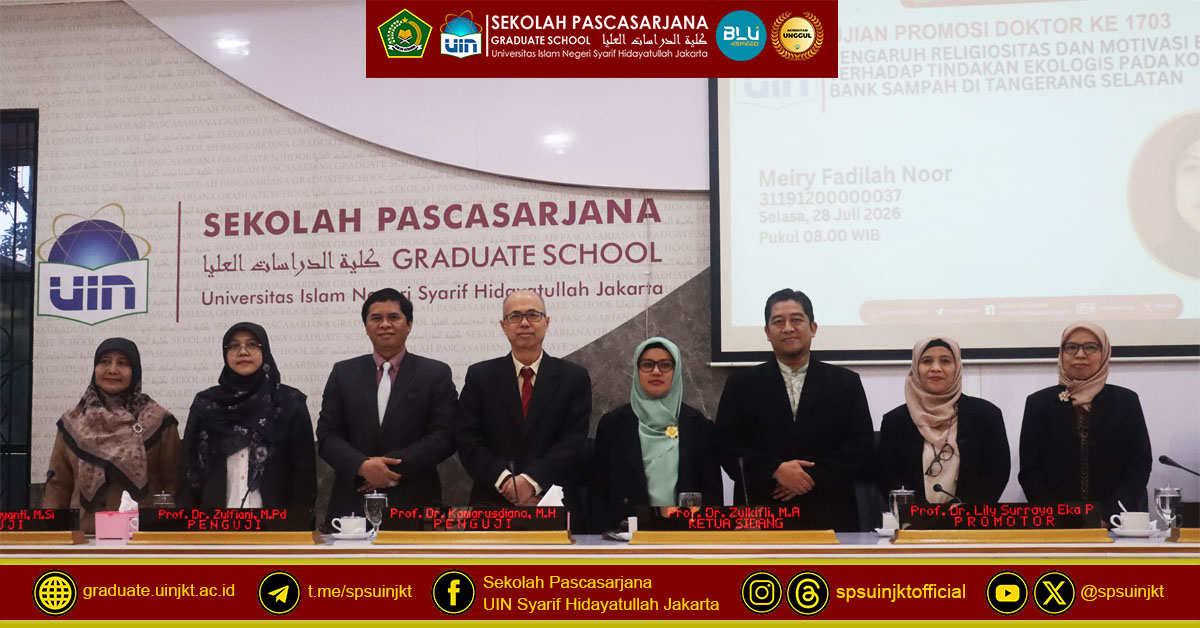
Meiry Fadilah Noor's Doctoral Promotion Exam, Deciphering Waste with Faith: Religiosity Becomes the Main Key to Environmental Sustainability in South Tangerang
Auditorium Prof. Dr. Suwito, MA SPs UIN Jakarta, SP NEWS – The Graduate School (SPs) of UIN Syarif Hidayatullah Jakarta held the 1703rd Doctoral Promotion Exam in the Auditorium Room of Prof. Dr. Suwito, MA on Tuesday, July 28, 2026 with promovenda Meiry Fadilah Noor.
Meiry is a student of the Doctoral program in Islamic Studies with a concentration in Religion and Science. His dissertation is entitled "The Influence of Religiosity and Economic Motivation on Ecological Actions in the Waste Bank Community in South Tangerang".
The research stemmed from concerns about the increasing ecological pressure in urban areas, especially around the Cipeucang Final Processing Site (TPA), South Tangerang City.
Through her research, Meiry aims to analyze the condition of plant and insect biodiversity around the Cipeucang Landfill as a real indicator of environmental pressure. In addition, this study aims to examine the extent to which religiosity and economic motivation affect people's ecological knowledge and behavior, as well as dissect the relationship between the two in the perspective of the Social-Ecological System (SES).
In order to get a comprehensive picture, Meiry applied a mixed methods approach with an Explanatory Sequential design. The stage begins by measuring biodiversity in the area around the Cipeucang Landfill using the Shannon–Wiener diversity index, the Simpson dominance index, and the species equality index to read the health of the local ecosystem.
The results of the initial measurements show an interesting fact: the area around the Cipeucang Landfill still has a fairly maintained biodiversity of plants and insects. This reflects that the ecological function of the local ecosystem is still running and surviving, despite continuing to receive heavy pressure due to city-scale garbage collection activities.
At the quantitative stage, this study involved 193 members of the Waste Bank community in South Tangerang City who met the criteria. Data testing was carried out using Partial Least Squares Structural Equation Modeling (PLS-SEM) analysis to see the relationship between variables in a measurable manner.
The findings from the PLS-SEM analysis showed significant results. Religiosity has been proven to have a strong influence on improving knowledge and ecological behavior of the community. In contrast, economic motivation did not show a significant influence on these two variables, breaking the assumption that financial incentives have always been the main drivers of environmental action.
Based on the value of the determination coefficient, religiosity and economic motivation were simultaneously able to explain 14.2% variation in ecological knowledge and 15.8% variation in ecological behavior of citizens. To deepen the quantitative findings, Meiry continued in-depth interviews that were analyzed using Thematic Analysis and integrated through joint display techniques.
From the results of the interview, it was revealed that the values of Islamic teachings such as the concept of trust, the role of humans as caliphs on earth, and the moral responsibility to protect nature are the main foundations that encourage the ecological actions of citizens. On the other hand, the Waste Bank community has proven to be effective in functioning as a social learning space that strengthens knowledge, forms environmentally friendly habits, and triggers active community participation.
This research makes an invaluable empirical and conceptual contribution in understanding the relationship between ecological pressures and real community action. By synthesizing biodiversity findings, quantitative analysis, and qualitative interviews into the Social-Ecological System (SES) framework developed by Ostrom (2009), this research successfully enriched the application of the SES model to community-based waste management in urban areas.
Meiry successfully defended her dissertation under the guidance of Prof. Dr. Zulkifli, MA, Prof. Dr. Lily Surayya Eka Putri, M.Env.Stud, and was tested in front of a board of examiners consisting of, Prof. Dr. Kamarusdiana, MH, Prof. Dr. Zulfiani, S.Si, M.Pd, Dr. Fahma Wijayanti, M.Si.
After paying attention to the dissertation writing, the comments of the examiner team and the promovenda's answers, the examiner team determined that Meiry Fadilah Noor graduated with the title of Very Satisfactory. Meiry Fadilah Noor is the 1699th Doctor in the field of Islamic Studies, doctoral program of the Graduate School of UIN Syarif Hidayatullah Jakarta. (Jay A)