
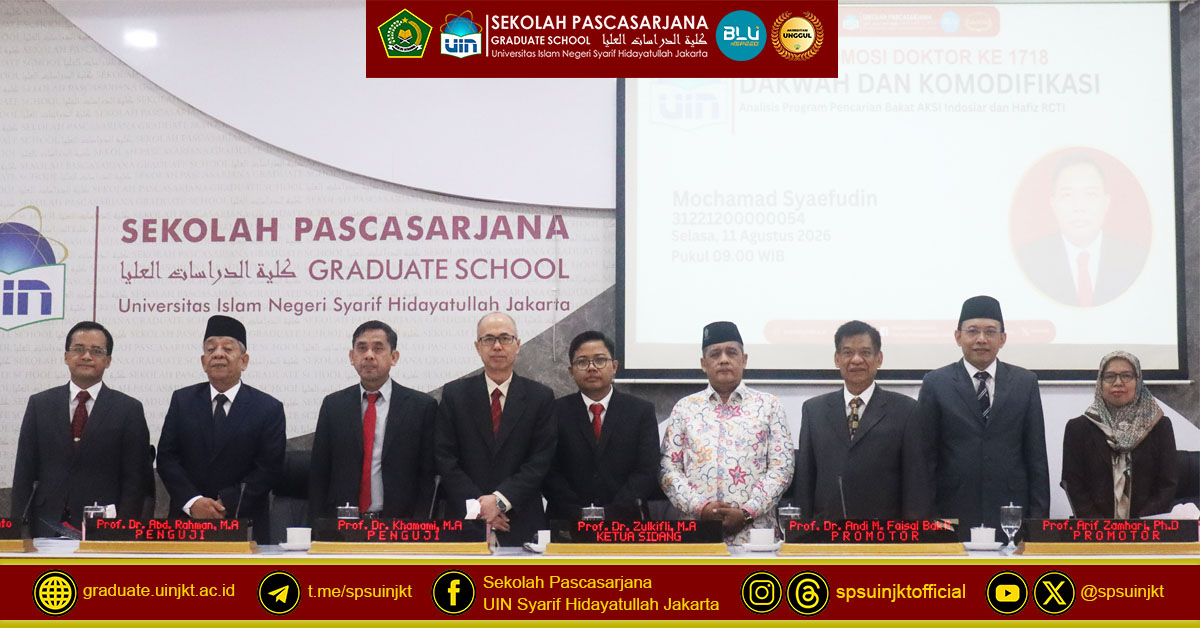
Mochamad Syaefudin Doctoral Promotion Exam, Da'wah and Commodification: Analysis of the Talent Search Program of AKSI Indosiar and Hafiz RCTI
Auditorium of Prof. Dr. Suwito, MA SPs UIN Jakarta, SP NEWS – The Graduate School (SPs) of UIN Syarif Hidayatullah Jakarta held the 1718th Doctoral Promotion Exam in the Auditorium Room of Prof. Dr. Suwito, MA Graduate School on Tuesday, August 11, 2026 with promovendus Mochamad Syaefudin.
Syaefudin is a student of the Doctoral program in Islamic Studies with a concentration in Da'wah and Communication. His dissertation is entitled "Da'wah and Commodification: Analysis of the Talent Search Program of AKSI Indosiar and Hafiz RCTI".
This dissertation was born from academic anxiety about the rampant practice of religious commodification in the talent search program for preachers and memorizers of the Qur'an. Even though they are packaged in the wrapping of a television entertainment industry that is thick with commercial aspects, these programs have proven to remain a spectacle that is in great demand by the wider public.
To dissect this phenomenon in depth, Syaefudin combines three theoretical analysis knives. He uses the communication theory of media production from Gill Branston and Roy Stafford (preproduction, production, postproduction), the political economy theory of media from Vincent Mosco (commodification of content, audience, and labor), and the theory of Islamic communication from Andi Faisal Bakti (tablīgh, taghyīr, amr maʿrūf nahy munkar, and Akhlāq/Khayru Ummah).
Methodologically, this research adopts a critical paradigm with a transdisciplinary approach that combines communication science, sociology, and da'wah studies. The researcher explored primary data through in-depth interviews with the participants, the jury, and the producers of the AKSI Indosiar and Hafiz RCTI programs, which were refined by observation and document search on television, digital, and social media platforms.
The first findings of this study map in detail the stages of media production in the two programs. The production flow is systematically divided from pre-production (ideation, audition, quarantine, and rehearsal), production stage (live and taping), to post-production which focuses on editing and screening evaluation.
The second finding reveals the forms of commodification that occur in the television industry. The commodification of content is evident when religious content is combined with entertainment elements such as comedy, music, games, and gimmicks. Meanwhile, audience commodification occurs when audience participation is used to boost ratings and shares in order to attract ads, while labor commodification positions participants, hosts, and judges as media workers in the daily viewing system (stripping).
Uniquely, in the third finding, this research revealed that the motivation of the participants was not only oriented to popularity or material alone. Their participation is driven by the intention of noble practices, self-development, Islamic values, personal beliefs, and community support. This sublime motivation is proven to be still in line with the corridor of Islamic da'wah values.
The results of this analysis also bring a strong argument that refutes the findings of senior researcher Ariel Heryanto (2008). If Heryanto said that the main motivation of the participants of the talent search program was solely for the sake of popularity and a career in the entertainment world, Syaefudin's findings actually prove that the pure intention to preach remains the main motivation of the participants behind the glittering television stage.
On the other hand, the accumulation of this commodification practice provides financial and non-financial benefits for television stations, juries, and participants. Talent search programs such as AKSI and Hafiz RCTI have also strengthened their position as a contemporary da'wah media that promises a popular stage for the birth of new preachers.
In conclusion, the dynamic between da'wah and commodification is increasingly nourishing the phenomenon of da'wah tainment (da'wah-entertainment) in the mass media. Syaefudin's findings strengthen the study of Dicky Sofjan (2013) who defined da'wah tainment as a systematic cross between spiritual enlightenment and entertainment, a compromising phenomenon that often risks reducing the weight of the religious message itself.
Syaefudin successfully defended his dissertation under the guidance of Prof. Dr. Andi Faisal Bakti, MA, Prof. Arif Zamhari, M.Ag, Ph.D, and was tested in front of a board of examiners consisting of Prof. Dr. Zulkifli, MA, Prof. Dr. Andi Faisal Bakti, MA, Prof. Arif Zamhari, M.Ag, Ph.D, Prof. Dr. H. Abd. Rahman, MA, Prof. Dr. Khamami, MA, Prof. Dr. Gun Gun Heryanto, M.Si.
After paying attention to the writing of the dissertation, the comments of the examiner team and the answers of the promovendus, the examiner team determined that Syaefudin graduated with the title of Very Satisfactory. Mochamad Syaefudin is the 1718th Doctor in the field of Islamic Studies, doctoral program of the Graduate School of UIN Syarif Hidayatullah Jakarta. (Jay A)