
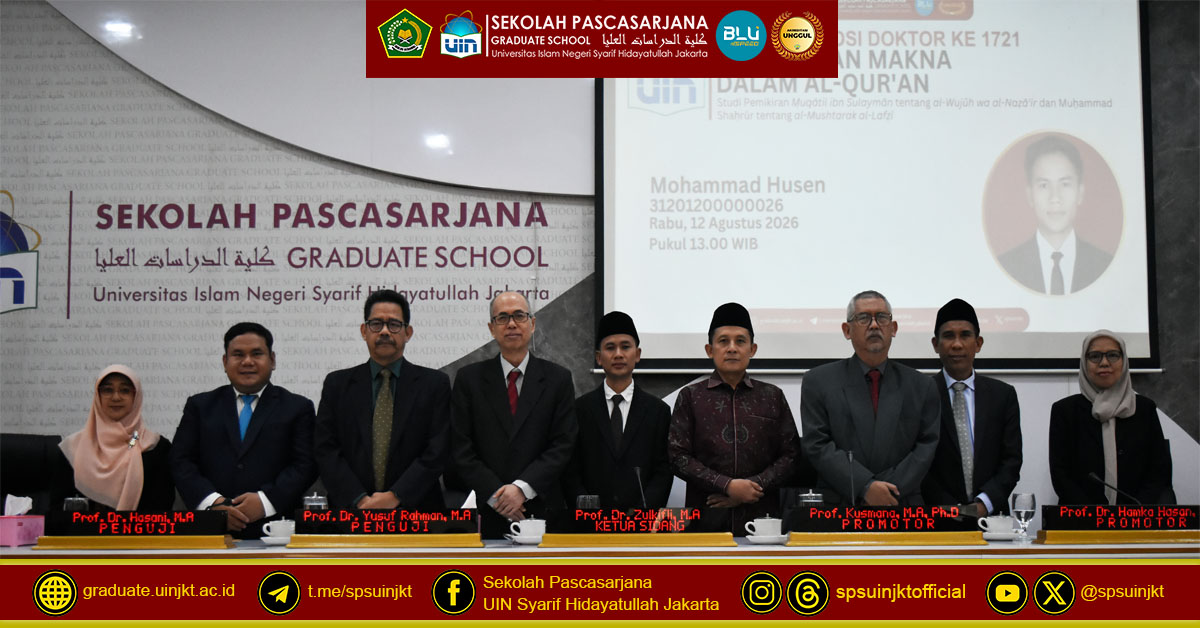
Mohammad Husen Doctoral Promotion Exam, Diversity of Meanings in the Qur'an
Auditorium of Prof. Dr. Suwito, MA SPs UIN Jakarta, SPs NEWS – The Graduate School (SPs) of UIN Syarif Hidayatullah Jakarta held the 1721st Doctoral Promotion Exam in the Auditorium Room of Prof. Dr. Suwito, MA Graduate School on Wednesday, August 12, 2026 with promovendus Mohammad Husen.
Husen is a student of the Doctoral program in Islamic Studies with a concentration in Tafsir. His dissertation was entitled "Diversity of Meanings in the Qur'an (Study of Muqātil ibn Sulaymān's Thought on al-Wujūh wa al-Naẓā'ir and Muḥammad Shaḥrūr on al-Mushtarak al-Lafẓī)". Through this research, Husen brought together two thinkers from very opposite eras to test the idea of relativity of meaning in sacred texts.
On the one hand, there is Muqātil ibn Sulaymān, a classical scholar who mapped the diversity of meanings of words (al-wujūh wa al-naẓā'ir) based on the context of the verse and the root of the language. On the other hand, stands Muḥammad Shaḥrūr, a modern thinker who gave birth to the concept of al-mushtarak al-lafẓī (polysemity) based on his grand view: thabāt al-naṣṣ wa taghayyur al-muḥtawā that the text of the Qur'an remains, but the content of its meaning continues to develop.
To dissect the flow of thought of the two figures, Husen formulated a number of important problem formulations. He examines how the understanding and practice of the methods of both, looking for common points and differences epistemologically, until they re-examine the concept hermeneutically so that it remains relevant in contemporary Islamic studies.
Methodologically, this qualitative research based on literature review is dissected using Hans-Georg Gadamer's hermeneutic analysis knife. Through a historical, pre-understanding, and horizon fusion approach (Horizontverschmelzung), Husen seeks to bridge the context of the past with the horizon of the present reader.
A number of monumental works were also used as the main source of data. Husen dug up classics such as Tafsīr al-Kabīr and Tafsīr al-Wujūh wa al-Naẓā'ir attributed to Muqātil, and then questioned them with key books by Shaḥrūr, including al-Kitāb wa al-Qur'ān and Nahwa Uṣūl Jadīdah li al-Fiqh al-Islāmī: Fiqh al-Mar'ah.
From this in-depth search, this study yielded fresh preliminary findings: both al-wujūh wa al-naẓā'ir and al-mushtarak al-lafẓī are not just descriptive tools for recording the meaning of words. More than that, both are living interpretive methods. From this was born a new theoretical concept initiated by Husen, namely al-dalālah al-ta'addudiyyah al-mutaḥarrikah , a plural and dynamic system of meaning of the Qur'an.
Subsequent findings show that Muqātil and Shaḥrūr both agreed to reject a single interpretation that freezes the text. Even so, their epistemological footing differs sharply. Muqātil moves from the historical-classical tradition, while Shaḥrūr steps from the ahistorical-rational point of view. The idea of bringing these two figures together with Gadamer's hermeneutic glasses is a patching of scientific gaps that have not been touched by previous researches.
In closing, Husen's research makes an important contribution to the development of contemporary interpretation studies. By emphasizing the relativity of meaning as an inevitability, this study succeeds in knitting a dialogue between classical and modern traditions. The concept of al-dalālah al-ta'addudiyyah al-mutaḥarrikah that he offers combines the linguistic rigor of Muqātil with the contextual flexibility of Shaḥrūr as a model of Qur'anic reading that is in tune with the times.
Husen successfully defended his dissertation under the guidance of Prof. Kusmana, MA, Ph.D, Prof. Dr. Hamka Hasan, MA, and was tested in front of a board of examiners consisting of Prof. Dr. Zulkifli, MA, Prof. Kusmana, MA, Ph.D, Prof. Dr. Hamka Hasan, MA, Prof. Dr. Yusuf Rahman, MA, Prof. Dr. Lilik Ummi Kaltsum, MA, Prof. Dr. Hasani, MA.
After paying attention to the writing of the dissertation, the comments of the examiner team and the answers of the promovendus, the examiner team determined that Husen graduated with the title of Very Satisfactory. Mohammad Husen is the 1721st Doctor in the field of Islamic Studies, a doctoral program at the Graduate School of UIN Syarif Hidayatullah Jakarta. (Jay A)