
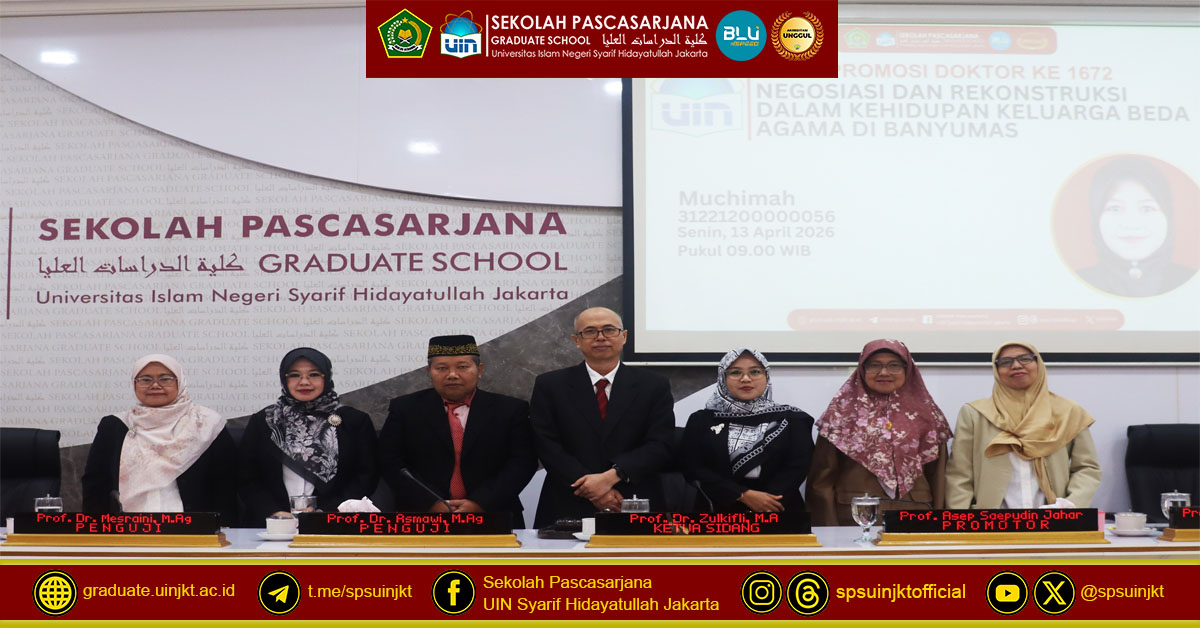
Muchimah Doctoral Promotion Exam, Negotiation and Reconstruction in Interfaith Family Life in Banyumas
Auditorium of Prof. Dr. Suwito, MA SPs UIN Jakarta, SPs NEWS – The Graduate School (SPs) of UIN Syarif Hidayatullah Jakarta held the 1672nd Doctoral Promotion Exam in the Auditorium Room of Prof. Dr. Suwito, MA on Monday, April 13, 2026 with promovenda Muchimah.
Muchimah is a student of the Doctoral program in Islamic Studies with a Concentration in Sharia. His dissertation is entitled "Negotiation and Reconstruction in the Life of Interfaith Families in Banyumas".
This study explains how the pluralist characteristics of the Banyumas society become a space that allows interfaith marriage to take place without becoming something socially taboo.
The main focus of this study is to analyze how these families negotiate conflicts over the reality of their daily rituals. Muchimah examines the legal culture that develops in the field to then formulate the construction of an ideal legal culture that can be a reference in seeing diversity in Indonesia.
In its course, this field research uses qualitative methods with a legal anthropological approach. Muchimah conducted in-depth observations and interviews with seven couples of different religions (Islam with Christianity, Catholicism, Hinduism, and Buddhism) and involved seven religious leaders in a focus group discussion (FGD) to verify the data comprehensively.
One of the most interesting findings is that conflict negotiations in interfaith families in Banyumas do not occur randomly or sporadically. Rather, the process forms a repetitive and systematic adaptive pattern in order to maintain relational harmony between family members who have different beliefs.
The first pattern found was the legal application of bricolage and ritual layering. In practice, couples actively assemble layered legitimacy by separating the sacramental realm or contract from the realm of state administration through civil registration, so that the relationship remains social-administratively valid without ignoring each other's theology.
The second pattern highlights the use of a "culturally neutral space" through the local tradition of Javanese Banyumasan as a third language. This tradition has proven to be effective in reducing the intensity of symbolic conflicts, especially at crucial moments such as birth rites, marriages, deaths, and religious holidays.
Furthermore, Muchimah found the principle of minimal harm and minimum symbol as the third pattern. Each family member seeks to reduce signs, gestures, or utterances that have the potential to hurt the spiritual dignity of the other party so that the tension that arises never turns into an open dispute that damages the relationship.
Sensitive issues regarding property are also bridged through a fourth pattern, namely distributive justice through grants or complementary wills. This mechanism is a practical response to the barriers to cross-religious inheritance in formal law, ensuring the distribution of wealth remains fair to children regardless of their religious affiliation.
The fifth pattern, which is no less crucial, is the orientation to the best interest of the child in terms of parenting or ḥaḍānah. This is manifested in various variations, ranging from mother-centered parenting, the granting of freedom of choice for children, to the strengthening of universal values without rigid formal labels.
These findings unequivocally dismiss the notion that interfaith families are synonymous with relativism or lack of religious observance. In fact, what is happening on the ground is a practice of measurable restraint, clear separation of domains, control of symbols, and locking of rights through formal mechanisms, not the fusion of beliefs.
Based on the local context, this research offers the articulation of living law or laws that live in the community, such as the values of harmony, tepa slira, sungkan, negbugan, and mutual cooperation. These values work as normative tools that regulate the boundaries of participation while reducing conflicts in the daily life of large families.
In conclusion, Muchimah emphasized that the legal culture of interfaith families in Banyumas is integrative, contextual, and creative. By prioritizing equal dignity and freedom from coercion, this research is an important contribution to family law policy in Indonesia to better recognize pluralism for the protection of the rights of every citizen.
Muchimah successfully defended her dissertation under the guidance of Prof. Asep Saepudin Jahar, MA, Ph.D and Prof. Dr. Ulfah Fajarini, M.Si, and was tested in front of a board of examiners consisting of Prof. Dr. Zulkifli, MA, Prof. Asep Saepudin Jahar, MA, Ph.D, Prof. Dr. Ulfah Fajarini, M.Si, Prof. Dr. Asmawi, M.Ag, Prof. Dr. Mesraini, M.Ag, Dr. Rosdiana, MA.
After paying attention to the writing of the dissertation, the comments of the examiner team and the answers of the promovendus, the examiner team determined that Muchimah graduated with the title of Very Satisfactory. Muchimah is the 1672nd Doctor in the field of Islamic Studies, the doctoral program of the Graduate School of UIN Syarif Hidayatullah Jakarta. (JA)